Electronic nose created to detect skin vapours
July 22, 2009
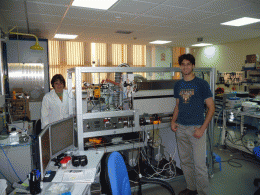
The functioning and devices of the ‘electronic nose’: the vapours emitted by the hand are ionised by an electrospray and their composition analysed in real time using mass spectrometry. Photo: Fernández de la Mora et al.
A team of researchers from the Yale University (United States) and a Spanish company have developed a system to detect the vapours emitted by human skin in real time. The scientists think that these substances, essentially made up of fatty acids, are what attract mosquitoes and enable dogs to identify their owners.
"The spectrum of the vapours emitted by human skin is dominated by fatty acids. These substances are not very volatile, but we have developed an ‘electronic nose' able to detect them", Juan Fernández de la Mora, of the Department of Mechanical Engineering at Yale University (United Status) and co-author of a study recently published in the Journal of the American Society for Mass Spectrometry, tells SINC.
The system, created at the Boecillo Technology Park in Valladolid, works by ionising the vapours with an electrospray (a cloud of electrically-charged drops), and later analysing these using mass spectrometry. This technique can be used to identify many of the vapour compounds emitted by a hand, for example.
"The great novelty of this study is that, despite the almost non-existent volatility of fatty acids, which have chains of up to 18 carbon atoms, the electronic nose is so sensitive that it can detect them instantaneously", says Fernández de la Mora. The results show that the volatile compounds given off by the skin are primarily fatty acids, although there are also others such as lactic acid and pyruvic acid.
The researcher stresses that the great chemical wealth of fatty acids, made up of hundreds of different molecules, "is well known, and seems to prove the hypothesis that these are the key substances that enable dogs to identify people". The enormous range of vapours emitted by human skin and breath may not only enable dogs to recognise their owners, but also help mosquitoes to locate their hosts, according to several studies.
World record for detecting explosives
Aside from identifying people from their skin vapours, another of the important applications of the new system is that it is able to detect tiny amounts of explosives. The system can "smell" levels below a few parts per trillion, and has been able to set a world sensitivity record at "2x10-14 atmospheres of partial pressure of TNT (the explosive trinitrotoluene)".
The "father" of ionisation using the mass spectrometry electrospray is Professor John B. Fenn, who is currently a researcher at the University of Virginia (United States), and in 2002 won the Nobel Prize in Chemistry for using this technique in the analysis of proteins.
More information:
Pablo Martínez Lozano y Juan Fernández de la Mora. “On-line Detection of Human Skin Vapors”. Journal of the American Society for Mass Spectrometry 20 (6): 1060-1063, 2009.
Pablo Martínez Lozano, Juan Rus, Gonzalo Fernández de la Mora, Marta Hernández, y Juan Fernández de la Mora. “Secondary Electrospray Ionization (SESI) of Ambient Vapors for Explosive Detection at Concentrations Below Parts Per Trillion”. Journal of the American Society for Mass Spectrometry 20 (2): 287-294, 2009.
-
Mass Spectrometry of Living Subjects
Sep 21, 2007 |
not rated yet |
0
-
Baby bathwater contains fragrance allergens
Jul 17, 2009 |
not rated yet |
0
-
Web 2.0 application developed to recommend television programmes
May 25, 2009 |
not rated yet |
0
-
Spanish scientists develop echolocation in humans
Jun 30, 2009 |
not rated yet |
0
-
The tulip entered Europe through al-Andalus five centuries before believed
Apr 16, 2009 |
not rated yet |
0
-
Engineers build first sub-10-nm carbon nanotube transistor
Feb 01, 2012 |
4.9 / 5 (31) |
30
-
Something old, something new: Evolution and the structural divergence of duplicate genes
Jan 31, 2012 |
4.6 / 5 (7) |
1
-
The hidden nanoworld of ice crystals: Revealing the dynamic behavior of quasi-liquid layers
Jan 30, 2012 |
5 / 5 (3) |
1
-
Stock market network reveals investor clustering
Jan 27, 2012 |
3.9 / 5 (23) |
8
-
Of microchemistry and molecules: Electronic microfluidic device synthesizes biocompatible probes
Jan 26, 2012 |
5 / 5 (1) |
0
-
AAS or Colorimeter method to determine zinc in a plant.
21 hours ago
-
Stoichiometry
Feb 10, 2012
-
Boiling and melting point of impure substances
Feb 10, 2012
-
Safe nitrogen compound to decompose a 500 deg C in a furnace?
Feb 09, 2012
-
[ask]electron inside drinking water
Feb 08, 2012
-
How to avoid formation of Lithium Chromate ???
Feb 08, 2012
- More from Physics Forums - Chemistry
More news stories
Hydrogen from acidic water: Researchers develop potential low cost alternative to platinum for splitting water
A technique for creating a new molecule that structurally and chemically replicates the active part of the widely used industrial catalyst molybdenite has been developed by researchers with the Lawrence Berkeley ...
Feb 09, 2012 |
4.8 / 5 (15) |
21
|
Fool's gold may prove an unlikely alternative to overexploited catalytic materials
Catalytic materials, which lower the energy barriers for chemical reactions, are used in everything from the commercial production of chemicals to catalytic converters in car engines. However, with current catalytic materials ...
Feb 10, 2012 |
4.4 / 5 (8) |
8
|
Research provides octagonal window of opportunity for carbon capture
(PhysOrg.com) -- Filtering carbon dioxide, a greenhouse gas, from factory smokestacks is a necessary, but expensive part of many manufacturing processes. However, a collaborative research team from the National ...
Feb 08, 2012 |
5 / 5 (1) |
5
|
Flexible paper robots
(PhysOrg.com) -- These inexpensive robots can stretch, bend and twist under control, and lift objects up to 120 times their own weight. Being soft, they can apply gentle and even pressure, and adapt to varied ...
Feb 09, 2012 |
5 / 5 (5) |
4
|
New form of hafnium oxide developed
(PhysOrg.com) -- A novel material developed by researchers at the University of Cambridge is opening up new possibilities for next generation electronic and optoelectronic devices, and paving the way for further ...
Feb 07, 2012 |
4.6 / 5 (5) |
4
|
Latin America mining boom clashes with conservation
Latin America is experiencing a mining boom as prices rise fuelled by a hike in global demand, but the region is also being hit by a wave of violent protests, strikes and rallies by environmentalists.
Love a click away in Indonesia's Twitter Republic
He was a geeky kid from Yogyakarta, she a glamorous city girl in Jakarta. In a country with one of the world's most vibrant social networking scenes they fell in love on Twitter.
Walney offshore wind farm is world's biggest (for now)
(PhysOrg.com) -- The Walney wind farm on the Irish Sea--characterized by high tides, waves and windy weather--officially opened this week. The farm is treated in the press as a very big deal as the Walney ...
GPS court ruling leaves US phone tracking unclear
A US Supreme Court decision requiring a warrant to place a GPS device on the car of a criminal suspect leaves unresolved the bigger issue of police tracking using mobile phones, legal experts say.
Europeans protest controversial Internet pact
Tens of thousands of people marched in protests in more than a dozen European cities Saturday against a controversial anti-online piracy pact that critics say could curtail Internet freedom.
Europe stakes billion-dollar bet on new rocket
A pencil-slim rocket is scheduled to lift into space from South America on Monday, carrying a billion-dollar bet that Europe can grab a juicy slice of the market to place satellites in low orbit.
Jul 23, 2009
Rank: not rated yet
Thank you for your future consideration in this matter. Please don't leave ass marks on the door on your way out.
Ethelred