'Long-haired' water moulds are the most virulent
July 22, 2009 'Long-haired' water moulds are the most virulent

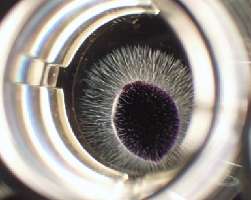
The last stage of the HeMP-methode. The water mould has a good growth - the medication does not work against Saprolegnia

The water mould Saprolegnia can cause skin disease in salmon during its freshwater phase. The mould attacks both fish and eggs and has at times caused great economic loss for the fish farming industry, both in Norway and in other salmon-producing countries. Saprolegnia infection may be seen with the naked eye as white patches on the skin or as "cotton-like" patches on eggs.

In his doctorate, Svein Stueland from the National Veterinary Institute showed that different strains of the water mould Saprolegnia vary in their ability to cause disease and mortality in farmed salmon. In addition, he developed a simple and effective method for testing new medications that may prove important for treating the disease.

Stueland's project grew out of a need for knowledge of the distribution of Saprolegnia and its disease-producing abilities. Such knowledge is necessary to develop better treatment methods against the disease. Earlier, the disease was effectively controlled with the dye malachite green, however, this substance is now forbidden and the fish farming industry needs new, effective and reliable medications against the disease.

During the study, Saprolegnia was collected from eggs and farmed salmon in Norway, Canada, Chile and Scotland. Significant differences in pathogenicity between the different strains of Saprolegnia were seen, with the mortality in salmon fry varying from zero to 89%.

The mould's appearance and its growth abilities are related to its ability to infect and produce disease in . The "long-haired" Saprolegnia, which also showed high growth rate early in its growth phase, had the greatest disease-producing ability. "Long-haired" Saprolegnia contains mould equipped with types of long hooks. Simultaneously, a connection was shown between the "genetic fingerprint" and the mould's pathogenic ability.

Molecular-biological analyses, or so-called fingerprinting, made it also possible to differentiate between the collected Saprolegnia . Genetic analyses revealed greater genetic variation in the moulds from particular countries, than between countries, indicating that Saprolegnia from Norway, Canada, Chile and Scotland share to a great degree a common genetic base.

As a part of his doctoral work, Stueland also developed a simple and effective method for testing the efficacy of medications for the treatment of this disease in fish farming.

The project was a collaboration between the National Veterinary Institute, the Norwegian School of Veterinary Science, PHARMAZ AS, Marine Harvest AS and the Norwegian Research Council.

Cand. med. vet. Svein Stueland defended his Ph. D. thesis, entitled "Saprolegnia infections in salmonids. Characterization of Saprolegnia species and search for new treatment of Saprolegnia infections", at the Norwegian School of Veterinary Science, on June 16, 2009.


The last stage of the HeMP-methode. The water mould has a good growth - the medication does not work against Saprolegnia

This picture shows that the tested medicament works - the water mould does not grow.

Source: Norwegian School of Veterinary Science (news : web)


print this article email this article download pdf blog this article bookmark this article     Stumble it Digg this share on Facebook retweet share on Reddit add to delicious
Rate this story - 3.7 /5 (3 votes)


July 22, 2009 all stories

Comments: 0

3.7 /5 (3 votes)
  • Stumble this up

  • Digg this

  • share this

  • hide
  • Related Stories

  • The pig of the future might be free of diseases that can infect people
    created Apr 07, 2009 | popularity not rated yet | comments 0
  • Malaria makes relapsing fever more serious
    created May 08, 2009 | popularity not rated yet | comments 0
  • The secretive immune system of the salmon
    created Jan 27, 2009 | popularity not rated yet | comments 0
  • A new parasite has been discovered in black green lizards from the Iberian Peninsula
    created Apr 03, 2009 | popularity not rated yet | comments 0
  • Deadly Parasite Could Endanger Salmon and Trout Populations
    created Jun 17, 2009 | popularity not rated yet | comments 0


  • hide
  • Relevant PhysicsForums posts

  • Selenocysteine in pH=7
    created 19 hours ago
  • What is the formula for calculating the speed of thought?
    created Nov 26, 2009
  • What does word "absorption" mean in the intestine?
    created Nov 26, 2009
  • What is transpulmonary pressure?
    created Nov 24, 2009
  • More from Physics Forums - Biology

Other News

The six elephants in Sierra Leone were shot and "crudely butchered"

S.Leone elephants 'wiped out' by poachers: official

Biology / Ecology

created 18 hours ago | popularity 5 / 5 (5) | comments 6

Poachers "wiped out" the entire elephant herd in Sierra Leone's only wildlife park, wildlife managers said Thursday after police said they had arrested a gang of 10 poachers.


First-ever blueprint of a minimal cell is more complex than expected

First-ever blueprint of a minimal cell is more complex than expected

Biology / Cell & Microbiology

created 16 hours ago | popularity 5 / 5 (14) | comments 1

What are the bare essentials of life, the indispensable ingredients required to produce a cell that can survive on its own? Can we describe the molecular anatomy of a cell, and understand how an entire organism ...


Ecological speciation by sexual selection on good genes: Is speciation adaptive?

Biology / Ecology

created 16 hours ago | popularity 5 / 5 (1) | comments 0

Darwin suggested that the action of natural selection can produce new species, but 150 years after the publication of his famous book, 'On the Origin of Species', debate still continues on the mechanisms of speciation. New ...


Whiteflies sabotage alarm system of plant in distress

Whiteflies sabotage alarm system of plant in distress

Biology / Plants & Animals

created 20 hours ago | popularity 5 / 5 (2) | comments 0

(PhysOrg.com) -- When spider mites attack a bean plant, the plant responds by producing odours which attract predatory mites. These predatory mites then exterminate the spider mite population, thus acting ...


Knockouts in human cells point to pathogenic targets

Knockouts in human cells point to pathogenic targets

Biology / Cell & Microbiology

created 19 hours ago | popularity not rated yet | comments 0

(PhysOrg.com) -- Whitehead researchers have developed a new approach for genetics in human cells and used this technique to identify specific genes and proteins required for pathogens.