Ytterbium's broken symmetry: The largest parity violations ever measured in an atom
July 22, 2009
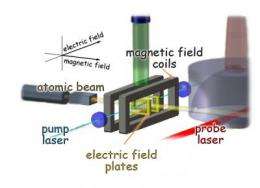
An atomic beam of ytterbium is generated in the oven at left, then passed through a chamber with magnetic and electric fields arranged at right angles -- the magnetic field colinear with the atomic beam, and the electric field colinear with a laser beam that excites a "forbidden" electron-energy transition. Weak interactions between electron and nucleus contribute to the forbidden transition. Credit: Lawrence Berkeley National Laboratory
Ytterbium was discovered in 1878, but until it recently became useful in atomic clocks, the soft metal rarely made the news. Now ytterbium has a new claim to scientific fame. Measurements with ytterbium-174, an isotope with 70 protons and 104 neutrons, have shown the largest effects of parity violation in an atom ever observed - a hundred times larger than the most precise measurements made so far, with the element cesium.
"Parity" assumes that, on the atomic scale, nature behaves identically when left and right are reversed: interactions that are otherwise the same but whose spatial configurations are switched, as if seen in a mirror, ought to be indistinguishable. Sounds like common sense but, remarkably, this isn't always the case.
"It's the weak force that allows parity violation," says Dmitry Budker, who led the research team. Budker is a member of the Nuclear Science Division at the U.S. Department of Energy's Lawrence Berkeley National Laboratory and a professor of physics at the University of California at Berkeley.
Of the four forces of nature - strong, electromagnetic, weak, and gravitational - the extremely short-range weak force was the last to be discovered. Neutrinos, having no electric charge, are immune to electromagnetism and only interact through the weak force. The weak force also has the startling ability to change the flavor of quarks, and to change protons into neutrons and vice versa.
Violating parity - neutrons and the weak force
Protons on their own last forever, apparently, but a free neutron falls apart in about 15 minutes; it turns into a proton by emitting an electron and an antineutrino, a process called beta decay. What makes beta decay possible is the weak force.
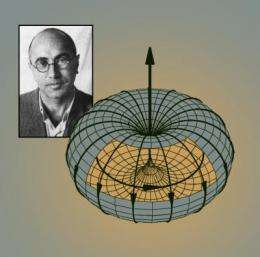
Yacov Zel'dovich proposed that the weak force induces electrical currents in the nucleus, which flow like currents in a tokamak. This anapole moment has been detected in nuclear valence protons but not yet in valence neutrons. Credit: Lawrence Berkeley National Laboratory
Scientists long assumed that nature, on the atomic scale, was symmetrical. It would look the same not only if left and right were reversed but also if the electrical charges of particles involved in an interaction were reversed, or even if the whole process ran backwards in time. Charge conjugation is written C, parity P, and time T; nature was thought to be C invariant, P invariant, and T invariant.In 1957 researchers realized that the weak force didn't play by the rules. When certain kinds of nuclei such as cobalt-60 are placed in a magnetic field to polarize them - line them up - and then allowed to undergo beta decay, they are more likely to emit electrons from their south poles than from their north poles.
This was the first demonstration of parity violation. Before the 1957 cobalt-60 experiment, renowned physicist Richard Feynman had said that if P violation were true - which he doubted - something long thought impossible would be possible after all: "There would be a way to distinguish right from left."
It's now apparent that many atoms exhibit parity violation, although it is not easy to detect. P violation has been measured with the greatest accuracy in cesium atoms, which have 55 protons and 78 neutrons in the nucleus, by using optical methods to observe the effect when atomic electrons are excited to higher energy levels.
The Berkeley researchers designed their own apparatus to detect the much larger parity violation predicted for ytterbium. In their experiment, ytterbium metal is heated to 500 degrees Celsius to produce a beam of atoms, which is sent through a chamber where magnetic and electric fields are oriented at right angles to each other. Inside the chamber the ytterbium atoms are hit by a laser beam, tuned to excite some of their electrons to higher energy states via a "forbidden" (highly unlikely) transition. The electrons then relax to lower energies along different pathways.
Weak interactions between the electron and the nucleus - plus weak interactions within the nucleus of the atom - act to mix some of the electron energy states together, making a small contribution to the forbidden transition. But other, more ordinary electromagnetic processes, which involve apparatus imperfections, also mix the states and blur the signal. The purpose of the chamber's magnetic and electric fields is to amplify the parity-violation effect and to remove or identify these spurious electromagnetic effects.
Upon analyzing their data, the researchers found a clear signal for atomic parity violations, 100 times larger than the similar signal for cesium. With refinements to their experiment, the strength and clarity of the ytterbium signal promise significant advances in the study of weak forces in the nucleus.
Watching the weak force at work
The Budker group's experiments are expected to expose how the weak charge changes in different isotopes of ytterbium, whose nuclei have the same number of protons but different numbers of neutrons, and will reveal how weak currents flow within these nuclei.
The results will also help explain how the neutrons in the nuclei of heavy atoms are distributed, including whether a "skin" of neutrons surrounds the protons in the center, as suggested by many nuclear models.
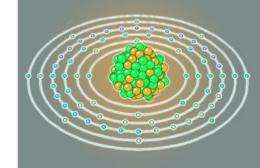
The most common isotope of ytterbium has 70 protons and 104 neutrons in the nucleus. Credit: LBNL
"The neutron skin is very hard to detect with charged probes, such as by electron scattering," says Budker, "because the protons with their large electric charge dominate the interaction."He adds, "At a small level, the measured atomic parity violation effect depends on how the neutrons are distributed within the nucleus - specifically, their mean square radius. The mean square radius of the protons is well known, but this will be the first evidence of its kind for neutron distribution."
Measurements of parity violation in ytterbium may also reveal "anapole moments" in the outer shell of neutrons in the nucleus (valence neutrons). As predicted by the Russian physicist Yakov Zel'dovich, these electric currents are induced by the weak interaction and circulate within the nucleus like the currents inside the toroidal winding of a tokamak; they have been observed in the valence protons of cesium but not yet in valence neutrons.
Eventually the experiments will lead to sensitive tests of the Standard Model - the theory that, although known to be incomplete, still best describes the interactions of all the subatomic particles so far observed.
"So far, the most precise data about the Standard Model has come from high-energy colliders," says Budker. "The carriers of the weak force, the W and Z bosons, were discovered at CERN by colliding protons and antiprotons, a 'high-momentum-transfer' regime. Atomic parity violation tests of the Standard Model are very different - they're in the low-momentum-transfer regime and are complementary to high-energy tests."
Since 1957, when Zel'dovich first suggested seeking atomic variation in atoms by optical means, researchers have come ever closer to learning how the weak force works in atoms. Parity violation has been detected in many atoms, and its predicted effects, such as anapole moments in the valence protons of cesium, have been seen with ever-increasing clarity. With their new experimental techniques and the observation of a large atomic parity violation in ytterbium, Dmitry Budker and his colleagues have achieved a new landmark, moving closer to fundamental revelations about our asymmetric universe on the atomic scale.
More information: "Observation of a large atomic parity violation in ytterbium," by K. Tsigutkin, D. Dounas-Frazer, A. Family, J. E. Stalnaker, V. V. Yashchuck, and D. Budker, appears in Physical Review Letters and is available online at http://arxiv.org/abs/0906.3039 .
-
Physicists propose new method of measuring the weak interaction
Oct 01, 2007 |
not rated yet |
0
-
Particle physics study finds new data for extra Z-bosons and potential fifth force of nature
Apr 28, 2009 |
not rated yet |
0
-
HAPPEx results hint at strangely magnetic proton
Apr 21, 2005 |
not rated yet |
0
-
NuTeV Anomaly Helps Shed Light on Physics of the Nucleus
Jun 29, 2009 |
not rated yet |
0
-
Scientists make landmark observations about weak force
Jul 13, 2005 |
not rated yet |
0
-
Engineers build first sub-10-nm carbon nanotube transistor
Feb 01, 2012 |
4.9 / 5 (31) |
30
-
Something old, something new: Evolution and the structural divergence of duplicate genes
Jan 31, 2012 |
4.6 / 5 (7) |
1
-
The hidden nanoworld of ice crystals: Revealing the dynamic behavior of quasi-liquid layers
Jan 30, 2012 |
5 / 5 (3) |
1
-
Stock market network reveals investor clustering
Jan 27, 2012 |
3.9 / 5 (23) |
8
-
Of microchemistry and molecules: Electronic microfluidic device synthesizes biocompatible probes
Jan 26, 2012 |
5 / 5 (1) |
0
-
what does negative resistivity mean
49 minutes ago
-
Calculating Electrostatic force between parallel plates
2 hours ago
-
Strength of induced magnetic field inside an inductor
5 hours ago
-
increasing time of daylight
6 hours ago
-
Light & Sight
6 hours ago
-
Wind Turbine Power
9 hours ago
- More from Physics Forums - General Physics
More news stories
Putting the squeeze on planets outside our solar system
(PhysOrg.com) -- Using high-powered lasers, scientists at Lawrence Livermore National Laboratory and collaborators discovered that molten magnesium silicate undergoes a phase change in the liquid state, abruptly ...
5 hours ago |
5 / 5 (1) |
0
|
Hovering not hard if you're top-heavy, researchers find
Top-heavy structures are more likely to maintain their balance while hovering in the air than are those that bear a lower center of gravity, researchers at New York University's Courant Institute of Mathematical Sciences ...
6 hours ago |
5 / 5 (1) |
1
|
SLAC, Stanford team focuses on high-energy electrons to treat cancer
Accelerator physicists at SLAC and cancer specialists from Stanford are working on a new technology that could dramatically reduce the time needed for cancer radiation treatments. The team ran an initial experiment ...
9 hours ago |
5 / 5 (1) |
0
Measurements from high-energy collisions lead to better understanding of why meson particles disappear
For several years, physicists at the Relativistic Heavy Ion Collider (RHIC) at Brookhaven National Laboratory (BNL), USA, have studied an unusual state of matter called the quarkgluon plasma, which they ...
9 hours ago |
5 / 5 (1) |
0
Explained: Sigma
It's a question that arises with virtually every major new finding in science or medicine: What makes a result reliable enough to be taken seriously? The answer has to do with statistical significance -- but ...
Feb 09, 2012 |
5 / 5 (16) |
46
Google users warned of threat to smartphone wallets
Users of Google smartphone wallets were being warned on Friday that there is a way to crack pass codes intended to thwart thieves from going on illicit shopping sprees.
Anonymous knocks CIA website offline (Update)
The website of the Central Intelligence Agency was inaccessible on Friday after the hacker group Anonymous claimed to have knocked it offline.
Complex wiring of the nervous system may rely on a just a handful of genes and proteins
Researchers at the Salk Institute have discovered a startling feature of early brain development that helps to explain how complex neuron wiring patterns are programmed using just a handful of critical genes. ...
NASA sees wide-eyed cyclone Jasmine
Cyclone Jasmine's eye has opened wider on NASA satellite imagery, as it moves through the Southern Pacific Ocean.
NASA sees Giovanna reach cyclone strength, threaten Madagascar
Tropical Storm 12S built up steam and became a cyclone on February 10, 2012 as NASA's Terra satellite passed overhead. Residents of east-central Madagascar should prepare for this cyclone to make landfall ...
The power of estrogen -- male snakes attract other males
A new study has shown that boosting the estrogen levels of male garter snakes causes them to secrete the same pheromones that females use to attract suitors, and turned the males into just about the sexiest ...


Jul 22, 2009
Rank: 2.1 / 5 (7)
Jul 22, 2009
Rank: 2 / 5 (4)
How clever you are.
Jul 22, 2009
Rank: 3 / 5 (4)
Jul 22, 2009
Rank: 4 / 5 (4)
Jul 23, 2009
Rank: 2.5 / 5 (2)
Jul 23, 2009
Rank: 4 / 5 (2)
Parity symmetry breaking is only present in weak interactions and it just so happens that neutrinos which are poorly understood and abundant here on Earth are only capable of weak interactions.
I find it much more probable that the presence of chiral background neutrinos makes one kind of weak decay more favorable then that left and right differ somehow on the most fundamental level.
Jul 23, 2009
Rank: 4.5 / 5 (2)
Negative result would not completely rule out the hypothesis as the effect may be nonlinear but a positive result would certainly confirm it.
Jul 23, 2009
Rank: 3 / 5 (2)
never mind the earth. it would swallow my milk!
Jul 23, 2009
Rank: 4.5 / 5 (2)
Jul 23, 2009
Rank: 4 / 5 (1)
Jul 25, 2009
Rank: 1 / 5 (1)
Thank you, and good night.
Jul 28, 2009
Rank: 3 / 5 (2)
The parity violation corresponds violation inside of Aether foam, which is forming the vacuum or interior of atom nuclei. This is because both particles, both antiparticles are formed by foam branes (i.e. by surface gradients of foam membranes), while normal particles are formed by gradients/vortices at the inner surface of foam bubbles, while antiparticles are formed by vortices on the outer surface gradients.
http://www.aether...ance.gif
While vacuum foam is sparse, the foam membranes are relatively thin here and here's nearly no difference between curvature of gradients on the inner and outer surface of foam membranes and between behavior of particles and antiparticles.
The situation inside of atom nuclei is different because of high mass/energy density and the Aether foam of space-time is very dense like soap foam shaken. Because bubbles of such foam are tiny and spherical, here exists a relatively large difference between curvature of inner and outer gradients and formation of particles is strongly preferred here due their higher surface curvature.
http://www.aether...ent2.jpg
The same situation existed in the universe in its very beginning, where most of matter was formed in symmetric way, but due the lower stability of antimatter under such condition most of antimatter evaporated into smaller particles, while rest of matter has condensed into stars and planets.
Why atoms of ytterbium are so god in demonstration of CP asymmetry I cannot explain exactly in this moment, but we can suppose, just inside of atom nuclei of Yb a maximal mass/energy density exists, because large atoms have lower surface curvature and tension, so they decay more easily and small atoms have low probability of interaction between electrons and atom nuclei, because of low number of protons, so that Yb can become a good compromise.
Aug 03, 2009
Rank: 2.3 / 5 (3)