Researchers Find Key 'Conductor' of Nature's Synchronicity
July 22, 2009
Researchers find key 'conductor' of nature's synchronicity

Enlarge

(PhysOrg.com) -- Synchronicity in nature is seen in beating hearts, the flashing of fireflies' lights, the ebb and flow of infectious disease—and the simultaneous rise and fall of populations across vast reaches of space. While scientists have identified some factors that account for this melodic phenomenon, they have yet to sort out the relative contribution each plays in this finely tuned orchestra.

Now researchers at Yale University and the University of Calgary report in the July 22 issue of Nature's advanced online publication that predator-prey interactions are the "conductors" of synchronicity in .

"Change these interactions and you can suffer disastrous consequences to these systems," said David Vasseur, co-author of the paper and assistant professor of ecology and at Yale.

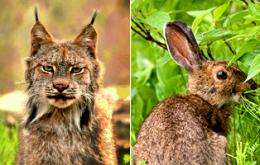
Vasseur and Jeremy Fox, professor of biological sciences at Calgary, set out to find a way to tease out which factors are most important in creating spatial synchronicity. The close relationship in the rise and fall of populations, for instance, has been well documented in Canadian lynx and snowshoe hare populations. Changes in the abundance of lynx and hare measured at one location are closely mimicked over the entire continent.

Researchers have identified three main causes of synchronicity - the simultaneous rise and fall of populations in different locations. For example, individual snowshoe hares or lynx living in isolated populations can move into other isolated populations. This factor—called dispersal—can link the rise and fall of populations.

The second factor is called the Moran effect, which stipulates that isolated groups of animals experiencing similar environmental fluctuations—such as droughts—will tend to rise and fall in unison.

The third factor is interactions of species—such as the predator-prey relationship.

To test which of these factors is most important, Vasseur and Fox devised a model coupled to a series of experiments that tracked numbers of freshwater microorganisms stored in bottles. They swapped organisms between bottles (dispersal), grew bottles in identical temperatures (the Moran effect), and introduced a predator that eats the microorganism. They tested all combinations of these factors. For instance, they dispersed organisms among bottles with identical temperatures in one treatment and kept organisms in identical temperatures with no dispersal in another. They found a consistent synchronicity in populations in response to temperature change. However, swapping organisms created synchronicity only when predators were present. Without the predators, populations didn't synchronize when individual organisms were exchanged.

"Predators fundamentally change the way that their prey vary through time, creating a cyclic pattern that is quickly synchronized across many locations with only small amounts of dispersal," Vasseur said. "The loss of these cycles, either through species extinctions or global change, may have drastic consequences for the stability of ecosystems and the persistence of species."

The presence of predator creates a cyclic pattern nearly identical to that found in other examples of synchrony in nature.
"This synchrony is achieved in the same manner as many other naturally synchronizing phenomena," Fox said. "Cyclic systems, from flashing fireflies to lynx and hares, are like kids bouncing up and down on a trampoline. Adding predators is like making them hold hands, so they all have to bounce together."

Source: Yale University (news : web)

3.9 /5 (8 votes)  

Filter


Move the slider to adjust rank threshold, so that you can hide some of the comments.


Display comments: newest first

Caliban
Jul 22, 2009

Rank: not rated yet
A new definition for Jung's concept? Synchronicity is by definition a-causal. It appears to me that these researchers are saying that an environmental change in one locality somehow induces the same change in another, but only demonstrated that the same environmental factors in different localities produce the same effects in their resident populations, i.e., cause and effect, not synchronicity.
poi
Jul 23, 2009

Rank: not rated yet
Adding predators is like making them hold hands, so they all have to bounce together."

seems like a very cogent and intelligent argument for social predators. now, they are not aberrations even if their behavior have to be treated like that in the criminal discipline. is rape then just a part of the happily bouncing holding-hand-together system this study is proposing? like saying: rape? neh, that's just part of life, live with it.
NeilFarbstein
Jul 23, 2009

Rank: 1 / 5 (1)
"Predators fundamentally change the way that their prey vary through time, creating a cyclic pattern that is quickly synchronized across many locations with only small amounts of dispersal,"

What does he mean by "many locations"?
Is he talking about separate bottles of organisms that synchronize growth despite their separation?
Rank 3.9 /5 (8 votes)
Relevant PhysicsForums posts
  • Factors affecting beet root cell membrane
    created4 hours ago
  • Stem cell question.
    createdFeb 10, 2012
  • Protease cleavage
    createdFeb 10, 2012
  • Pertubance in a model
    createdFeb 10, 2012
  • Cancer drugs and Alzheimer's, Oh my!
    createdFeb 09, 2012
  • Squishing cells
    createdFeb 09, 2012
  • More from Physics Forums - Biology

More news stories

Entire genome of extinct human decoded from fossil

(PhysOrg.com) -- In 2010, Svante Pääbo and his colleagues presented a draft version of the genome from a small fragment of a human finger bone discovered in Denisova Cave in southern Siberia. The ...

Biology / Biotechnology

created Feb 07, 2012 | popularity 4.7 / 5 (58) | comments 48 | with audio podcast

Why are there so few fish in the Earth's oceans?

(PhysOrg.com) -- A Stony Brook University researcher has found that, contrary to popular belief, there are not plenty of fish in the sea.

Biology / Plants & Animals

created Feb 08, 2012 | popularity 4.3 / 5 (17) | comments 27 | with audio podcast

Miami battling invasion of giant African snails

No one knows how they got there. But an invasion of African giant snails has southern Florida in a panic over potential crop damage, disease and general yuckiness surrounding the slimy gastropods.

Biology / Ecology

created Feb 10, 2012 | popularity 4.7 / 5 (3) | comments 5

Deciding to go left or right: Researchers use device to determine that lower animals can navigate too

For decades, scientists have associated binary decision making — opting to go left or right — with higher-ranking animals, including humans. A team of Harvard researchers, however, is rewriting that ...

Biology / Plants & Animals

created Feb 09, 2012 | popularity 4 / 5 (1) | comments 4 | with audio podcast

Study shows chimps able to understand needs of others

(PhysOrg.com) -- By setting up a unique experiment, a small team of researchers has found that chimpanzees are able to understand need in other chimps, despite their general disinclination to offer aid when ...

Biology / Plants & Animals

created Feb 07, 2012 | popularity 5 / 5 (2) | comments 4 | with audio podcast report


Injured boomers beware: Know when to see doctor

(AP) -- It happened to nurse Jane Byron years after an in-line skating fall, business owner Haralee Weintraub while doing "men's" push-ups, and avid cyclist Gene Wilberg while lifting a heavy box.

Google might launch Drive for cloud storage soon

(PhysOrg.com) -- Google's next big move, according to the Wall Street Journal, is a cloud storage service called Drive. Hardly first to the plate, Google is simply catching up to introducing its cloud reposi ...

Latin America mining boom clashes with conservation

Latin America is experiencing a mining boom as prices rise fuelled by a hike in global demand, but the region is also being hit by a wave of violent protests, strikes and rallies by environmentalists.

Love a click away in Indonesia's Twitter Republic

He was a geeky kid from Yogyakarta, she a glamorous city girl in Jakarta. In a country with one of the world's most vibrant social networking scenes they fell in love on Twitter.

Europeans protest controversial Internet pact

Tens of thousands of people marched in protests in more than a dozen European cities Saturday against a controversial anti-online piracy pact that critics say could curtail Internet freedom.

Walney offshore wind farm is world's biggest (for now)

(PhysOrg.com) -- The Walney wind farm on the Irish Sea--characterized by high tides, waves and windy weather--officially opened this week. The farm is treated in the press as a very big deal as the Walney ...