New evidence: AIDS-like disease in wild chimpanzees
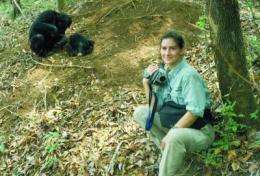
An international consortium has found that wild chimpanzees naturally infected with Simian Immunodeficiency Viruses (SIV) - long thought to be harmless to the apes - can contract an AIDS-like syndrome and die as a result. The findings are published in the July 23 edition of the journal Nature.
Scientists have known that the AIDS virus, HIV-1, first entered the human population after transmission from chimpanzees. The precursor virus, SIV, has many different forms, most of which infect various African monkey species. While there are data for only a few of these species, all of the evidence so far has indicated that monkey SIVs are not pathogenic in their natural hosts.
"We all assumed that the same was true of SIV infection in chimpanzees, but that turns out not to be the case," said Dr. Beatrice Hahn, a professor of medicine at the University of Alabama at Birmingham, who led the investigation. "But of course chimps are not monkeys. Chimpanzees and humans are very similar genetically, so perhaps we should not be surprised that these closely related viruses cause disease in both hosts."
The study focused on chimpanzees at Gombe National Park, on the shores of Lake Tanganyika in Tanzania. For nearly 50 years, primatologist Jane Goodall and her colleagues have studied the chimpanzee communities at Gombe, monitoring their biology and behavior.
Lincoln Park Zoo and University of Illinois researchers, in cooperation with the Jane Goodall Institute (JGI) and Tanzania National Parks (TANAPA), established a chimpanzee health-monitoring program at Gombe. This program provided the necessary field laboratories and veterinary expertise to enable post-mortem analyses of chimpanzees that died during the course of the study.
"We are pleased to see the groundbreaking results coming out of the multidisciplinary epidemiological health monitoring system we've established in Gombe," said veterinary epidemiologist Dominic Travis, vice president of conservation and science at Lincoln Park Zoo and an author on the study. "This has significance for Gombe chimp health and park management, disease ecology as it relates to retroviral emergence, and to ape conservation as a whole by using Gombe as a laboratory. This field site is once again a model of how long-term scientific studies can inform us in many ways."
For the last nine years, the consortium has been monitoring the SIV infection status of the Gombe chimpanzees. It was possible to determine from fecal samples which individuals were infected at the start of the study, and which became infected during the study. At any one time during this period, between 10 and 20 percent of chimpanzees were SIV-positive. Statistical death hazard analyses, taking into account factors such as an individual's age and sex, indicated that those chimpanzees infected with SIV were 10 to16 times more likely to die in any year than those who remained uninfected.
According to anthropology professor Jamie Holland Jones of Stanford University, who performed the analyses, "at this point we cannot be too precise about the magnitude of the effect, because the number of chimpanzees surveyed is still limited. Nevertheless, the evidence is clear that infected apes have lower survival rates."
The consortium also found that infected females were significantly less likely to give birth, and that any infants born to infected mothers had a low chance of survival.
Additional evidence came from necropsies performed by veterinary pathologists from the University of Illinois Zoological Pathology Program. A hallmark of HIV-1 infection in humans is the loss of CD4+ T-cells; these cells are a vital component of the immune system, and their depletion renders patients susceptible to many other infections - the classic symptoms of AIDS.
"When I first looked at these samples I was taken aback," said University of Illinois veterinary pathologist Karen Terio, a primary author on the paper. "Slides from one of the chimps showed extreme lymphatic tissue destruction, and looked just like a sample from a human patient who has died of AIDS."
Analysis by Jake Estes, an investigator at the National Cancer Institute and a primary author on the paper, confirmed a link between SIV infection and CD4+ T-cell decline in the chimpanzees.
Although this study was limited to chimpanzees at Gombe, SIV infection is widespread across two subspecies, central and eastern chimpanzees, which range from Cameroon in west central Africa to Tanzania in the east. (Two other subspecies, western and Nigerian chimpanzees, do not appear to have SIV infections.)
"Previously, we didn't think SIV could affect chimpanzee population health. Now we know it's possible," said primatologist Elizabeth Lonsdorf from Lincoln Park Zoo, a co-primary investigator of the zoo-led health monitoring initiative. "The next step is to understand this issue better in Gombe to see if it is site-specific, or if it has potential widespread implications for chimpanzee conservation."
The finding that SIV causes disease in chimpanzees opens up a number of new avenues of research.
Source: University of Illinois at Urbana-Champaign (news : web)


