First nanoscale mass spectrometer created
July 22, 2009
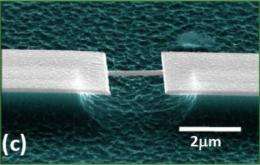
This photo shows scanning electron micrographs showing one of the doubly-clamped beam NEMS devices used in these experiments. It is embedded in a nanofabricated three-terminal UHF bridge circuit. Credit: Fabricated by Akshay Naik and Selim Hanay in the Roukes lab and the Kavli Nanoscience Institute/Caltech.
Using devices millionths of a meter in size, physicists at the California Institute of Technology (Caltech) have developed a technique to determine the mass of a single molecule, in real time.
The mass of molecules is traditionally measured using mass spectrometry, in which samples consisting of tens of thousands of molecules are ionized, to produce charged versions of the molecules, or ions. Those ions are then directed into an electric field, where their motion, which is choreographed by both their mass and their charge, allows the determination of their so-called mass-to-charge ratio. From this, their mass can ultimately be ascertained.
The new technique, developed over 10 years of effort by Michael L. Roukes, a professor of physics, applied physics, and bioengineering at the Caltech and codirector of Caltech's Kavli Nanoscience Institute, and his colleagues, simplifies and miniaturizes the process through the use of very tiny nanoelectromechanical system (NEMS) resonators. The bridge-like resonators, which are 2 micrometers long and 100 nanometers wide, vibrate at a high frequency and effectively serve as the "scale" of the mass spectrometer.
"The frequency at which the resonator vibrates is directly proportional to its mass," explains research physicist Askshay Naik, the first author of a paper about the work that appears in the latest issue of the journal Nature Nanotechnology. Changes in the vibration frequency, then, correspond to changes in mass.
"When a protein lands on the resonator, it causes a decrease in the frequency at which the resonator vibrates and the frequency shift is proportional to the mass of the protein," Naik says.
As described in the paper, the researchers used the instrument to test a sample of the protein bovine serum albumin (BSA), which is known to have a mass of 66 kilodaltons (kDa; a dalton is a unit of mass used to describe atomic and molecular masses, with one dalton approximately equal to the mass of one hydrogen atom).
The BSA protein ions are produced in vapor form using an electrospray ionization (ESI) system.The ions are then sprayed on to the NEMS resonator, which vibrates at a frequency of 450 megahertz. "The flux of proteins reaching the NEMS is such that only one to two protein lands on the resonator in a minute," Naik says.
When the BSA protein molecule is dropped onto the resonator, the resonator's vibration frequency decreases by as much as 1.2 kiloHertz—a small, but readily detectable, change. In contrast, the beta-amylase protein molecule, which has a mass of about 200 kDa, or three times that of BSA, causes a maximum frequency shift of about 3.6 kHz.
In principle, Naik says, it should be possible to use the system to detect one dalton differences in mass, the equivalent of a single hydrogen atom, but this will require a next-generation of nanowire-based devices that are smaller and have even better noise performance.
Because the location where the protein lands on the resonator also affects the frequency shift—falling onto the center of the resonator causes a larger change than landing on the end or toward the sides, for example—"we can't tell the mass with a single measurement, but needed about 500 frequency jumps in the published work," Naik says. In future, the researchers will decouple measurements of the mass and the landing position of the molecules being sampled. This technique, which they have already prototyped, will soon enable mass spectra for complicated mixtures to be built up, molecule-by molecule.
Eventually, Roukes and colleagues hope to create arrays of perhaps hundreds of thousands of the NEMS mass spectrometers, working in parallel, which could determine the masses of hundreds of thousands of molecules "in an instant," Naik says.
As Roukes points out, "the next generation of instrumentation for the life sciences—especially those for systems biology, which allows us to reverse-engineer biological systems—must enable proteomic analysis with very high throughput. The potential power of our approach is that it is based on semiconductor microelectronics fabrication, which has allowed creation of perhaps mankind's most complex technology."
More information: The paper, "Towards single-molecule nanomechanical mass spectrometry," appears in the July 4 issue of Nature Nanotechnology.
-
Golden scales: Nanoscale mass sensor from Berkeley can be used to weigh individual atoms and molecules
Jul 28, 2008 |
not rated yet |
0
-
Device For Weighing Individual Molecules
Mar 29, 2005 |
not rated yet |
0
-
New method to detect quantum mechanical effects in ordinary objects
Jun 22, 2009 |
not rated yet |
0
-
NEMS device detects the mass of a single DNA molecule
May 19, 2005 |
not rated yet |
0
-
Side-to-side shaking of nanoresonators throws off impurities
Aug 13, 2007 |
not rated yet |
0
-
Engineers build first sub-10-nm carbon nanotube transistor
Feb 01, 2012 |
4.9 / 5 (33) |
30
-
Something old, something new: Evolution and the structural divergence of duplicate genes
Jan 31, 2012 |
4.6 / 5 (7) |
1
-
The hidden nanoworld of ice crystals: Revealing the dynamic behavior of quasi-liquid layers
Jan 30, 2012 |
5 / 5 (4) |
1
-
Stock market network reveals investor clustering
Jan 27, 2012 |
3.9 / 5 (23) |
8
-
Of microchemistry and molecules: Electronic microfluidic device synthesizes biocompatible probes
Jan 26, 2012 |
5 / 5 (2) |
0
-
Anatomy of Fat man: implosion-critical bomb
3 hours ago
-
what makes two sounds similar???
3 hours ago
-
What would happen when a jet travelling at Mach 10 experiences engine failure
10 hours ago
-
Rust from my microwave ruined a nice bowl of soup and also my day
12 hours ago
-
gas leaks in space
15 hours ago
-
Weight required to balance a boom stand?
16 hours ago
- More from Physics Forums - General Physics
More news stories
Lab study raises questions over nano-particle impact
Tests involving chickens have raised questions about the impact on health from engineered nano-particles, the ultra-fine grains commonly used in drugs and processed foods, scientists said on Sunday.
Nanotechnology / Bio & Medicine
5 hours ago |
5 / 5 (5) |
0
New kind of solar cell could capture significantly more energy than current cells
New solar cells could increase the maximum efficiency of solar panels by over 25%, according to scientists from the University of Cambridge.
Feb 08, 2012 |
4.5 / 5 (13) |
14
|
Nanoshell whispering galleries improve thin solar panels
Visitors to Statuary Hall in the U.S. Capitol Building may have experienced a curious acoustic feature that allows a person to whisper softly at one side of the cavernous, half-domed room and for another on ...
Nanotechnology / Nanomaterials
Feb 07, 2012 |
4.4 / 5 (7) |
6
|
'Dark plasmons' transmit energy
Microscopic channels of gold nanoparticles have the ability to transmit electromagnetic energy that starts as light and propagates via "dark plasmons," according to researchers at Rice University.
Feb 09, 2012 |
4.8 / 5 (10) |
1
|
Revealing how a battery material works
Since its discovery 15 years ago, lithium iron phosphate (LiFePO4) has become one of the most promising materials for rechargeable batteries because of its stability, durability, safety and ability to deliver ...
Nanotechnology / Nanomaterials
Feb 08, 2012 |
5 / 5 (6) |
0
|
Declining health-care productivity in England: Who says so?
Reports that the National Health Service in England has been declining in productivity in the last decade appear to have been accepted as fact. However, a Viewpoint published Online First by The Lancet disputes this. The Vi ...
Scientists discover molecular secrets of 2,000-year-old Chinese herbal remedy
For roughly two thousand years, Chinese herbalists have treated Malaria using a root extract, commonly known as Chang Shan, from a type of hydrangea that grows in Tibet and Nepal. More recent studies suggest that halofuginone, ...
Overeating may double risk of memory loss
New research suggests that consuming between 2,100 and 6,000 calories per day may double the risk of memory loss, or mild cognitive impairment (MCI), among people age 70 and older. The study was released today and will be ...
New method to examine batteries -- MRI from the inside
There is an ever-increasing need for advanced batteries for portable electronics, such as phones, cameras, and music players, but also to power electric vehicles and to facilitate the distribution and storage of energy derived ...
A mitosis mystery solved: How chromosomes align perfectly in a dividing cell
Although the process of mitotic cell division has been studied intensely for more than 50 years, Whitehead Institute researchers have only now solved the mystery of how cells correctly align their chromosomes during symmetric ...
Starve a virus, feed a cure? Findings show how some cells protect themselves against HIV
A protein that protects some of our immune cells from the most common and virulent form of HIV works by starving the virus of the molecular building blocks that it needs to replicate, according to research published online ...
Jul 22, 2009
Rank: 1 / 5 (1)
Jul 23, 2009
Rank: not rated yet