Integral satellite disproves dark matter origin for mystery radiation
July 22, 2009 Integral satellite disproves dark matter origin for mystery radiation

Enlarge

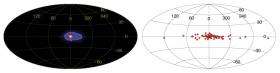
The left-hand panel shows the glow of 511 keV gamma rays coming from the annihilation of electrons by their antimatter counterparts, the positrons. The map shows the entire sky, with the galactic centre at the middle. The emission can be seen extending towards the right-hand side of the map. The right-hand panel shows the distribution of hard low mass X-ray binary stars. This stellar population has a distribution that matches the extent of the 511 keV map. Credits: ESA/ Integral/ MPE (G. Weidenspointner et al.)

(PhysOrg.com) -- A team of researchers working with data from ESA’s Integral gamma-ray observatory has disproved theories that some form of dark matter explains mysterious radiation in the Milky Way.

That this exists has been known since the 1970s, and several theories have been proposed to explain it. Integral’s unprecedented spectral and spatial resolution showed that it strongly peaks towards the centre of the Galaxy, with an asymmetry along the Galactic disc.

Several researchers have invoked a variety of dark matter to explain Integral’s observations. Dark matter is thought to exist throughout the Universe - undetectable matter that differs from the normal material that makes up stars, planets and us. It is also believed to be present within and around the , in the form of a halo.

The recent study has found that the ‘positrons’ fuelling the radiation are not produced from dark matter but from an entirely different, and much less mysterious, source: massive stars explode and leave behind radioactive elements that decay into lighter particles, including positrons, the antimatter counterparts of electrons.
Integral
Enlarge

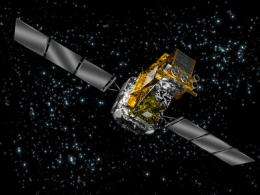
This is an artist’s impression of ESA’s orbiting gamma-ray observatory, Integral. Credits: ESA

The reasoning behind the original hypothesis was that positrons, being electrically charged, would be affected by magnetic fields and thus would not be able to travel far. As the radiation was observed in places that did not match the known distribution of stars, dark matter was invoked as an alternative for the origin of the positrons.

But the recent finding by a team of astronomers led by Richard Lingenfelter at the University of California at San Diego, proves otherwise. The astronomers show that the positrons formed by radioactive decay of elements left behind after explosions of are, in fact, able to travel great distances, with many leaving the thin Galactic disc.

Taking this into account, dark matter is no longer required to explain what Integral saw. A better understanding of how positrons behave has explained the mysterious radiation in our Galaxy.

More information:

Reference publication

Lingenfelter, R.E., Higdon, J.C. Rothschild, R.E., "Is There a Signal in the Galactic Positron Annihilation Radiation?", Physical Review Letters, Volume 103, Issue 3, 031301, 2009. DOI:10.1103/PhysRevLett.103.031301

Related publications

Higdon, J. C., Lingenfelter, R. E., Rothschild, R. E., "The Galactic Positron Annihilation Radiation and the Propagation of Positrons in the Interstellar MediDOI:10.1088/0004-637Xical Journal, Volume 698, Issue 1, pp. 350-379, 2009. DOI:10.1088/0004-637X/698/1/350

WeidensDOI:10.1038/nature06490An asymmetric distribution of positrons in the Galactic disk revealed by gamma-rayDOI:10.1016/j.newar.2008.06.019, 2008a. DOI:10.1038/nature06490

Weidenspointner, G., et al., "Positron astronomy with SPI/INTEGRAL", New Astronomy Reviews, Volume 52, Issues 7-10, pp 454-456, 2008b. DOI:10.1016/j.newar.2008.06.019

Provided by ESA


print this article email this article download pdf blog this article bookmark this article     Stumble it Digg this share on Facebook retweet share on Reddit add to delicious
Rate this story - 4.5 /5 (10 votes)

Rank Filter

Move the slider to adjust rank threshold, so that you can hide some of the comments.


Display comments: newest first

  • omatumr - Jul 22, 2009
    • Rank: 3 / 5 (4)
    SANITY RETURNS: MYSTERY SOLVED WITHOUT DARK MATTER

    There was another recent news report from UC-San Diego that came to the same conclusion:

    Ordinary matter doing ordinary things produced the radiation that had been attributed to imaginary dark matter.

    This is indeed encouraging!

    With kind regards,
    Oliver K. Manuel
    http://www.omatumr.com

  • OregonWind - Jul 22, 2009
    • Rank: 5 / 5 (3)
    'SANITY RETURNS: MYSTERY SOLVED WITHOUT DARK MATTER'

    In this case, maybe that is the case, although further analysis needs to be done, to be conclusive. However, there are many other 'mysteries' which need to be resolved and dark matter still is a strong possibility. Would someone here be willing to present a better explanation than dark matter?

  • frajo - Jul 22, 2009
    • Rank: 1 / 5 (1)
    Nice results. Hope to see more of the kind in the near future. :)
  • frajo - Jul 22, 2009
    • Rank: 1 / 5 (1)
    Would someone here be willing to present a better explanation than dark matter?

    Steinhardt, Turok, Randall, Sundrum et al.
  • Damon_Hastings - Jul 22, 2009
    • Rank: not rated yet
    Would someone here be willing to present a better explanation than dark matter?

    Steinhardt, Turok, Randall, Sundrum et al.

    Is that a citation for a single paper? Google Scholar shows many papers written by some of those authors, but none written by all of them. Could you link to a specific article, or articles? I'm not going to read all of the hundred or so papers written by all those guys. ;-)
  • earls - Jul 22, 2009
    • Rank: 3.3 / 5 (6)
    Would someone here be willing to present a better explanation than dark matter?


    Absolutely! By AWT...
  • frajo - Jul 23, 2009
    • Rank: 1 / 5 (1)
    Would someone here be willing to present a better explanation than dark matter?

    Steinhardt, Turok, Randall, Sundrum et al.

    Is that a citation for a single paper?

    No. It was meant as a listing of some of those who are known to already having presented a "better" explanation than dark matter. ("Better" of course not being necessarily a purely scientific measure.)
    Google Scholar shows many papers written by some of those authors, but none written by all of them.

    Yes. Steinhardt and Turok have been working together on the Ekpyrotic Model and its successor, the Cyclic Model. Randall and Sundrum have introduced another cosmological model involving branes and higher dimensions. Both models are IMHO a lot more elegant than the dominant standard cosmological model.
    Could you link to a specific article, or articles? I'm not going to read all of the hundred or so papers written by all those guys. ;-)

    Neither can I although I'd like to.
    For beginners I recommend two Wikipedia articles:
    http://en.wikiped...ic_model
    http://en.wikiped...-Sundrum
  • RayCherry - Jul 23, 2009
    • Rank: not rated yet
    Perhaps (and probably) there is a lot of missing information here, and reading through the documents offered on the subject would throw more light on the subject, but I wonder if somebody contributing to the comments could briefly answer a few of questions.

    The evidence we have of the gamma ray phenomenon is %u2026 the gamma ray phenomenon. That is, we have detected and mapped the source (or group of contiguous sources) of gamma ray emissions from the direction of the centre of the galaxy. Plus, thanks to Integral's high resolution observations, we have found a group of 'remnant stars' in the area at the centre of the same galaxy. The group remnant stars are distributed about the centre of the galaxy in a manner that forms a shape, (as observed from earth today), that is similar to that of the source(s) of the gamma ray phenomenon.

    Has Integral (or any other experiment) detected the 'positron debris' or witnessed any of the 'matter/antimatter annihilations' from the proposed explosions of massive stars?

    Has the age of the gamma rays been compared to that of the light (of lower energy emissions) from the remnant stars?

    More philosophically, could it be said that 'dark matter' has been explained in this theoretical model as 'normal matter' that has been transformed by events that have become 'hidden in time'?

    I know (from that which has been reported in popular fiction and the science journals upon which it was based) that CERN, and possibly other labs around the world, have 'captured' and stored securely small amounts of anti-matter, and that some experimental annihilations have been witnessed and recorded. Gamma radiation, (as one group of frequencies of light, amongst the many, including visible light), is product of such events. Perhaps it would be better to say that an immense range or spectra of light, (visible, invisible and extremely high energy) is produced by each annihilation.

    But %u2026 is annihilation the only natural occurring event that could produce the gamma radiation, (emission of light, described often in this specific phenomenon as a 'glow'), that could account for the observations in that area of the sky, or is this article simply reporting the relief felt by many theoretical mathematicians and cosmologists that a more acceptable, (slightly more traditional; even more relational), theory has been proposed for the inconclusively-explained phenomenon?

    Fifty years from now the shape formed by those remnant stars as they orbit around the galactic centre will obviously change, but the pattern of distribution of the proposed particulate debris (from the (simultaneous?) massive star explosions) will be much less affected by the orbit from which they originate. Perhaps the current observation will be inverted, and the majority of remnant stars will appear on the left of the galactic centre while the majority of the gamma ray glow will still appear of the right. Would the new theory fit so well if that configuration was observed by Integral today?

    Last thought: the entire cosmos is smoke and mirrors, and we are trying to discern where the magician's hands have been. In this scenario, one of the hands may be the black hole that resides in the centre of those Integral observations.
  • RayCherry - Jul 23, 2009
    • Rank: not rated yet
    '%u2026' replaces '...' in physorg's upload streams. Could the webmaster use 'quoted text' for the upload of comments?
  • omatumr - Jul 23, 2009
    • Rank: 1.4 / 5 (5)
    NEUTRON REPULSION POWERS COSMO BY NUCLEAR DISSOCIATION !

    Ray Cherry, there is zero (0) probability (P), P = 0.0000000, that cosmologists and astrophysicists will ever comprehend the origin of radiation coming from the galactic centre if they continue to ignore experimental evidence that nuclear dissociation, rather than fusion, powers the Sun and the cosmos [See: "The sun's origin, composition and source of energy", in Lunar and Planetary Science XXIX, Abstract 1041, available as 1041-pdf from Lunar and Planetary Institute, Houston, TX (CD-ROM, 2001); "Attraction and repulsion of nucleons: Sources of stellar energy", Journal of Fusion Energy 19, 93-98 (2001); "Nuclear systematics: III. The source of solar luminosity", Journal of Radio-analytical and Nuclear Chemistry 252, 3-7 (2002); "The standard solar model versus experimental observations" in Proceedings of the Third International Conference on Beyond Standard Model Physics - BEYOND 2002 (IOP, Bristol, editor: H. V. Klapdor-Kleingrothaus) pp. 307-316 (2003); "Neutron repulsion confirmed as energy source", Journal of Fusion Energy 20, 197-201 (2003); etc.]

    With kind regards,
    Oliver K. Manuel
    http://www.omatumr.com


  • Myria83 - Jul 23, 2009
    • Rank: 3.7 / 5 (3)
  • Damon_Hastings - Jul 24, 2009
    • Rank: 5 / 5 (3)
    Would someone here be willing to present a better explanation than dark matter?

    Steinhardt, Turok, Randall, Sundrum et al.

    For beginners I recommend two Wikipedia articles:
    http://en.wikiped...ic_model
    http://en.wikiped...-Sundrum

    Neither of those articles suggest any alternative to dark matter; nor do they even mention galactic rotation rates (the main evidence for dark matter.)

    The Cyclic Model is just the theory that each Big Bang is followed by a Big Crunch and then another Big Bang. Pretty basic stuff. Dark matter is consistent with that model; in fact it's usually a part of the model.

    Your wiki article says that the Steinhardt-Turok model describes dark energy as a repulsive force between colliding branes; but it doesn't refute dark energy (or even mention dark matter). Not that dark energy and dark matter have anything to do with each other anyway.

    The article on the Randall-Sundrum models also discusses branes and dark energy, but again with no reference to dark matter. Were you confusing dark matter with dark energy?

    Anyway, I'm still seeing no alternative explanation for the strange rotational rates of galaxies, or gravitational lensing which exceeds the mass of visible matter, or unexplained gas distributions, or any of the other evidence for dark matter.

    You know, I don't understand why people consider dark matter to be so strange anyway -- "dark matter" simply means "matter which we can't see." Is it really so hard to believe that there's a lot of matter in the universe that we can't see? I mean, our deep-space sensing abilities are pretty limited... And, yeah, I know it's not just a bunch of space rocks (it's nonbaryonic), but it *could* be largely made up of neutrinos.
  • omatumr - Jul 25, 2009
    • Rank: 1.2 / 5 (5)
    FIRST STUDY THE MATTER YOU CAN SEE !

    Damon Hastings does not "understand why people consider dark matter to be so strange anyway -- "dark matter" simply means "matter which we can't see."

    Is it really so hard to believe that there's a lot of matter in the universe that we can't see?"

    During the Dark Ages, it would have seemed reasonable to to believe that there's a lot of matter in the universe that we can't see.

    There is no longer any "mystery radiation," "mysterious cosmic explosions," nor "mysteriously vanishing solar neutrinos" for those who study the 3,000 nuclear mass data points [ http://www.omatum...Data.htm ] that describe the ground state of every atom in the visible universe [See: Neutron repulsion confirmed as energy source, Journal of Fusion Energy 20 (2001) pages 197-201: http://tinyurl.com/38un57 ]

    With kind regards,
    Oliver K. Manuel
  • Mercury_01 - Jul 27, 2009
    • Rank: 1 / 5 (1)
    I think its "dark energy" that we should be suspicious of. Its far less outlandish to believe that our 4D happened to disseminate through energetic symmetry breaking from a higher dimensional spacetime, thereby being cut off from a lot of the matter there.
  • yyz - Jul 29, 2009
    • Rank: 5 / 5 (1)
    Again, there seems to be some dispute over the interpretation of the Integral (and PAMELA) observations. See the (much more statistically significant) observations recently obtained by Fermi and H.E.S.S. here: http://www.physor...494.html .

July 22, 2009 all stories

Comments: 15

4.5 /5 (10 votes)
  • Stumble this up

  • Digg this

  • share this

  • hide
  • Related Stories

  • Integral discovers the galaxy’s antimatter cloud is lopsided
    created Jan 09, 2008 | popularity not rated yet | comments 0
  • Astrophysicists solve mystery in Milky Way galaxy
    created Jul 09, 2009 | popularity not rated yet | comments 0
  • Proposed Particle Help Explains Odd Galactic Photons
    created Jul 25, 2008 | popularity not rated yet | comments 0
  • Clemson astronomers to study mysterious antimatter in the Milky Way
    created Feb 16, 2009 | popularity not rated yet | comments 0
  • Integral: Three Years Of Insight Into The Violent Cosmos
    created Oct 24, 2005 | popularity not rated yet | comments 0


  • hide
  • Relevant PhysicsForums posts

  • Question about 2-body gravity
    created Nov 24, 2009
  • life on Mars
    created Nov 24, 2009
  • Semi-major axis from cartesian co-ordinates
    created Nov 23, 2009
  • Primary Mirror grinding
    created Nov 23, 2009
  • dark energy can escape black holes.
    created Nov 23, 2009
  • Are there green, purple and pink stars?
    created Nov 22, 2009
  • More from Physics Forums - General Astronomy

Other News

Cosmic 'dig' reveals vestiges of the Milky Way's building blocks

Cosmic 'Dig' Reveals Vestiges of the Milky Way's Building Blocks

Space & Earth / Astronomy

created 26 minutes ago | popularity not rated yet | comments 0

(PhysOrg.com) -- Peering through the thick dust clouds of our galaxy's "bulge" (the myriads of stars surrounding its center), a team of astronomers has unveiled an unusual mix of stars in the stellar grouping ...


Cutting greenhouse pollutants could directly save millions of lives worldwide

Space & Earth / Environment

created 2 hours ago | popularity 1 / 5 (2) | comments 1

Tackling climate change by reducing carbon dioxide and other greenhouse emissions will have major direct health benefits in addition to reducing the risk of climate change, especially in low-income countries, according to ...


Small faults in Southeast Spain reduce earthquake risk of larger ones

Small faults in Southeast Spain reduce earthquake risk of larger ones

Space & Earth / Earth Sciences

created 2 hours ago | popularity not rated yet | comments 0

A team of Spanish scientists, studying recent, active deformations in the Baetic mountain range, have shown that the activity of smaller tectonic structures close to larger faults in the south east of the ...


Mars Reconnaissance Orbite

Mars Reconnaissance Orbite Team Plans Uplink of Protective Files

Space & Earth / Space Exploration

created 5 hours ago | popularity 5 / 5 (1) | comments 0

(PhysOrg.com) -- The team operating NASA's Mars Reconnaissance Orbiter plans to uplink protective files to the spacecraft next week as one step toward resuming the orbiter's research and relay activities.


It's not just dirt!

Space & Earth / Environment

created 2 hours ago | popularity 5 / 5 (1) | comments 0

Soil is the linchpin of the environment, where atmosphere, biosphere, and hydrosphere meet. Despite that, many students see soil as "just dirt" - a place to grow plants, but nothing more. Soil science educators are challenged ...