Beyond flash -- memories are made of this
(PhysOrg.com) -- The race is on for a successor to the popular 'flash' memory used in portable devices. European researchers think they have found a candidate in novel materials combined with a simple, easily fabricated 'crossbar' architecture.
When you turn off your mobile phone you don’t lose the address book. That’s because data is stored in ‘non-volatile’ memory chips that remember your precious contacts even when the power is off.
The most popular non-volatile technology is called ‘flash’ and it is found in the ubiquitous USB memory stick as well as mobile phones, digital cameras and many other portable devices. Some of the small but popular ‘netbook’ computers store all their data in flash memory, removing the need for a hard disk drive.
But there are limits to what flash can do, says Dr Grazia Tallarida of the Laboratorio Nazionale MDM, near Milan, the coordinator of the VERSATILE project. “Making these devices smaller and also enlarging their capacity is becoming more and more difficult. So there is a lot of work now to find different technologies for non-volatile memories.”
One of the most promising is based on ‘phase change’ or ‘resistive change’ materials. “These are materials in which you store information - zero or one - by changing the electrical properties,” Tallarida explains. “They just need a voltage drop across them to be switched between an ‘off’ state and an ‘on’ state.”
Crossbar architecture
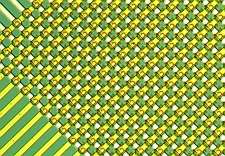
An array of tiny memory cells, made from materials such as nickel oxide, can be sandwiched between two sets of parallel conductors, at right angles to each other, so that a voltage can be applied to any cell. This is known as crossbar architecture.
One problem is that the closely packed cells can interfere with each other and degrade the performance of the memory. The solution is to connect each cell through a diode to ensure that cells only respond to the signal intended for them. And that is where the EU-funded VERSATILE project comes in. “The main point is not researching the memory cell itself,” Tallarida says, “but about the crossbar architecture and the diodes that are needed to build the crossbar devices.”
While the design is potentially simple and cheap to make, the memory array is laid down on top of other circuitry and that means that the temperature in the manufacturing process must be kept below 350 degrees Celsius. That rules out the use of silicon diodes, which need much higher temperatures in their fabrication.
Instead, the VERSATILE partners have designed a diode based on zinc oxide, a material not normally used in conventional CMOS technology, but which only needs temperatures of around 100 degrees.
The project involves research labs in Germany, Denmark and Poland as well as Italy. The industrial partner is Numonyx, a joint venture of Intel and STMicroelectronics set up in 2008 to exploit the market for non-volatile memory.
Stacked arrays
So far they have built a prototype array of 10,000 cells, each measuring 5 micrometres across. Each cell stores one bit, so this array has a capacity of 10 kilobits or about 1.2 kilobytes. By using a computer simulation, the partners have shown that an array of 100 million cells - 12 megabytes - could be integrated on to a chip using the same technology.
A big advantage of the crossbar architecture is that arrays can simply be stacked - one on top of the other - on a single chip to build up devices with large storage capacities.
“What we are doing now, the last part of the project, is to demonstrate that this can be scaled down to a much smaller size,” says Tallarida.
The team is currently fabricating an experimental 25-cell array with 100-nanometre cells and will try an even smaller scale if it is successful.
VERSATILE complements another project, EMMA, also funded by the EU’s Sixth Framework Programme for research and both ending this summer. EMMA has been developing materials for the memory cells themselves and supplied the nickel oxide cells used by VERSATILE.
Tallarida sees great potential in taking the results from the two projects to create an even better memory chip. “That could be the starting point for continuing with the work: some combination of the diode with the memory cell to see if the complete approach works.”
Organic semiconductors
She would also like to pursue another idea examined earlier in the project of using organic semiconductor diodes. “We think that there is also a need for an effort to push through the combination of organic and inorganic semiconductors. That could be interesting especially for low-cost or even disposable devices.”
Crossbar technology could ultimately take over from flash, especially in the mass consumer market. “You could obtain the same microchip at lower cost while still keeping the reliability and performance.”
It could also have applications for disposable products such as medical devices, smart cards, toys and games.
Korean giant Samsung is known to be working on a similar technology but Tallarida says that the new VERSATILE diode has a lower noise level than Samsung’s equivalent which means that more cells could be packed into a smaller space.
Could Europe make an impact in this area? In principle, yes, but it’s a mighty competitive market.
“This is one of those fields you have to arrive in before the others,” Tallarida points out. “It makes a difference!”
More information: www.mdm.infm.it/Versatile
Provided by ICT Results


