A New Path of Conduction for Future Electronics
July 22, 2009 by Calla Cofield A New Path of Conduction for Future Electronics

Enlarge

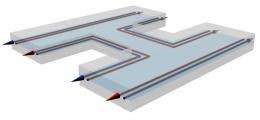
Schematic representing trajectories of electrons "dancing" along the edges of a device. Red arrows correspond to electrons with "spin up"; blue, "spin down." An electron injected from one leg of the "H" can end up in the other without bumping into other electrons or defects in the bulk of the material, and hence without any resistance, by traveling unimpeded along the edge. (Image courtesy Shou-Cheng Zhang.)

(PhysOrg.com) -- Last month, researchers from SLAC National Accelerator Laboratory made headlines when they revealed experimental evidence of a topological insulator: a material that could revolutionize computer processors by allowing electricity to flow without resistance. This week in Science, SLAC theorists along with an experimental group in Germany report additional details about the way these topological insulators conduct electricity. Using the topological insulator mercury telluride, the paper shows that an electric current sent through these materials goes against conventional physics knowledge and travels far away from its input points, to the outer edges of the material.

"This is another manifestation of this new state of matter, which is totally different than anything we're familiar with," said co-author Shou-Cheng Zhang of the Stanford Institute for Materials and Energy Science at SLAC. The current generation of microprocessors dissipate a lot of energy as heat, Zhang said, as result of . "It's one of the greatest obstacles facing the information age today. The current experiment proves that there is a possible motion of the electrons that does not dissipate energy in the traditional way."

Imagine moving through a crowded ballroom trying to make your way from one end to the other while dancing couples fill the space. You keep bumping into other dancers, losing your energy and your patience along the way. Similarly, as electric currents pass through conductors, they bump into other electrons and lose their energy. But in topological insulators the electrons exhibit a spin-orbit coupling, as if they were traveling and spinning smoothly in the same direction as all the other dancers, preventing collisions and loss of energy. Last month Zhang and colleagues demonstrated this behavior in bismuth telluride. The new results show that the electrons also take a unique path through the "ballroom." They move around the edge of the topological insulator, even if that means moving far away from the input and output points of the current. In contrast, the current in a regular conductor will take the shortest route possible between those two points.

Zhang and SLAC physicists and Xiao-Liang Qi and Joseph Maciejko predicted this bizarre behavior theoretically, earlier this year. Experimentalists at the Physikalisches Institut and Röntgen Center for Complex Material Systems at the Universität Würzburg in Würzburg, Germany tested the theories in the lab—and their results matched the predictions exactly.

The researchers achieved the new results by shining light on telluride to observe its properties. The German research team sent a current through the material, which provided more precise information and more closely modeled the way these topological insulators will be used in future applications.

Since the first theoretical prediction made by Zhang's group, the field of topological insulators has been roaring forward and research papers on the subject are appearing in the journals Science and Nature every few weeks. To make these the materials ready for applications, Zhang said, engineering researchers must test them for compatibility with current computer technology then confirm that material will operate at room temperature. Maciejko added, "The step toward initial implementation is not that large."

More information: Science paper: http://www.sciencemag.org/cgi/content/full/325/5938/294

Provided by SLAC National Accelerator Laboratory (news : web)


Rate this story - 4.9 /5 (27 votes)

Rank Filter

Move the slider to adjust rank threshold, so that you can hide some of the comments.


Display comments: newest first

  • earls - Jul 22, 2009
    • Rank: not rated yet
    How does this effect compare and contrast with superconductors? The "ballroom" analogy I've read before.

    A breakthrough of this caliber is just the tip of the iceberg.
  • winthrom - Jul 22, 2009
    • Rank: not rated yet
    If this can carry current then transmission lines can be more effective
  • poi - Jul 23, 2009
    • Rank: not rated yet
    "The step toward initial implementation is not that large."

    if they were asking for funding, they'd be denied if they said this.
    so time table pleeaase...
  • Riverbill - Jul 24, 2009
    • Rank: not rated yet
    It was my understanding that electrons travel fastest on the outer regons of a conducter, not through the center of the ballroom? How does this efect EMFRadiation? Losses may increase in power transmission.
  • earls - Jul 24, 2009
    • Rank: not rated yet
  • Birger - Jul 27, 2009
    • Rank: not rated yet
    If such a component could be given a near-fractal surface, would it be able to carry useful amounts of current on a scale where it could replace copper for electricity power networks?
  • Slotin - Jul 28, 2009
    • Rank: 1 / 5 (1)
    How does this effect compare and contrast with superconductors?
    Bismuth telluride isn't superconductor - instead of it, in its pure state it behaves like perfect insulator. Just the surface of crystals remains conductive and it exhibits a classical, but relativelly high metallic conductivity.
    To understand this behavior we should learn a bit about electron structure of bismuth telluride. Due the relative size of Bi and Te ions and low concentration of conductive electrons, movable electrons are confined ("locked") by their repulsive forces to sparse hexagonal mesh (so called Wigner crystal), surrounding Bi2Te3 atoms in crystal lattice. With compare to metals, where movable electrons can occupy a continuous space around atoms ("electron sea"), Bi2Te material remains nonconductive in its monocrystalline pure state.
    http://www.aether...ide3.gif
    http://www.aether...tor1.gif
    Just at the surface of crystals, where repulsive forces of individual electrons aren't compensated from outside the free electrons remains movable, so that surface of material can serve as a 2D conductor. Bi2Te3 exhibits many other interesting properties, for example we can met with it in Peltier cells, serving for cooling of processors.
  • Slotin - Jul 28, 2009
    • Rank: 1 / 5 (1)
    We can model this behavior partially, if we penetrate hydrophobic porous material by fluid of high surface tension (like water) under pressure. Because fluid remains confined to free spaces between particles, the fluid (i.e. electrons) cannot flow through bulk of porous material. Only at the free surface of porous material the repulsive capillary forces aren't compensated, so that fluid can form a continuous layer and to remain movable and conductive.

    The model of porous surface covered by fluid is quite effective model in explanation of electron analogies of solid phase and we can even use it for explanation of semiconductor junction.

    http://aetherwave...ors.html

July 22, 2009 all stories

Comments: 8

4.9 /5 (27 votes)

  • hide
  • Related Stories

  • New exotic material could revolutionize electronics
    created Jun 15, 2009 | popularity not rated yet | comments 0
  • Super-efficient Transistor Material Predicted
    created May 15, 2009 | popularity not rated yet | comments 0
  • Making magnetic monopoles, and other exotica, in the lab
    created Feb 05, 2009 | popularity not rated yet | comments 0
  • It's all in the spin: Quantum physics cools down computers
    created Sep 25, 2007 | popularity not rated yet | comments 0
  • Researchers predict a new state of matter in semiconductors
    created Dec 14, 2006 | popularity not rated yet | comments 0


  • hide
  • Relevant PhysicsForums posts

Other News

Extra large carbon

Extra large carbon

Physics / General Physics

created 5 hours ago | popularity 4.7 / 5 (9) | comments 3 | with audio podcast

An exotic form of carbon has been found to have an extra large nucleus, dwarfing even the nuclei of much heavier elements like copper and zinc, in experiments performed in a particle accelerator in Japan. ...


Scientist explore future of high-energy physics

Scientist explore future of high-energy physics

Physics / General Physics

created 11 hours ago | popularity 4.9 / 5 (10) | comments 4 | with audio podcast

In a 1954 speech to the American Physical Society, the University of Chicago's Enrico Fermi fancifully envisioned a particle accelerator that encircled the globe. Such would be the ultimate theoretical outcome, ...


Leaf veins inspire a new model for distribution networks (w/ Video)

Physics / General Physics

created 8 hours ago | popularity 5 / 5 (2) | comments 0 | with audio podcast

(PhysOrg.com) -- Following the straight and narrow may be good moral advice, but it’s not a great design principle for a distribution network. In new research, a team of biophysicists describe a complex netting of interconnected ...


New magnetic tuning method enhances data storage

New magnetic tuning method enhances data storage

Physics / General Physics

created 11 hours ago | popularity 4.3 / 5 (3) | comments 0 | with audio podcast

Researchers in Chicago and London have developed a method for controlling the properties of magnets that could be used to improve the storage capacity of next-generation computer hard drives.


New method for measuring fluid flow in algae could herald revolution for fluid mechanics

Physics / General Physics

created 13 hours ago | popularity 5 / 5 (2) | comments 0 | with audio podcast

In the words of Todd Squires, of the University of California, Santa Barbara "Nature has long inspired researchers in fluid mechanics to explore the mechanical strategies used by living creatures. Where better to look for ...