Still a low chance of development for two lows
July 22, 2009 Still a low chance of development for 2 lows

Enlarge

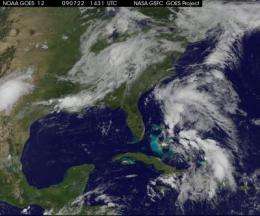
GOES-12 captured the lows on July 22 at 10:31 a.m. EDT (1431 UTC). The satellite image shows two comma-like cloud formations, one east of Florida's east coast, and the other with its "tail" over Hispaniola. Both have a low chance of developing into a tropical depression according to the National Hurricane Center. Credit: NASA GOES Project, Goddard Space Flight Center, Greenbelt, Md.

The two areas of thunderstorms in the Caribbean from yesterday, July 21, are on the move. One area is now moving into out of the Caribbean and into the eastern Atlantic Ocean while the other is now moving over the southeastern Bahamas and Hispaniola on a northwest track.

The Geostationary Operational Environmental (GOES) satellite, GOES-12 grabbed another satellite snapshot of the two areas of thunderstorms on Wednesday, July 22. The satellite image shows two comma-like cloud formations, one east of Florida's east coast, and the other with its "tail" over Hispaniola.

Showers and thunderstorms that are closest to the U.S. mainland are showing less of a chance of developing into something tropical. They're located from the northern Bahamas northward into the and span several hundred miles. That group of storms is associated with a weak surface trough, that is, an elongated area of low pressure. The National Hurricane Center in Miami, Fla. says that there is a low chance of development, less than 30 percent now, of any further development into something tropical because the on the surface is high. This area of showers and thunderstorms is forecast to move along the U.S. East coast bringing showers to the coastline from Delaware north to New England before it moves to sea.

The second area of disorganized showers and thunderstorms has spread over the eastern Caribbean including southeastern Bahamas and Hispaniola. That group of storms is associated with a tropical wave. This tropical wave is moving northwest near 20-25 mph.

Tropical waves in the Atlantic Ocean are an elongated area of low pressure, also called a "trough." They consist of clouds and thunderstorms and stretch from north to south and move west across the Atlantic Ocean, originating off the African coast. They are generated or enhanced by the African Easterly Jet stream. They can lead to the formation of in the north Atlantic and northeast Pacific basins.

The National Hurricane Center noted that upper-level winds remain unfavorable for this group of storms to develop into a tropical depression in the next day or two. Further, interaction with land also inhibits organization of a tropical cyclone, because they draw their power from warm tropical waters. There is less than 30 percent of this system becoming a tropical cyclone during the next 48 hours.

GOES is operated by the National Oceanic and Atmospheric Administration. NASA's GOES Project, located at NASA's Goddard Space Flight Center, Greenbelt, Md. creates some of the images from the GOES satellites.

Elsewhere in the Atlantic Ocean, Caribbean and Gulf of Mexico, tropical cyclone formation isn't expected for another two days, but GOES-11 and GOES-12 are watching.

Source: NASA/Goddard Space Flight Center


print this article email this article download pdf blog this article bookmark this article     Stumble it Digg this share on Facebook retweet share on Reddit add to delicious
Rate this story - not rated yet


July 22, 2009 all stories

Comments: 0

not rated yet
  • Stumble this up

  • Digg this

  • share this

  • hide
  • Related Stories

  • Hurricane Hanna Not Moving Much Near North of the Caicos Islands
    created Sep 01, 2008 | popularity not rated yet | comments 0
  • NASA eyes warm sea surface temperatures for hurricanes
    created Aug 17, 2007 | popularity not rated yet | comments 0
  • Tropical Depression Erin Soaking East Texas
    created Aug 16, 2007 | popularity not rated yet | comments 0
  • Atlantic and East Pacific Ocean Hurricane Seasons Begin for 2009
    created Jun 01, 2009 | popularity not rated yet | comments 0
  • Did dust bust the 2006 hurricane season forecasts?
    created Mar 28, 2007 | popularity not rated yet | comments 0


  • hide
  • Relevant PhysicsForums posts

  • Climate Science Update
    created Nov 27, 2009
  • The IPCC and the term "most"
    created Nov 23, 2009
  • Is global warming a fact?
    created Nov 23, 2009
  • Random variability of wind patterns
    created Nov 23, 2009
  • More from Physics Forums - Earth

Other News

Ohio school district sues over air pollution

Space & Earth / Environment

created 19 minutes ago | popularity not rated yet | comments 0

(AP) -- A school district near Cincinnati is suing a plastics plant, accusing it of continuing to release chemicals in the air that exceed government safety standards.


The International Space Station

NASA: Floating 'junk' no threat to space station

Space & Earth / Space Exploration

created 5 hours ago | popularity not rated yet | comments 0

(AP) -- NASA says a piece of old space junk that it's been tracking for a few days is no threat to the International Space Station.


Japan launches 5th spy satellite (AP)

Japan launches 5th spy satellite

Space & Earth / Space Exploration

created 13 hours ago | popularity 4 / 5 (2) | comments 0

(AP) -- Japan launched its fifth spy satellite into orbit Saturday in a bid to boost its ability to independently gather intelligence, the government said.


Is global warming unstoppable?

Space & Earth / Environment

created Nov 23, 2009 | popularity 3.4 / 5 (41) | comments 61

In a provocative new study, a University of Utah scientist argues that rising carbon dioxide emissions - the major cause of global warming - cannot be stabilized unless the world's economy collapses or society builds the ...


Humanity would need five Earths to create the resources needed if everyone lived as like Americans, a report has stated

Mankind using Earth's resources at alarming rate

Space & Earth / Environment

created Nov 24, 2009 | popularity 3.2 / 5 (18) | comments 48

Humanity would need five Earths to produce the resources needed if everyone lived as profligately as Americans, according to a report issued Tuesday.