Chimps, like humans, focus on faces
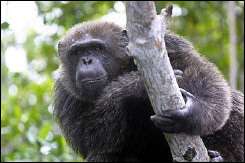
July 23, 2009 A chimpanzee

A chimp's attention is captured by faces more effectively than by bananas. A series of experiments described in BioMed Central's open access journal Frontiers in Zoology suggests that the apes are wired to respond to faces in a similar manner to humans.

Masaki Tomonaga and Tomoko Imura from the Primate Research Institute at Kyoto University, Japan, tested the effects of a series of different images on chimps' reaction times. Tomonaga said, "It is well known that are processed in a different manner from other types of complex visual stimuli. Recent studies of face perception in humans clarified that faces represent special stimuli with regard to visuospatial attention as well. That is, they are able to capture our attention. We've shown that chimps share this tendency to notice and pay attention to faces in preference to other objects."

The researchers gave chimps the option of playing a game for food. If the chimps chose to, they could approach a computer screen where an image would be displayed, followed by a target. If the chimps pressed the target, they would receive a reward. In one set of experiments, the image was displayed on one side of the screen followed by the target either on the same side or the previously blank side. Reaction times were shown to improve when the target appeared behind the image. The chimps were then presented with two images side by side, one of which was a chimpanzee face. When the target appeared behind the face, reaction times were better than when it appeared behind the other object - showing that attention had indeed been drawn to the face-side of the screen.

Chimpanzee faces were shown to attract attention more effectively than bananas and other objects such as flowers, houses or trains. This effect was reduced when the faces were inverted, suggesting that it is the specific configuration of an upright face that catches the eye. According to Tomonaga, "This attentional capture was also observed when upright human faces were presented, indicating that this effect is not limited to their own species".

More information: Faces capture the visuospatial of (Pan troglodytes): evidence from a cueing experiment, Masaki Tomonaga and Tomoko Imura, Frontiers in Zoology (in press), http://www.frontiersinzoology.com/

Source: BioMed Central (news : web)


print this article email this article download pdf blog this article bookmark this article     Stumble it Digg this share on Facebook retweet share on Reddit add to delicious
Rate this story - not rated yet


July 23, 2009 all stories

Comments: 0

not rated yet
  • Stumble this up

  • Digg this

  • share this

  • hide
  • Related Stories

  • Humans and chimps register faces by using similar brain regions
    created Dec 18, 2008 | popularity not rated yet | comments 0
  • Psychologists reveal the secret of successful wooing
    created Feb 13, 2009 | popularity not rated yet | comments 0
  • Face facts: People don't stand out in crowds
    created Jan 18, 2008 | popularity not rated yet | comments 0
  • Autism explained by weak brain links
    created Apr 10, 2006 | popularity not rated yet | comments 0
  • Here's looking at you, fellow!
    created Mar 02, 2009 | popularity not rated yet | comments 0


  • hide
  • Relevant PhysicsForums posts

  • What is transpulmonary pressure?
    created Nov 24, 2009
  • Is there a gay gene?
    created Nov 23, 2009
  • Super quick question about Starling forces?
    created Nov 22, 2009
  • Questions about diffusion
    created Nov 22, 2009
  • More from Physics Forums - Biology

Other News

Variable Temperatures Leave Insects wtih a Frosty Reception

Biology / Plants & Animals

created 7 hours ago | popularity not rated yet | comments 0

(PhysOrg.com) -- For the first time, scientists at The University of Western Ontario have shown that insects exposed to repeated periods of cold will trade reproduction for immediate survival.


When camouflage is a plant's best protection

Rare woodland plant uses 'cryptic coloration' to hide from predators

Biology / Plants & Animals

created 10 hours ago | popularity 4.3 / 5 (3) | comments 0

It is well known that some animal species use camouflage to hide from predators. Individuals that are able to blend in to their surroundings and avoid being eaten are able to survive longer, reproduce, and ...


Cells defend themselves from viruses, bacteria with armor of protein errors

Biology / Cell & Microbiology

created 11 hours ago | popularity 5 / 5 (7) | comments 0

When cells are confronted with an invading virus or bacteria or exposed to an irritating chemical, they protect themselves by going off their DNA recipe and inserting the wrong amino acid into new proteins to defend them ...


'Safety valve' protects photosynthesis from too much light

Biology / Cell & Microbiology

created 11 hours ago | popularity 5 / 5 (2) | comments 0

Photosynthetic organisms need to cope with a wide range of light intensities, which can change over timescales of seconds to minutes. Too much light can damage the photosynthetic machinery and cause cell death. Scientists ...


Researchers discover biological basis of 'bacterial immune system'

Biology / Cell & Microbiology

created 12 hours ago | popularity 4.7 / 5 (3) | comments 0

Bacteria don't have easy lives. In addition to mammalian immune systems that besiege the bugs, they have natural enemies called bacteriophages, viruses that kill half the bacteria on Earth every two days.