The auroras in the Northern and the Southern hemispheres are not identical (w/ Video)
July 23, 2009 The auroras in the Northern and the Southern hemispheres are not identical

Enlarge

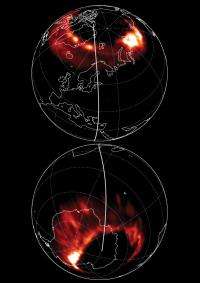
Asymmetric aurora. Polar VIS Earth (J. B. Sigwarth) and IMAGE WIC (S. B. Mende)

In a Nature letter published July 23, 2009, Norwegian researchers present evidence that the auroras in the Northern and the Southern hemispheres can be totally asymmetric. These findings contradict the commonly made assumption of aurora being mirror images of each other.

The study with the sensational results has been performed by PhD student Karl Magnus Laundal and professor Nikolai Řstgaard at the Institute of Physics and Technology at the University of Bergen.

The aurora is produced due to collisions between the Earth’s atmosphere and electrically charged particles streaming along the ’s geomagnetic field lines. "Since these processes occur above the two hemispheres, both the Northern and the Southern light are created. So far researchers have assumed that these auroras are mirror images of each other, but our findings show that this is not always the case," professor Nikolai Řstgaard says.

FLV player

Assymetric aurora. Animation based on data made by Espen Madsen.

The full version of this animation can be downloaded here.

The researchers at the University of Bergen have used data from the two NASA-satellites IMAGE and Polar to examine the Northern and the Southern light. In the Nature letter they present several possible explanations to the unexpected result.

"The most plausible explanation involves electrical currents along the magnetic field lines. Differences in the solar exposure may lead to currents between the two hemispheres, explaining why the Northern and the Southern light are not identical," PhD student Karl Magnus Laundal says.

In addition to yielding new knowledge about the aurora, the results are important for other researchers studying the near-Earth space.

"Our study shows that data from only one hemisphere is not sufficient to state the conditions on the other hemisphere. This is important because most of our knowledge about the , as well as processes in the upper atmosphere in the polar regions, is based solely on data from the ," Řstgaard points out.

Nature has also chosen to use an image of the Northern and Southern light on their front cover, taken from the letter of Řstgaard and Laundal.

More information: Laundal, K.M. and Řstgaard, N., Asymmetric auroral intensities in the Earth's Northern and Southern hemispheres, Nature 460, 491-493 (23 July 2009); doi:10.1038/nature08154

Source: University of Bergen


print this article email this article download pdf blog this article bookmark this article     Stumble it Digg this share on Facebook retweet share on Reddit add to delicious
Rate this story - 5 /5 (7 votes)

Rank Filter

Move the slider to adjust rank threshold, so that you can hide some of the comments.


Display comments: newest first

  • RayCherry - Jul 23, 2009
    • Rank: 5 / 5 (2)
    A possible method for measuring the condition of the core? Energy absorbtion and redistribution efficientcies? Wow.

    Might also help to explain why Saturn is glowing at only one pole. Congratulations to the Bergen team.
  • mattytheory - Jul 23, 2009
    • Rank: 5 / 5 (2)
    expecting the earth to have identical auroras at each pole assumes that the sun radiates energy equally across its surface. it may be true that it radiates equally across its surface ON AVERAGE, but on the instant that we measure an auroras it may not be.
  • nkalanaga - Jul 23, 2009
    • Rank: 4.5 / 5 (2)
    Another factor is the Earth's tilt. If the Sun was directly over the equator, and the magnetic poles aligned with the rotational poles, both hemispheres would have a better chance of receiving the same solar input. As it is, the Sun's energy, and the solar wind, generally affect one hemisphere more than the other.
  • RayCherry - Jul 23, 2009
    • Rank: not rated yet
    Maybe I don't read enough, but doesn't the solar energy enter one pole (the south) and leave the through the other (the north) having passed through the core of the planet where much of the energy remains?

    I was given to thinking that the electromagnetic field around the planet is maintained by the spin of the huge iron core, and that the dangerous particles emitted by the sun where captured in this field/shield and transfered to the south pole for absorption in the inner mantle, (if not the frictionless plasma surrounding the core itself). The energy emitted from the north pole being, primarily, a continuous immense flow of (relatively harmless for us) electrons, which either deflect the inbound solar material; collide with it and damage it causing the emission of photons (in the visible light spectra) known as the aurora; or conveyor-belt it to the south pole.

    Ok, this is a very basic description, but is my understanding so wrong?
  • nkalanaga - Jul 23, 2009
    • Rank: 5 / 5 (1)
    No, most of the energy follows the field lines, but not to the core. The energy is in the form of charged particles, and it stops when it hits the atmosphere, which is what produces the aurora. The light is primarily from ionized nitrogen and oxygen atoms, which have their electrons knocked off by collisions with the high-energy solar electrons.

    About all the core produces is a magnetic field, which controls the flow of the electrons and other particles produced by the Sun. Mars has auroras, and it doesn't even have a planet-wide magnetic field. The solar particles hit the atmosphere directly. It doesn't make nearly as good a show, because the particles have less energy, but it's there.

    There is a current flow from the ionosphere to the ground and back, but it's maintained by solar ionization and thunderstorm activity.
  • Sean_W - Jul 24, 2009
    • Rank: 5 / 5 (1)
    Another factor is the Earth's tilt. If the Sun was directly over the equator, and the magnetic poles aligned with the rotational poles, both hemispheres would have a better chance of receiving the same solar input. As it is, the Sun's energy, and the solar wind, generally affect one hemisphere more than the other.


    I was thinking about the tilt too. It might be interesting for someone to check to see if they are more symetrical near spring and fall than during winter and summer.
  • visual - Jul 24, 2009
    • Rank: 5 / 5 (2)
    I would never expect the auroras to be identical.
    I expect the most significant reason is the angle between Earth's axis and the ecliptic, causing particles from the Sun to enter the magnetic field in different angles.
    Maybe this experiment should be performed around the equinox dates? But even then I wouldn't expect a symmetry - there would always be some differences. Differences in atmospheric conditions like winds, temperature and pressure should affect both the locations at which the light is generated as well as its scattering through the atmosphere. Differences in the solar activity directed towards the two poles, however small, obviously could have an effect as well.
  • yyz - Jul 24, 2009
    • Rank: 5 / 5 (2)
    Where did this idea of the northern and southern auroras being identical come from? As visual points out, there's a lot of variables to be taken into account. I occasionally check out images aquired by IMAGE and before that, Polar, and none ever displayed identical auroral ovals.
  • RayCherry - Jul 24, 2009
    • Rank: 4 / 5 (1)
    Thank you nkalanaga, I did some additional reading, (unfortunately revision, as my error became obvious in minutes), and understand that one pole's aurora is the result of positively charge particles, and the other of negatively charged particles. This results in different (primary) colours of the two auroras.

    Also, I found an interesting twist on the Earth Axis causing disparity between Northern ans Southern Lights. Apparently the Sun is also rotating on an axis that is not perpendicular to the plane of the orbits of the planets, (the ecliptic).

    http://en.wikiped...currence

    Like the weather, the rules for Aurora strength are more complex than we would initially imagine, and the fluctuations in magnetic field, solar wind and the consequent electic fields generated are, as many here have said, unlikely to produce a simultaneous symmetrical display at both Poles.
  • RayCherry - Jul 24, 2009
    • Rank: not rated yet
    Franklin flew a kite into the clouds and showed the conduction of electricity. How high would we have to fly our new 'kites' to conduct energy from the Aurora's Electric Field?

    With all the fuss about collecting solar power, does the Aurora not only collect and concentrate solar energy, but through a natural interaction with our polar environments, convert the collected solar energy into electricity - albeit a 'randomly distributed' electric field.

    Do the satelites montoring the Aurora have the equipment to map the consequent electric storms?

  • earls - Jul 24, 2009
    • Rank: not rated yet
    "the energy is in the form of charged particles, and it stops when it hits the atmosphere"

    Citation?
  • nkalanaga - Jul 24, 2009
    • Rank: not rated yet
    That's been shown for decades. If the charged particles didn't stop in the upper atmosphere, we'd detect them at the surface. Since they can be detected in space, and pose a hazard to both people and machines, but don't make it to the surface, they must stop somewhere in between.

    As for generating electricity, it may be practical. I don't know the recharge rate, so don't know how much continuous power is available. Also, if there is a lot of energy stored in the ionosphere, tapping it could be hazardous. Considering the energy in a common lightning bolt, what would happen if we short-circuited the ionosphere, and, in effect, the Earth's magnetic field? It could be an interesting field of study, though, and might actually be practical.

July 23, 2009 all stories

Comments: 12

5 /5 (7 votes)
  • Stumble this up

  • Digg this

  • share this

  • hide
  • Related Stories

  • Study finds Earth's auroras are not mirror images
    created Apr 06, 2005 | popularity not rated yet | comments 0
  • Chandra looks back at the Earth
    created Dec 29, 2005 | popularity not rated yet | comments 0
  • Saturn's atmosphere shares strange feature with Earth, say scientists
    created Feb 10, 2006 | popularity not rated yet | comments 0
  • Cassini Finds Mysterious New Aurora on Saturn
    created Nov 12, 2008 | popularity not rated yet | comments 0
  • NASA Satellites Discover What Powers Northern Lights
    created Jul 24, 2008 | popularity not rated yet | comments 0


  • hide
  • Relevant PhysicsForums posts

  • The IPCC and the term "most"
    created 14 hours ago
  • Is global warming a fact?
    created 15 hours ago
  • Random variability of wind patterns
    created Nov 23, 2009
  • Record precipitation in the UK
    created Nov 22, 2009
  • More from Physics Forums - Earth

Other News

'Cosmic fruit machine' matches collisions

'Cosmic fruit machine' matches collisions

Space & Earth / Astronomy

created 50 minutes ago | popularity not rated yet | comments 0

(PhysOrg.com) -- A new website will give everyone the chance to contribute to science by playing a 'cosmic fruit machine' and compare images of colliding galaxies with millions of simulated images of galactic ...


New computer-developed map shows more extensive valley network on Mars

New computer-developed map shows more extensive valley network on Mars

Space & Earth / Space Exploration

created 14 hours ago | popularity 4.5 / 5 (8) | comments 0

New research adds to the growing body of evidence suggesting the Red Planet once had an ocean.


Supervolcano eruption -- in Sumatra -- deforested India 73,000 years ago

Supervolcano eruption -- in Sumatra -- deforested India 73,000 years ago

Space & Earth / Earth Sciences

created 15 hours ago | popularity 4.3 / 5 (10) | comments 2

A new study provides "incontrovertible evidence" that the volcanic super-eruption of Toba on the island of Sumatra about 73,000 years ago deforested much of central India, some 3,000 miles from the epicenter, ...


Spitzer Telescope Observes Baby Brown Dwarf

Spitzer Telescope Observes Baby Brown Dwarf

Space & Earth / Astronomy

created 12 hours ago | popularity 4.7 / 5 (9) | comments 0

(PhysOrg.com) -- NASA's Spitzer Space Telescope has contributed to the discovery of the youngest brown dwarf ever observed -- a finding that, if confirmed, may solve an astronomical mystery about how these ...


Scientist: Leak of climate e-mails appalling

Space & Earth / Environment

created 18 hours ago | popularity 3.2 / 5 (10) | comments 8

(AP) -- A leading climate change scientist whose private e-mails are included in thousands of documents that were stolen by hackers and posted online said Sunday the leaks may have been aimed at undermining next month's ...