Small fossils provide key clues for interpreting environmental changes
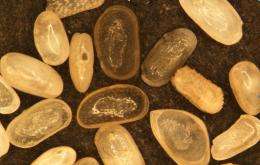
The Micropalaeontology team at the Department of Stratigraphy and Palaeontology at the University of the Basque Country (Spain) is working on the study of microfossils under the direction of Mr Julio Rodríguez Lázaro. The concentrations of these types of fossils and the composition of their shells can provide much information about the conditions of life thousands or even millions of years ago. These microfossils once belonged to aquatic organisms and their analysis enables a knowledge of past ocean and lake characteristics to be gained - data that is highly significant in the study of climate change.
Microfossils are found in rocks and are very abundant. Samples are gathered, the species are identified and the geochemical analysis of their shells is undertaken, which enable the characteristics of the water in which these organisms lived to be identified. The UPV/EHU team has been collaborating for many years with a research team from Bordeaux (France) and mainly works with foraminiferes and ostracods. These organisms have inhabited the planet for many millions of years, in such a way that the variations observed within their populations help to describe environmental situations in the past.
The present is the key to the past
But, to understand what happened to these organisms in the past, it is necessary to know how they live today. To this end, current samples are gathered and where and in what conditions they live are analysed. Very different zones are studied in order to know how these organisms live in very distinct situations. The UPV/EHU team worked in areas such as the Cantabrian coast, the coast of Morocco, the Atlantic coast of the United States and in oceanic waters at various places in South America, as well as with the continental waters of the river Ebro (Spain)
The data obtained in the studies were compared with samples of different layers of the ocean beds or lakes, in order to observe the changes in the distribution of the microfossils. Thus, for example, a species that can be currently observed living in cold Nordic waters appeared in great quantities in the south of the Gulf of Bizkaia during a determined period, indicating that, in that period, the waters of the Cantabrian Sea were much colder than they are now. Dating of these samples confirm that this period coincided with the last Great Ice Age and detected by the UPV/EHU team in waters of the Basque continental shelf and carbon dated (14C) at about 23,000 years.
Using this analysis and the comparison of the microfossils, the UPV/EHU team deduced changes in the natural environment and were able to interpret environmental changes taking place in the past, changes that happened in the oceans and were even able to determine where the limit was at any time between the ocean and the continent. Some of these changes produced in littoral areas have practical implications; for example, if a determined area was previously a marsh before and, thereby, subject to coastal legislation.
These studies enable the characterisation of marine registers with great detail; their interpretation enables an understanding, over a great time scale, of what the tendencies were of the cycles and where these environmental changes were going.
Study of lakes
The research work of this team was not limited to oceans, but microfossils in continental waters were also studied. In order to get to know the data provided by microfossils in more detail, they are deeply involved in a pioneering project together with the Jaume Almera Institute of Earth Sciences (ICTJA-CSIC) in Barcelona.
Given that the only trace left of these organisms when they die is their shells — its carbonate converted into fossil which has survived to the present day —, it is important to know how these shells were formed and how this formation was affected by the distinct chemical conditions of the water. To this end, they cultured samples of ostracods, gastropods and Charophyte algae in different conditions — water temperature, salinity, pH, chemical composition, etc.—, controlled by means of computer, in order to see how the shell was formed. This chemical balance determines the elements making up the shell in such a way, by extracting and analysing the quantity of a determined element in the fossils, the chemical conditions at the moment in which the organism lived can be determined. Thus, thanks to the results that this novel project provides, the chemical conditions of the waters thousands or millions of years ago can be deduced.
Source: Elhuyar Fundazioa


