Big Advantage for the Small -- Climate change influences the size of marine organisms
July 23, 2009 Big Advantage for the Small -- Climate change influences the size of marine organisms

Enlarge

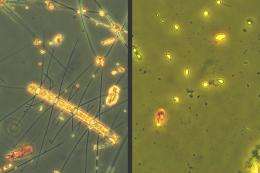
Drastical change of Phytoplankton: the left pictures shows a microscopic photo of the spring bloom on current environmental conditions. Big diatoms are dominating. With a warming of six degrees (right picture) much smaller flagellates are dominating. Photos: IFM-GEOMAR

The ice is melting, the sea level is rising and species are conquering new habitats. The warming of the world climate has many consequences. In the current issue of the renowned journal 'Proceedings of the National Academy of Sciences' researchers from the Leibniz Institute of Marine Sciences (IFM-GEOMAR) and the HYAX Lake Ecosystem Laboratory in Aix-en-Provence (Germany) report that climate change influences the size of aquatic organisms.

For a long time scientists have observed the biological consequences of . One of the most famous symptoms is the shift of habitats from the equator further north or further south. More recent studies show that not only the habitats but also the size of organisms is affected. Dr. Martin Daufresne of the HYAX Lake Ecosystem Laboratory in Aix-en-Provence, France, as well as Prof. Ulrich Sommer and Dr. Kathrin Lengfellner of the Leibniz-Institute of Marine Sciences (IFM-GEOMAR) in Kiel have proved that global warming leads to reduced body size of organisms in the ocean and in freshwater. Very different organisms showed this tendency: bacteria, plankton-algae, zooplankton and fishes in the North and and in French rivers.

Three mechanisms seem to play a role in this process. First: The proportion of smaller species grows. Second: The proportion of smaller individuals grows within one species. And third: The animals reach with smaller body size.

“This development affects the functioning of the whole eco-system: The body size is decisive for what animals can eat and by whom they are eaten. A shift to smaller species and individuals within the could lead to a reduction of zooplankton because small fish will eat less fish and more zooplankton. This could pave the way fvor massive and unpleasant . Furthermore, with smaller fish the economic value of fishery declines”, explains Prof. Sommer.
 
The bacteria, algae and zooplankton were examined in experiments of Baltic Sea plankton as part of the German Research Foundation-programme AQUASHIFT. The results about fish size are based on long term measurements in the North Sea, the Baltic and in French Rivers.

More information: Daufresne M, Lengfellner K, Sommer U (2009) Global warming benefits the small in aquatic ecosystems. PNAS Early edition; doi: 10.1073/pnas.0902080106

Source: Leibniz Institute of Marine Sciences


print this article email this article download pdf blog this article bookmark this article     Stumble it Digg this share on Facebook retweet share on Reddit add to delicious
Rate this story - 2.5 /5 (2 votes)


July 23, 2009 all stories

Comments: 0

2.5 /5 (2 votes)
  • Stumble this up

  • Digg this

  • share this

  • hide
  • Related Stories

  • Greenhouse ocean may downsize fish
    created Jan 11, 2008 | popularity not rated yet | comments 0
  • Climate Change Alters Base of Tahoe Food Web
    created Sep 29, 2008 | popularity not rated yet | comments 0
  • How fish species suffer as a result of warmer waters
    created Jan 04, 2007 | popularity not rated yet | comments 0
  • Researchers find animal with ability to survive climate change
    created Sep 24, 2008 | popularity not rated yet | comments 0
  • Harmful algae taking advantage of global warming
    created Apr 03, 2008 | popularity not rated yet | comments 0


  • hide
  • Relevant PhysicsForums posts

  • Human Leukocyte Antigen (HLA) typing
    created 5 hours ago
  • Breeding program
    created Nov 20, 2009
  • How does a concentration gradient provide energy?
    created Nov 20, 2009
  • Eyesight and Neural Damage from Electronics
    created Nov 19, 2009
  • More from Physics Forums - Biology

Other News

The Monarchs' annual migration ritual has yet to be scientifically explained

Tree-eating bugs threaten Monarch butterfly in Mexico

Biology / Ecology

created 6 hours ago | popularity 4 / 5 (1) | comments 0

The mysterious Monarch butterfly, which migrates en masse annually between Canada and Mexico, is now facing a new peril: another insect thriving in Western Mexican forests.


Extinct goat Myotragus balearicus

Extinct goat was cold-blooded

Biology / Plants & Animals

created Nov 18, 2009 | popularity 4.9 / 5 (33) | comments 10

(PhysOrg.com) -- An extinct goat that lived on a barren Mediterranean island survived for millions of years by reducing in size and by becoming cold-blooded, which has never before been discovered in mammals.


Bigger not necessarily better, when it comes to brains

Bigger not necessarily better, when it comes to brains

Biology / Plants & Animals

created Nov 17, 2009 | popularity 4.5 / 5 (17) | comments 11

(PhysOrg.com) -- Tiny insects could be as intelligent as much bigger animals, despite only having a brain the size of a pinhead, say scientists at Queen Mary, University of London.


Right-handed chimpanzees provide clues to the origin of human language

Biology / Plants & Animals

created Nov 16, 2009 | popularity 3 / 5 (1) | comments 7

Most of the linguistic functions in humans are controlled by the left cerebral hemisphere. A study of captive chimpanzees at the Yerkes National Primate Research Center (Atlanta, Georgia), reported in the January 2010 issue ...


The creature was found at a depth of 161 metres

Japanese researchers film rare baby fish 'fossil'

Biology / Plants & Animals

created Nov 17, 2009 | popularity 4.7 / 5 (7) | comments 4

Japanese marine researchers said Tuesday they had found and successfully filmed a young coelacanth -- a rare type of fish known as "a living fossil" -- in deep water off Indonesia.