Baby whale's first breath caught on camera off Australia
July 23, 2009
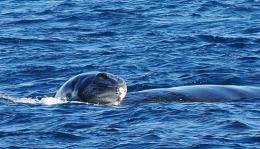
This photo received from the Centre for Whale Research in Western Australia shows a new-born humpback whale calf being lifted clear of the water to take its very first breath off Ningaloo Reef in the waters off Western Australia. Australian scientists have photographed a humpback whale helping a newborn calf take what appears to be its first breath, a rare event/
Australian scientists have photographed a humpback whale helping a newborn calf take what appears to be its first breath, a rare event described as the "Holy Grail" for whale-watchers.
The marine scientists from Western Australia's Centre for Whale Research said they watched in astonishment as the mother swam beneath the distressed baby and lifted it above the water, clearing its blowhole to take in air.
"We feel awed and privileged to have finally seen this spectacle after over 20 years of research," said scientist Curt Jenner.
The researchers said the water was full of blood, indicating the mother had just given birth on the migration route off Western Australia. They added that the "small and skinny" baby was instantly revived by its first breath.
"It was apparent that the calf was struggling to stay at the surface to breathe and was swimming around in tight, clockwise circles with only the tip of its snout protruding," said Jenner's wife and fellow scientist, Micheline.
"As soon as the cow lowered its newborn back into the water, its little tail flukes began to beat like a wind-up toy being lowered into the bath," she added.
Humpbacks are one of the largest whale species, growing up to 18 metres (60 foot) long. They are a mainstay of the whale-watching industry in Australia, which is worth an estimated 300 million dollars (246 million US) a year.
(c) 2009 AFP
-
Biologists to euthanize beached whale
Jan 01, 2008 |
not rated yet |
0
-
New study finds most North Pacific humpback whale populations rebounding
May 21, 2008 |
not rated yet |
0
-
Whale shark secrets finally revealed
Sep 26, 2005 |
not rated yet |
0
-
Photo-monitoring whale sharks
Dec 26, 2007 |
not rated yet |
0
-
Third blue whale found dead in California
Sep 23, 2007 |
not rated yet |
0
-
Engineers build first sub-10-nm carbon nanotube transistor
Feb 01, 2012 |
4.9 / 5 (33) |
30
-
Something old, something new: Evolution and the structural divergence of duplicate genes
Jan 31, 2012 |
4.6 / 5 (7) |
1
-
The hidden nanoworld of ice crystals: Revealing the dynamic behavior of quasi-liquid layers
Jan 30, 2012 |
5 / 5 (4) |
1
-
Stock market network reveals investor clustering
Jan 27, 2012 |
3.9 / 5 (23) |
8
-
Of microchemistry and molecules: Electronic microfluidic device synthesizes biocompatible probes
Jan 26, 2012 |
5 / 5 (2) |
0
-
Factors affecting beet root cell membrane
14 hours ago
-
Stem cell question.
Feb 10, 2012
-
Protease cleavage
Feb 10, 2012
-
Pertubance in a model
Feb 10, 2012
-
Cancer drugs and Alzheimer's, Oh my!
Feb 09, 2012
-
Squishing cells
Feb 09, 2012
- More from Physics Forums - Biology
More news stories
A mitosis mystery solved: How chromosomes align perfectly in a dividing cell
Although the process of mitotic cell division has been studied intensely for more than 50 years, Whitehead Institute researchers have only now solved the mystery of how cells correctly align their chromosomes during symmetric ...
11 hours ago |
4.3 / 5 (17) |
0
|
Researchers find extensive RNA editing in human transcriptome
In a new study published online in Nature Biotechnology, researchers from BGI, the world's largest genomics organization, reported the evidence of extensive RNA editing in a human cell line by analysis of RNA-seq data, demons ...
10 hours ago |
5 / 5 (4) |
0
|
The proteins ensuring genome protection
Researchers from the University of Geneva (UNIGE), Switzerland, have discovered the crucial role of two proteins in developing a cell 'anti-enzyme shield'. This protection system, which operates at the level of molecular ...
11 hours ago |
5 / 5 (3) |
0
|
Entire genome of extinct human decoded from fossil
(PhysOrg.com) -- In 2010, Svante Pääbo and his colleagues presented a draft version of the genome from a small fragment of a human finger bone discovered in Denisova Cave in southern Siberia. The ...
Feb 07, 2012 |
4.7 / 5 (60) |
51
|
Why are there so few fish in the Earth's oceans?
(PhysOrg.com) -- A Stony Brook University researcher has found that, contrary to popular belief, there are not plenty of fish in the sea.
Feb 08, 2012 |
4.3 / 5 (19) |
27
|
Scientists discover molecular secrets of 2,000-year-old Chinese herbal remedy
For roughly two thousand years, Chinese herbalists have treated Malaria using a root extract, commonly known as Chang Shan, from a type of hydrangea that grows in Tibet and Nepal. More recent studies suggest that halofuginone, ...
New method to examine batteries -- MRI from the inside
There is an ever-increasing need for advanced batteries for portable electronics, such as phones, cameras, and music players, but also to power electric vehicles and to facilitate the distribution and storage of energy derived ...
Google might launch Drive for cloud storage soon
(PhysOrg.com) -- Google's next big move, according to the Wall Street Journal, is a cloud storage service called Drive. Hardly first to the plate, Google is simply catching up to introducing its cloud reposi ...
Lab study raises questions over nano-particle impact
Tests involving chickens have raised questions about the impact on health from engineered nano-particles, the ultra-fine grains commonly used in drugs and processed foods, scientists said on Sunday.
Starve a virus, feed a cure? Findings show how some cells protect themselves against HIV
A protein that protects some of our immune cells from the most common and virulent form of HIV works by starving the virus of the molecular building blocks that it needs to replicate, according to research published online ...
Overeating may double risk of memory loss
New research suggests that consuming between 2,100 and 6,000 calories per day may double the risk of memory loss, or mild cognitive impairment (MCI), among people age 70 and older. The study was released today and will be ...