NASA celebrates Chandra X-Ray Observatory's 10th anniversary (w/ Video)
July 23, 2009
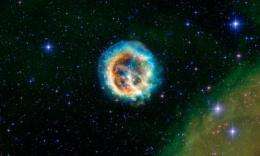
To commemorate the 10th anniversary of Chandra, this new image of the supernova remnant known as E0102 is being released. First observed with Chandra shortly after its launch in 1999, this new version gives astronomers a much more detailed look at the debris of this exploded star. Credit: X-ray: NASA/CXC/MIT/D.Dewey et al. & NASA/CXC/SAO/J.DePasquale; Optical: NASA/STScI
Ten years ago, on July 23, 1999, NASA's Chandra X-ray Observatory was launched aboard the space shuttle Columbia and deployed into orbit. Chandra has doubled its original five-year mission, ushering in an unprecedented decade of discovery for the high-energy universe.
With its unrivaled ability to create high-resolution X- ray images, Chandra has enabled astronomers to investigate phenomena as diverse as comets, black holes, dark matter and dark energy.
"Chandra's discoveries are truly astonishing and have made dramatic changes to our understanding of the universe and its constituents," said Martin Weisskopf, Chandra project scientist at NASA's Marshall Space Flight Center in Huntsville, Ala.
This video is not supported by your browser at this time.
This motion graphic combines images of the supernova remnant E0102 with an animation of a three dimensional model for this object. It begins with the Chandra X-ray image of E0102, then dissolves to a so-called "velocity map" that shows material moving away from us (in red) and towards us (in blue). A cylinder-shaped model for E0102 is then shown, along with two smaller, faster moving regions. The model then dissolves back into the velocity map and the Chandra data. Credit: NASA/STScI/G.Bacon; X-ray: NASA/CXC/MIT/D.Dewey et al. & NASA/CXC/SAO/J.DePasquale
The science that has been generated by Chandra -- both on its own and in conjunction with other telescopes in space and on the ground -- has had a widespread, transformative impact on 21st century astrophysics. Chandra has provided the strongest evidence yet that dark matter must exist. It has independently confirmed the existence of dark energy and made spectacular images of titanic explosions produced by matter swirling toward supermassive black holes.To commemorate the 10th anniversary of Chandra, three new versions of classic Chandra images will be released during the next three months. These images, the first of which is available Thursday, provide new data and a more complete view of objects that Chandra observed in earlier stages of its mission. The image being released today is of E0102-72, the spectacular remains of an exploded star.
"The Great Observatories program -- of which Chandra is a major part -- shows how astronomers need as many tools as possible to tackle the big questions out there," said Ed Weiler, associate administrator of NASA's Science Mission Directorate at NASA Headquarters in Washington. NASA's other "Great Observatories" are the Hubble Space Telescope, Compton Gamma-Ray Observatory and Spitzer Space Telescope.
The next image will be released in August to highlight the anniversary of when Chandra opened up for the first time and gathered light on its detectors. The third image will be released during "Chandra's First Decade of Discovery" symposium in Boston, which begins Sept. 22.
"I am extremely proud of the tremendous team of people who worked so hard to make Chandra a success," said Harvey Tananbaum, director of the Chandra X-ray Center at the Smithsonian Astrophysical Observatory in Cambridge, Mass. "It has taken partners at NASA, industry and academia to make Chandra the crown jewel of high-energy astrophysics."
Tananbaum and Nobel Prize winner Riccardo Giacconi originally proposed Chandra to NASA in 1976. Unlike the Hubble Space Telescope, Chandra is in a highly elliptical orbit that takes it almost one third of the way to the moon, and was not designed to be serviced after it was deployed.
Marshall manages the Chandra program for NASA's Science Mission Directorate. The Smithsonian Astrophysical Observatory controls science and flight operations from the Chandra X-ray Center.
-
Dark energy, black holes and exploding stars
Aug 12, 2004 |
not rated yet |
0
-
Six Years Into Its Mission, Chandra Continues To Achieve Scientific Firsts
Aug 23, 2005 |
not rated yet |
0
-
Stars Flood Space with Gravitational Waves
May 30, 2005 |
not rated yet |
0
-
Chandra catches early phase of cosmic assembly
Aug 15, 2004 |
not rated yet |
0
-
Chandra examines Jupiter during new horizons approach
Mar 01, 2007 |
not rated yet |
0
-
Engineers build first sub-10-nm carbon nanotube transistor
Feb 01, 2012 |
4.9 / 5 (30) |
30
-
Something old, something new: Evolution and the structural divergence of duplicate genes
Jan 31, 2012 |
4.6 / 5 (7) |
1
-
The hidden nanoworld of ice crystals: Revealing the dynamic behavior of quasi-liquid layers
Jan 30, 2012 |
5 / 5 (3) |
1
-
Stock market network reveals investor clustering
Jan 27, 2012 |
3.9 / 5 (23) |
8
-
Of microchemistry and molecules: Electronic microfluidic device synthesizes biocompatible probes
Jan 26, 2012 |
5 / 5 (1) |
0
-
Titan's lack of impact craters
17 hours ago
-
Real pictures of black hole eating a star?
Feb 08, 2012
-
Hypothetical way to travel faster than light, but not technically exceed lightspeed
Feb 06, 2012
-
How do scientists monitor the Sun's activity?
Feb 05, 2012
-
Search patterns in observational studies
Feb 05, 2012
-
Derivation of Pogson's law
Feb 03, 2012
- More from Physics Forums - General Astronomy
More news stories
New views show old NASA Mars landers
(PhysOrg.com) -- The High Resolution Imaging Science Experiment (HiRISE) camera on NASA's Mars Reconnaissance Orbiter recorded a scene on Jan. 29, 2012, that includes the first color image from orbit showing ...
Space & Earth / Space Exploration
21 hours ago |
4.9 / 5 (7) |
9
|
Black holes and star formation
(PhysOrg.com) -- It has long been recognized that galaxy mergers or even close interactions can play a vital role in shaping the morphology of galaxies. One way they can do so, it is thought, is by triggering ...
20 hours ago |
4.1 / 5 (7) |
5
|
Deconstructing a mystery: What caused Snowmaggedon?
In the quiet after the storms, streets and cars had all but disappeared under piles of snow. The U.S. Postal Service suspended service for the first time in 30 years. Snow plows struggled to push the evidence ...
Space & Earth / Earth Sciences
13 hours ago |
4.7 / 5 (3) |
1
|
Ocean microbe communities changing, but long-term environmental impact is unclear
As oceans warm due to climate change, water layers will mix less and affect the microbes and plankton that pump carbon out of the atmosphere but researchers say it's still unclear whether these processes ...
Space & Earth / Earth Sciences
15 hours ago |
5 / 5 (2) |
2
|
Researchers create 3-D laser maps that show how earthquake changes landscape
Geologists have a new tool to study how earthquakes change the landscape down to a few inches, and it's giving them insight into how earthquake faults behave. In the Feb. 10 issue of the journal Science, a team ...
Space & Earth / Earth Sciences
15 hours ago |
5 / 5 (4) |
0
|
Fighting crimes against biodiversity: How to catch a killer weed
Invasive species which have the potential to destroy biodiversity and influence global change could be tracked and controlled in the same way as wanted criminals, according to new research from Queen Mary, University of London.
A novel method for simultaneously measuring blood pressure and arterial stiffness
Arterial stiffness due to is a major contributor to cardiovascular disease but is very difficult to measure. It also can influence blood pressure readings since these rely on the time taken for arteries to return to normal ...
Study finds that red blood cell transfusion decreases fatigue in women with acute postpartum anemia
In a study to be presented today at the Society for Maternal-Fetal Medicine's annual meeting, The Pregnancy Meeting , in Dallas, Texas, researchers will report findings that show that in women with acute postpartum ...
Study weighs risks and benefits of birthing facilities
In a study to be presented today at the Society for Maternal-Fetal Medicine's annual meeting, The Pregnancy Meeting , in Dallas, Texas, researchers will report findings that indicate that the risk of obstetric intervention ...
FDA-approved drug rapidly clears amyloid from the brain, reverses Alzheimer's symptoms in mice
Neuroscientists at Case Western Reserve University School of Medicine have made a dramatic breakthrough in their efforts to find a cure for Alzheimer's disease. The researchers' findings, published in the journal Science, show t ...
'Dark plasmons' transmit energy
Microscopic channels of gold nanoparticles have the ability to transmit electromagnetic energy that starts as light and propagates via "dark plasmons," according to researchers at Rice University.
Jul 24, 2009
Rank: 1 / 5 (3)
NASA's Chandra X-ray Observatory has successfully shown that the universe is still very poorly understood.
The answer is in repulsive interactions between neutrons that is recorded in rest mass data of the 3,000 types of atoms that comprise the entire visible universe.
Unfortunately, scientists at the Smithsonian Astrophysical Observatory are instead looking for the answer in imaginary invisible dark matter.
With kind regards,
Oliver K. Manuel
http://myprofile....anuelo09