Circus performer's flight preview steals NASA show
July 23, 2009 By MARCIA DUNN , AP Aerospace Writer
Cirque du Soleil founder steals space show (AP)

Enlarge

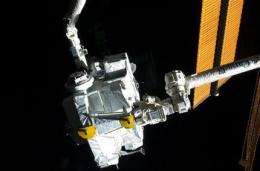
In this image provided by NASA the Japanese Logistics Module is handed over from Endeavour's remote manipulator system to the space station's remote manipulator system during unberthing and mating operations Tuesday July 21, 2009. (AP Photo/NASA)

(AP) -- A former stiltwalker and fire-eater stole NASA's show Thursday, saying he'll be "like a kid in a candy store" experimenting with zero-gravity tricks on his upcoming tourist trip to the international space station.

Cirque du Soleil founder Guy Laliberte is shelling out a reported $35 million for his round-trip ticket aboard a Russian spacecraft. He will rocket into orbit from Kazakhstan at the end of September with a professional astronaut and cosmonaut, and spend more than a week at the space station.

At a news conference in Houston, as 13 people circled overhead on the shuttle-station complex, Laliberte was bombarded with questions from journalists, most of them gathered in his home country of Canada.

"As you know, I'm not a scientist. I'm not a doctor. I'm not an engineer. I'm an artist. I'm a creator, and I'll try to do and accomplish this mission with my creativity and what life has given me as a tool," said the Quebec billionaire, who turns 50 in September.

He described his life as a fairy tale and said watching men land on the moon 40 years ago this week, on a black-and-white television at a campground in the middle of the forest, taught him that all things are possible.

Laliberte assured reporters that he we will not play with any fire in space - for obvious reasons. But he hopes to try some acrobatics in weightlessness and may teach his crewmates a card trick or two.

"I don't know how we'll be using stilts up there," he said. "But I think there are a couple little things, hopefully, that I have learned in my career of street entertainer that will try to apply up there."

Laliberte said he's seen pictures of floating bottles and other items at the space station that might make for some interesting tricks. But he noted, "I think I will be more like a kid in a candy store up there, discovering things that those guys know. Because I know what I can do on Earth. But what I'm really interested, is to gain and learning what their world is."

As Laliberte talked up creativity, art and safe water for the world's poor in both English and French, astronauts 220 miles up worked to place science experiments on the new front porch of Japan's $1 billion space station lab.

The combined crews of the space station and shuttle Endeavour installed the porch last week.

Thursday's work involved using the 33-foot robot arm on the lab, Kibo - Japanese for "hope" - to install the experiments. The first to go on was an X-ray telescope for astronomical observations. Up next were a package of communication equipment and a space environment monitor for measuring atomic oxygen, cosmic dust and light particles, and their effects on electronics and other materials.

Japanese astronaut Koichi Wakata was at the controls of the lab's robot arm, being used for the first time to hoist payloads. He's been at the space station since March and will return to Earth next week aboard Endeavour.

Back in Houston at the home of Mission Control, meanwhile, Laliberte promised to announce next month the full details of his "social, poetic mission" to draw attention to the world's dwindling water supply.

The circus performer-turned-manager is at Johnson Space Center this week, along with Soyuz crewmates Jeffrey Williams and Maxim Suraev, for training in emergency procedures and familiarization with NASA equipment.

Laliberte will become the seventh space tourist, courtesy of Virginia-based Space Adventures, which brokered the deals with Russian officials. The first six were software, technology and business types, making Laliberte the first professional artist set for space.

---

On the Net:

NASA: http://www.nasa.gov/mission(underscore)pages/shuttle/main/index.html

©2009 The Associated Press. All rights reserved. This material may not be published, broadcast, rewritten or redistributed.

Filter


Move the slider to adjust rank threshold, so that you can hide some of the comments.


Display comments: newest first

showme
Jul 24, 2009

Rank: 1 / 5 (1)
I think it will be very cool to have an acrobat on the ISS. Hopefully he'll have time to learn some imaginative things to do in 0-g
Rank 4 /5 (1 vote)
Related Stories
Relevant PhysicsForums posts
  • Is Venus Slowing Down?
    created1 hour ago
  • Never ending outer space.....
    createdFeb 11, 2012
  • Neutron Star fragments?
    createdFeb 11, 2012
  • stationary or not?
    createdFeb 11, 2012
  • Scale of the Universe
    createdFeb 10, 2012
  • Titan's lack of impact craters
    createdFeb 09, 2012
  • More from Physics Forums - General Astronomy

More news stories

Planck mission steps closer to the cosmic blueprint

(PhysOrg.com) -- ESA's Planck mission has revealed that our Galaxy contains previously undiscovered islands of cold gas and a mysterious haze of microwaves. These results give scientists new treasure to mine ...

Space & Earth / Astronomy

created 2 minutes ago | popularity not rated yet | comments 0 | with audio podcast

Scientists drill two miles down to ancient Lake Vostok

(PhysOrg.com) -- Russian scientists last week finished penetrating more than two miles through the Antarctic ice sheet to Lake Vostok, a huge freshwater lake that has been buried under the ice for millions ...

Space & Earth / Earth Sciences

created 1 hour ago | popularity 5 / 5 (1) | comments 0

Transforming galaxies

(PhysOrg.com) -- Many of the Universe's galaxies are like our own, displaying beautiful spiral arms wrapping around a bright nucleus. Examples in this stunning image, taken with the Wide Field Camera 3 on ...

Space & Earth / Astronomy

created 1 hour ago | popularity 5 / 5 (1) | comments 0 | with audio podcast

New European rocket lifts off on maiden flight

Europe on Monday successfully launched a new lightweight rocket carrying a test payload, culminating a more than 12-year quest to master the entire range of space launchers.

Space & Earth / Space Exploration

created 3 hours ago | popularity 5 / 5 (5) | comments 2

Alien matter in the solar system: A galactic mismatch

This just in: The Solar System is different from the space just outside it.

Space & Earth / Space Exploration

created 1 hour ago | popularity 4 / 5 (5) | comments 6 | with audio podcast


Fast photon control brings quantum photonic technologies closer

(PhysOrg.com) -- Using photons instead of electrons to transmit information could lead to faster and more secure ways to communicate, among other advantages. Now a team of physicists has taken another step toward realizing ...

New ability to regrow blood vessels holds promise for treatment of heart disease

(Medical Xpress) -- University of Texas at Austin researchers have demonstrated a new and more effective method for regrowing blood vessels in the heart and limbs — a research advancement that could have ...

Nanostructured electrodes for rechargeable sodium-Ion batteries

Highly efficient 3V cathodes for rechargeable sodium-ion batteries have been developed by users from Argonne National Laboratory's Materials Science, Chemical Sciences & Engineering, and X-ray Sciences Divisions, ...

A lost world? How zooarchaeology can inform biodiversity conservation

A new study of tropical forests will provide a 50,000-year perspective on how animal biodiversity has changed, explored through an archaeological investigation of animal bones.

Myths and shame keep many from seeking bankruptcy protection

(PhysOrg.com) -- Two interesting facts that may counter modern ideas about bankruptcy: The overwhelming majority of U.S. filings belong to individuals rather than corporations or entities, and most of these ...

Teaching teens safety in the virtual world

A new cyber safety program on the dangers of social networking is being developed by Flinders University, in light of an alarming report which shows children as young as 12 are meeting internet strangers in ...