Silicon with afterburners: New process could be boon to electronics manufacturer
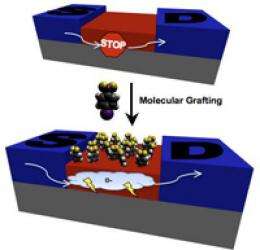
Scientists at Rice University and North Carolina State University have found a method of attaching molecules to semiconducting silicon that may help manufacturers reach beyond the current limits of Moore's Law as they make microprocessors both smaller and more powerful.
Their findings are published this month by the Journal of the American Chemical Society.
Moore's Law, suggested by Intel co-founder Gordon Moore in 1965, said the number of transistors that can be placed on an integrated circuit doubles about every two years. But even Moore has said the law cannot be sustained indefinitely.
The challenge is to get past the limits of doping, a process that has been essential to creating the silicon substrate that is at the heart of all modern integrated circuits, said James Tour, Rice's Chao Professor of Chemistry and professor of mechanical engineering and materials science and of computer science.
Doping introduces impurities into pure crystalline silicon as a way of tuning microscopic circuits to a particular need, and it's been effective so far even in concentrations as small as one atom of boron, arsenic or phosphorus per 100 million of silicon.
But as manufacturers pack more transistors onto integrated circuits by making the circuits ever smaller, doping gets problematic.
"When silicon gets really small, down to the nanoscale, you get structures that essentially have very little volume," Tour said. "You have to put dopant atoms in silicon for it to work as a semiconductor, but now, devices are so small you get inhomogeneities. You may have a few more dopant atoms in this device than in that one, so the irregularities between them become profound."
Manufacturers who put billions of devices on a single chip need them all to work the same way, but that becomes more difficult with the size of a state-of-the-art circuit at 45 nanometers wide -- a human hair is about 100,000 nanometers wide -- and smaller ones on the way.
The paper suggests that monolayer molecular grafting -- basically, attaching molecules to the surface of the silicon rather than mixing them in -- essentially serves the same function as doping, but works better at the nanometer scale. "We call it silicon with afterburners," Tour said. "We're putting an even layer of molecules on the surface. These are not doping in the same way traditional dopants do, but they're effectively doing the same thing."
Tour said years of research into molecular computing with an eye toward replacing silicon has yielded little fruit. "It's hard to compete with something that has trillions of dollars and millions of person-years invested into it. So we decided it would be good to complement silicon, rather than try to supplant it."
He anticipates wide industry interest in the process, in which carbon molecules could be bonded with silicon either through a chemical bath or evaporation. "This is a nice entry point for molecules into the silicon industry. We can go to a manufacturer and say, 'Let us make your fabrication line work for you longer. Let us complement what you have.'
"This gives the Intels and the Microns and the Samsungs of the world another tool to try, and I guarantee you they'll be trying this."
More information: The paper, "Controllable Molecular Modulation of Conductivity in Silicon-Based Devices," was authored by Tour and his team of graduate student David Corley and former postdoctoral students Tao He, Meng Lu and Jianli He, along with Neil Halen Di Spigna, David Nackashi and Paul Franzon of North Carolina State University. The paper is online at pubs.acs.org/doi/abs/10.1021/ja9002537 .
Source: Rice University (news : web)


