Parasites keep things sexy in 'hotspots'
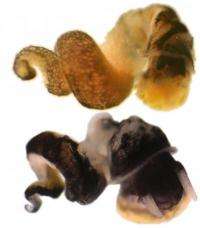
The coevolutionary struggle between a New Zealand snail and its worm parasite makes sex advantageous for the snail, whose females favor asexual reproduction in the absence of parasites, say Indiana University Bloomington and Swiss Federal Institute of Technology biologists in this week's Current Biology.
The scientists' report represents direct experimental evidence for the "Red Queen Hypothesis" of sex, which suggests sexual reproduction allows host species to avoid infection by their coevolving parasites by producing genetically variable offspring.
"We have shown that parasites can play a role in the maintenance of sex -- and on an incredibly small scale," said Kayla King, IU Biology Ph.D. student and lead author of the paper. "The females that reproduce asexually aren't as exposed to the parasites, and are just a few meters away."
The Current Biology report also supports the "Geographic Mosaic Theory," which says natural selection need not act uniformly on all members of a species, but can be intense in pockets of a population (hot spots) and absent elsewhere (cold spots).
"Asexual females can have a very large reproductive advantage, as all the individuals in the clone can directly produce offspring," said IU evolutionary biologist and coauthor Curt Lively, who has been working on the system for 25 years. "So evolutionary biologists have long wondered why clonal reproduction does not replace sexual reproduction in natural populations. Our studies suggest that interactions with parasites might be part of the answer, because genetically variable sexual individuals might be more likely to escape infection."
The biologists examined Potamopyrgus antipodarum, a common freshwater snail, in Lake Alexandrina and Lake Kaniere on New Zealand's South Island. The two lakes are on opposite sides of the Southern Alps mountain range, so the researchers assume that neither the worms nor the snails exchange genetic material between the lakes.
The snail's parasite, a genus of trematode worms called Microphallus, can be found in both Alexandrina and Kaniere lakes, as well as a third lake, Poerua. The worms' eggs are ingested by the snails. Once inside, the eggs hatch and worm larvae reproduce within the snail, causing infertility. Ducks that live on the lakes scavenge for food at the lakes' periphery, where the water is shallow. The ducks consume infected snails, but are not, as far as the scientists can tell, adversely affected by the worms. Inside the ducks' enteric tracts, the worms reach adulthood and mate. The worms' eggs are excreted in the ducks' spoor, which often lands in the lake and sinks in the shallows or at depth, where snails help the worm complete its life cycle by eating the eggs and providing a host for the next generation of worm larvae.
The scientists observed that the snails at Alexandrina and Kaniere were more likely to reproduce sexually in the lakes' shallows, where ducks can feed, rather than at depth, where ducks rarely go and where parasites are less common.
"The parasite can infect both sexual and asexual snails," said IU evolutionary biologist Lynda Delph, who also coauthored the Current Biology report. "What matters here is the fact that the parasite can't complete its life cycle in the deeper parts of the lakes because the ducks only forage in the shallow-water margins of the lake."
Sexual reproduction is clearly favored in the lakes' shallows, but why? To test whether worm parasites play a key role in the maintenance of the snails' selective sexual reproduction, the researchers devised an elegant experiment.
The scientists exposed snails from each of the two lakes to worm parasites from their native lakes, but also cross-exposed the snails from Alexandrina with worms from Kaniere, and vice versa. The researchers exposed snails from both lakes to parasites from the third lake, Poerua, as a kind of control.
The researchers learned that snails from the shallows are especially susceptible to their native worms, but extremely resistant to the infection of worms from other lakes. Furthermore, they learned snails from the same lake were far more likely to be susceptible to infection if they came from the shallows, where snails reproduce sexually, than from the depths of the lake, where the snails tend to reproduce asexually.
Despite a simple experimental design, the revelations were rich. First, higher infection rates by local worms show the snails in the shallows are in active host-parasite coevolution with their local worm parasites, but not with worms from other lakes. Second, the low susceptibility of snails to parasites from the other lakes shows snails in the shallows are not inherently susceptible to parasites, but are rather susceptible to the parasites coevolving with them. Third, higher infection rates in the shallows (Alexandrina or Kaniere) show that sexual reproduction is favored in the presence of coevolving parasites, and not in their absence.
Source: Indiana University


