Chemists make liquid protein
July 23, 2009 Bristol chemists make liquid protein

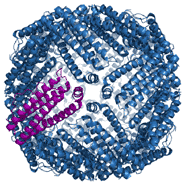
Ferritin is a globular protein complex consisting of 24 protein subunits and is the primary intracellular iron-storage protein.

(PhysOrg.com) -- The first known example of a liquid protein has been made by chemists at the University of Bristol opening up the possibility of a number of medical and industrial applications including high-potency pharmaceuticals and protein-based coolants and lubricants.

Professor Stephen Mann and Dr Adam Perriman of the University’s School of Chemistry, along with Helmut Cölfen of the Max Planck Institute for Colloid and Interface Research in Germany, have made a liquid form of the iron storage protein, ferritin. Their technique modifies the surface of the protein so that it melts into a viscous liquid.

The Bristol team attached positively charged amine groups to the surface of the ferritin, which then acted as binding sites for electrostatic attachment of a negatively charged polymer surfactant, creating proteins that bristle with long hairs. This ferritin-polymer composite forms a solid that melts at around 30°C to a liquid crystal with an orderly orientation of particles. When heated to 50°C, the liquid appears to act like an ordinary fluid, with disorder in the positions and orientations of particles.

The work has just been published in the chemistry journal, , and preliminary results on other proteins such as haemoglobin and myoglobin - proteins that carrying oxygen around the body - indicate that the method may be of general application.

The liquid protein is more highly concentrated than a protein dissolved in water which means that higher doses of medically useful proteins could be administered, for example in new wound dressing treatments which could deliver oxygen more efficiently to a wound in order to promote healing. Enzymes that break apart other proteins could also be used to clear wounds of debris from dead cells.

Professor Mann said: “This is a very exciting result with fundamental significance for understanding liquids comprising nanostructured components. Also, it represents a possible way forward to a novel state of biomolecular matter, and could therefore have a number of important applications. We hope to explore some of these - for example in biomedical and sensor technology - over the next five years or so.”

Provided by University of Bristol (news : web)


print this article email this article download pdf blog this article bookmark this article     Stumble it Digg this share on Facebook retweet share on Reddit add to delicious
Rate this story - 4.8 /5 (4 votes)


July 23, 2009 all stories

Comments: 0

4.8 /5 (4 votes)
  • Stumble this up

  • Digg this

  • share this

  • hide
  • Related Stories

  • Protein Cage Helps Nanoparticles Target Tumors
    created Jan 17, 2007 | popularity not rated yet | comments 0
  • RESEARCHERS USING PROTEINS TO DEVELOP NANOPARTICLES TO AID IN ENVIRONMENTAL REMEDIATION
    created Aug 26, 2004 | popularity not rated yet | comments 0
  • Nanoparticles Double Their Chances of Getting Into Sticky Situations
    created Feb 16, 2009 | popularity not rated yet | comments 0
  • Scientists discover novel way to remove iron from ferritin
    created Nov 02, 2007 | popularity not rated yet | comments 0
  • Scientist Creates Liquid Crystals with High Metal Content
    created Apr 03, 2006 | popularity not rated yet | comments 0


  • hide
  • Relevant PhysicsForums posts

  • MO diagram of NO
    created 10 hours ago
  • limiting reagent
    created 13 hours ago
  • preparation of acetanilide
    created 13 hours ago
  • Putting every element in a box
    created Nov 25, 2009
  • More from Physics Forums - Chemistry

Other News

Sandia CR5

Machine Converts CO2 into Gasoline, Diesel, and Jet Fuel

Chemistry / Biochemistry

created Nov 23, 2009 | popularity 4.6 / 5 (31) | comments 20

(PhysOrg.com) -- Researchers at Sandia National Laboratories have built a machine that uses the sun's energy to convert carbon dioxide waste from power plants into transportation fuels such as gasoline, diesel, ...


New hydrogen-storage method discovered

New hydrogen-storage method discovered

Chemistry / Materials Science

created Nov 22, 2009 | popularity 4.3 / 5 (42) | comments 15

Scientists at the Carnegie Institution have found for the first time that high pressure can be used to make a unique hydrogen-storage material. The discovery paves the way for an entirely new way to approach ...


New chemical reaction offers opportunities for drug development

Chemistry / Biochemistry

created Nov 26, 2009 | popularity not rated yet | comments 2

Researchers led by Conway Fellow, Professor Pat Guiry have solved a chemistry problem that has stumped researchers worldwide for more than a decade. The results have earned the group the cover story of the leading scientific ...


Research sheds light on workings of anti-cancer drug

Chemistry / Analytical Chemistry

created Nov 26, 2009 | popularity not rated yet | comments 0

(PhysOrg.com) -- The copper sequestering drug tetrathiomolybdate (TM) has been shown in studies to be effective in the treatment of Wilson disease, a disease caused by an overload of copper, and certain metastatic cancers. ...


Chemists get custom-designed microscopic particles to self-assemble in liquid crystal

Chemists get custom-designed microscopic particles to self-assemble in liquid crystal

Chemistry / Materials Science

created Nov 25, 2009 | popularity 5 / 5 (5) | comments 0

(PhysOrg.com) -- The scientists anticipate their "LithoParticles" will have significant applications in photonics, optical communications and other areas.