Study shows strong evidence that cloud changes may exacerbate global warming
July 23, 2009
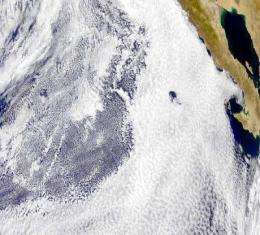
This image shows unique cloud patterns over the Pacific Ocean of the coast of Baja California, an area of great interest to Amy Clement and Robert Burgman of the University of Miami and Joel Norris of Scripps Oceanography, as they study the role of low-level clouds in climate change. Credit: NASA
The role of clouds in climate change has been a major question for decades. As the earth warms under increasing greenhouse gases, it is not known whether clouds will dissipate, letting in more of the sun's heat energy and making the earth warm even faster, or whether cloud cover will increase, blocking the Sun's rays and actually slowing down global warming.
In a study published in the July 24 issue of Science, researchers Amy Clement and Robert Burgman from the University of Miami's Rosenstiel School of Marine and Atmospheric Science and Joel Norris from Scripps Institution of Oceanography at UC San Diego begin to unravel this mystery. Using observational data collected over the last 50 years and complex climate models, the team has established that low-level stratiform clouds appear to dissipate as the ocean warms, indicating that changes in these clouds may enhance the warming of the planet.
Because of inconsistencies in historical observations, trends in cloudiness have been difficult to identify. The team broke through this cloud conundrum by removing errors from cloud records and using multiple data sources for the northeast Pacific Ocean, one of the most well-studied areas of low-level stratiform clouds in the world. The result of their analysis was a surprising degree of agreement between two multi-decade datasets that were not only independent of each other, but that employed fundamentally different measurement methods. One set consisted of collected visual observations from ships over the last 50 years, and the other was based on data collected from weather satellites.
"The agreement we found between the surface-based observations and the satellite data was almost shocking," said Clement, a professor of meteorology and physical oceanography at the University of Miami, and winner of the American Geophysical Union's 2007 Macelwane Award for her groundbreaking work on climate change. "These are subtle changes that take place over decades. It is extremely encouraging that a satellite passing miles above the earth would document the same thing as sailors looking up at a cloudy sky from the deck of a ship."
What was not so encouraging, however, was the fact that most of the state-of-the-art climate models from modeling centers around the world do not reproduce this cloud behavior. Only one, the Hadley Centre model from the U.K. Met Office, was able to reproduce the observations. "We have a long way to go in getting the models right, but the Hadley Centre model results can help point us in the right direction," said co-author Burgman, a research scientist at the University of Miami.
Together, the observations and the Hadley Centre model results provide evidence that low-level stratiform clouds, which currently shield the earth from the sun's radiation, may dissipate in warming climates, allowing the oceans to further heat up, which would then cause more cloud dissipation.
"This is somewhat of a vicious cycle potentially exacerbating global warming," said Clement. "But these findings provide a new way of looking at clouds changes. This can help to improve the simulation of clouds in climate models, which will lead to more accurate projections of future climate changes. "
One key finding in the study is that it is not the warming of the ocean alone that reduces cloudiness -- a weakening of the trade winds also appears to play a critical role. All models predict a warming ocean, but if they don't have the correct relationship between clouds and atmospheric circulation, they won't produce a realistic cloud response.
"I am optimistic that there will be major progress in understanding global cloud changes during the next several years," said Norris. "The representation of clouds in models is improving, and observational records are being reprocessed to remove spurious variability associated with satellite changes and other problems."
-
The insides of clouds may be the key to climate change
Feb 17, 2007 |
not rated yet |
0
-
NASA Study Links Severe Storm Increases, Global Warming
Dec 19, 2008 |
not rated yet |
0
-
Has global warming research misinterpreted cloud behavior?
Jun 09, 2008 |
not rated yet |
0
-
NASA Finds Polluted Clouds Hold Less Moisture & Cool Earth Less
Dec 23, 2004 |
not rated yet |
0
-
Dutch research into fair-weather clouds important in climate predictions
Dec 08, 2008 |
not rated yet |
0
-
Engineers build first sub-10-nm carbon nanotube transistor
Feb 01, 2012 |
4.9 / 5 (31) |
30
-
Something old, something new: Evolution and the structural divergence of duplicate genes
Jan 31, 2012 |
4.6 / 5 (7) |
1
-
The hidden nanoworld of ice crystals: Revealing the dynamic behavior of quasi-liquid layers
Jan 30, 2012 |
5 / 5 (3) |
1
-
Stock market network reveals investor clustering
Jan 27, 2012 |
3.9 / 5 (23) |
8
-
Of microchemistry and molecules: Electronic microfluidic device synthesizes biocompatible probes
Jan 26, 2012 |
5 / 5 (1) |
0
-
Discrepancy between oxygen and carbon-dioxide levels
18 hours ago
-
where gems are found in the world
22 hours ago
-
Wind Waves in Reservoir ~ Wind run-up and Wind set-up
Feb 08, 2012
-
Balance of oxygen in the atmosphere
Feb 01, 2012
-
The case for a methanol-based economy
Jan 30, 2012
-
Weather in a rotating cylinder
Jan 25, 2012
- More from Physics Forums - Earth
More news stories
Humans may have helped the decline of African rainforests 3000 years ago
(PhysOrg.com) -- Large areas of rainforests in Central Africa mysteriously disappeared over three thousand years ago, to be replaced by savannas. The prevailing theory has been that the cause was a change ...
Could Venus be shifting gear?
(PhysOrg.com) -- ESAs Venus Express spacecraft has discovered that our cloud-covered neighbour spins a little slower than previously measured. Peering through the dense atmosphere in the infrared, the ...
Space & Earth / Space Exploration
7 hours ago |
5 / 5 (5) |
7
|
Mars Science Laboratory computer issue resolved
(PhysOrg.com) -- Engineers have found the root cause of a computer reset that occurred two months ago on NASA's Mars Science Laboratory and have determined how to correct it.
Space & Earth / Space Exploration
8 hours ago |
5 / 5 (5) |
3
|
Clam fields found at deep, low-temperature Mariana vents
(PhysOrg.com) -- Scientists have marveled at the unusual life forms thriving at high temperature hydrothermal vents of the deep ocean.
Space & Earth / Earth Sciences
7 hours ago |
not rated yet |
0
|
Two new moons for Jupiter
Advances in technology have lead to the discovery of new planets outside of our Solar System, and now even new moons in our own backyard.
Space & Earth / Space Exploration
7 hours ago |
not rated yet |
5
Complex wiring of the nervous system may rely on a just a handful of genes and proteins
Researchers at the Salk Institute have discovered a startling feature of early brain development that helps to explain how complex neuron wiring patterns are programmed using just a handful of critical genes. ...
CIA website offline, Anonymous takes credit
The website of the Central Intelligence Agency was unresponsive on Friday after the hacker group Anonymous claimed to have knocked it offline.
Q&A: Obama and the birth control controversy
(AP) -- What birth control debate? A half-century after the introduction of the pill, acceptance of birth control by American women is virtually universal.
The power of estrogen -- male snakes attract other males
A new study has shown that boosting the estrogen levels of male garter snakes causes them to secrete the same pheromones that females use to attract suitors, and turned the males into just about the sexiest ...
New error-correcting codes guarantee the fastest possible rate of data transmission
Error-correcting codes are one of the triumphs of the digital age. Theyre a way of encoding information so that it can be transmitted across a communication channel such as an optical fiber o ...
Both maternal and paternal age linked to autism
Older maternal and paternal age are jointly associated with having a child with autism, according to a recently published study led by researchers at The University of Texas Health Science Center at Houston (UTHealth).
Jul 23, 2009
Rank: 5 / 5 (4)
Jul 23, 2009
Rank: 3 / 5 (2)
Check out photo number 19
Jul 23, 2009
Rank: 3 / 5 (2)
Jul 24, 2009
Rank: 1 / 5 (3)
(if they know clouds at all)
The research appears to identify yet another symptom, but can only suggest possible causes. Short of a major change in human behaviour, we can not isolate the environmental effects sufficiently to say which are caused by normal Earth/animal population/mineral cycles and which are caused by the (perceptibly) artificial technological processes created by humans.
Cloud cover of the oceans: Warm water melting the ice: Heat trapped in the low sky: Ice water cooling the oceans: Ocean currents changing courses: Clouds changing their formation behaviours: Solar energy variance warming the oceans: Air composition changes: Solar energy reflected from upper sky, (by clouds of water vapour and other minerals): The politics and finance of science...
Infinity Interrupted or Evolution Unimpaired?
Jul 24, 2009
Rank: 2.3 / 5 (6)
The UN IPCC models do not account for clouds properly, as documented here. They also do not account for solar variation, nor the giant oceanic cycles. Let's see some articles exploring those major areas, too.
Jul 24, 2009
Rank: 2.6 / 5 (5)
You forgot to mention geological emissions (volcanoes, geysers, erosion, etc.).
Jul 24, 2009
Rank: 3 / 5 (4)
Certainly there are serious downside risks associated with feedback loops that cause excessive heating or cooling of the planet, but in the geologic history of the planet we see these processes are rare and often self limiting. They are not as much a reason for changes in human activity as would be the approach of a massive meteor or rash of earthquakes or volcanoes.
At a minimum, delete from the article unfounded suppositions about the "cause" of global warming and restrict the discourse to explaining our ignorance about environmental processes.
Jul 25, 2009
Rank: 1 / 5 (3)
Last time I checked clouds made the earth warmer as they trap heat 24/7 vs clear skies which allow heat about 8hrs peak as the early, late daylight have much lower heating ability, the clear of 16hrs/day would let out much more than it received. Thus more cooling if clear.
One only needs to check out night time temps clear vs cloudy to comfirm this.
Also during 9-11 when jets stopped making contrails the temps changed radically by several degrees. Though it was both higher and lower as above more hours radiating out than receiving.
So folks let's be careful what you predict isn't against the facts.
Jul 25, 2009
Rank: 1 / 5 (1)
Jul 26, 2009
Rank: 5 / 5 (2)
Jul 26, 2009
Rank: 5 / 5 (3)
You're right -- they UNDERESTIMATE the warming that will be caused by clouds. Just as they underestimated the rate at which the north pole cap would melt, and the contribution of permafrost, etc. The IPCC faced a lot of unknowns, and they generally always took the more conservative (i.e. optimistic) assumption. So it's not surprising that their predictions were overly rosy.
Yes they did.
Yes they did. But I think you're referring to an article a month or two ago refining the model of the "Atlantic conveyor belt". The impact of that refinement was limited largely to regional effects (i.e. northern Europe.)
In general you're correct -- there have been refinements to make our predictions both more optimistic and more pessimistic. But on average, more pessimistic.
Oh, and I agree with you 100% about the inadequacy of any treaty or protocol which fails to reign in China and India. And for that matter, the Kyoto Protocol would be inadequate even if all countries on Earth signed it. Renewable energy is the only viable long-term solution. Kyoto is widely regarded as just a temporary stop-gap measure.
Jul 28, 2009
Rank: 1.3 / 5 (3)
Which is a nice way of saying that they cooked the data.
Jul 28, 2009
Rank: 1 / 5 (2)
Why do the proponents of AGW feel they have to be so certain that they are right when they cannot possibly know for certain that their theory is correct? If it turns out that astro-physicists like Svensmark are right, the damage done to the credibility of all these hysterical climate scientists will be irreparable.
Jul 29, 2009
Rank: 1 / 5 (2)
AGW is a hoax.
If there were an actual greenhouse effect, this year's abnormally cool summer in the mid and upper lattitudes of the US would be impossible.
If there really were a global blanketting effect caused by "greenhouse gases" then we should see the following trends worsening every year and quite literally every day of every year with little or no deviation.
1) Should break "record high overnight low temperature" for each night almost every night, and they should virtually always be "above average".
That is, every night the over night low should be "warmer than average" or even "record high" for that particular day of the year. It isn't.
2) Record daytime highs for each day of the year, almost day of every year.
3) Above average daytime high for each day of the year every year with little or no deviation.
4) All of the three trends above would be exceptionally pronounced at mid and upper lattitudes, both in northern and southern hemisphere.
===
We simply do not see these effects. The glaring example is again in North America, where the northern and mid lattitudes are experiencing exceptionally cool summer compared to average.
Jul 29, 2009
Rank: not rated yet
This is why you see the terminology shifting to "global climate change", and why the AGW/climate change rhetoric/debate needs to end.
Obviously there's not unilateral and absolute warming across the globe, the system is too complex for anything to manifest that way. Any climate change whether natural or man-made will manifest in a vast variety of ways, many potentially inconsistent with the ways mankind has come to depend on them.
And one guarantee is that climate does change. Combine this uncertainty, with the great potential for fossil fuel supplies to fall behind the growing needs of developing nations (which I'm making no statement here about timeframe, only that this too will happen), and you can see that mankind is more exposed to potential humanitarian disasters (war) as widely available water, food and energy (the very fundamentals of civilized life) will all be compromised.
In order to minimize the effect of any given climatological pattern change or energy cost elevation, in any given area, we need to develop sustainable societies. i.e. any given population unit (a household, city, state, nation, and anything inbetween) needs to be made to be more self-reliant, which has amazing beneficial implications for world-society, economy and environment.
What people need to be made to realize is that the people who have probably the best knowledge of when fossil availability is going to fall behind demand, are the same people who profit most from it (they don't want you to know, and won't let you know until it's too late to do anything except pay). And while they will want to maintain their cash-flow into any future, I can all but guarantee they will not be able to maintain supply to meet rising demand as China and India continue to develop in the coming decades, (and that they are already directing their companies towards sustainable energies should tell you it IS coming), and prices will rise probably quite quickly, probably to very uncomfortable levels for your average person.
I guess the moral of the story being we REALLY don't want to be behind the "sustainable-curve"...