Bone from Blood: Circulating Cells Form Bone Outside the Normal Skeleton, Study Finds
July 23, 2009 Bone from blood: Circulating cells form bone outside the normal skeleton, Penn study finds

Enlarge

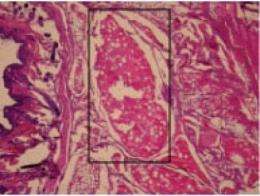
Circulating osteogenic precursor cells form bone in vivo. COP cells were transplanted into nude mice with histological sections revealing hard tissue containing osteoctyes and bone-lining cells (boxed area) eight weeks later. Credit: Robert Pignolo, MD, PhD, University of Pennsylvania School of Medicine

(PhysOrg.com) -- The accepted dogma has been that bone-forming cells, derived from the body's connective tissue, are the only cells able to form the skeleton. However, new research shows that specialized cells in the blood share a common origin with white blood cells derived from the bone marrow and that these bloodstream cells are capable of forming bone at sites distant from the original skeleton. This work, published online this month in the journal Stem Cells, represents the first example of how circulating cells may contribute to abnormal bone formation.

The discovery that circulating blood cells can form bone outside the normal was made while studying a rare genetic disease of misplaced bone growth, fibrodysplasia ossificans progressiva, or FOP.

"Identifying circulating cells with bone-forming potential in humans has important implications for FOP, as well as more common disorders where bone is formed outside the skeleton, such as in end-stage aortic valve disease, following head and spinal cord injury, and after hip and knee replacements," says senior author Robert J. Pignolo, MD, PhD, Assistant Professor of Medicine at the University of Pennsylvania School of Medicine. "This type of aberrant bone growth also occurs after severe trauma, such as blast injuries suffered by Iraqi war veterans, and its study may help us understand how bone forms after the development of the skeleton has ceased, with possible applications in bone diseases where only scarce or poor quality bone forms." Pignolo is also the Director of the Ralston-Penn Clinic for Osteoporosis & Related Bone Disorders

The researchers analyzed blood samples from patients with FOP and unaffected individuals, isolating cells that could form bone when transplanted subcutaneously into animals. The isolated cells were characterized using surface and other markers, which identified them as being derived from bone marrow. The researchers also examined tissue from FOP patients that had formed new bone, and found that these cells had migrated into the early sites of the lesion.

"This study provides an explanation for how bone-forming cells could seed sites of injury and inflammation that subsequently develop ossifications outside the skeleton," says Frederick S. Kaplan, MD, Isaac & Rose Nassau Professor of Orthopedic Molecular Medicine and Director of the Center for FOP & Related Disorders at Penn. "Dr. Pignolo and researchers in his lab demonstrated that these circulating cells are able to home to damaged tissue."

Source: University of Pennsylvania School of Medicine (news : web)


print this article email this article download pdf blog this article bookmark this article     Stumble it Digg this share on Facebook retweet share on Reddit add to delicious
Rate this story - 4 /5 (1 vote)


July 23, 2009 all stories

Comments: 0

4 /5 (1 vote)
  • Stumble this up

  • Digg this

  • share this

  • hide
  • Related Stories


  • hide
  • Relevant PhysicsForums posts

  • 23 Years in a Vegetative State....or not?
    created 21 hours ago
  • Has the H1N1 vaccine been scientifically proven to work?
    created Nov 24, 2009
  • nesfatin
    created Nov 22, 2009
  • Obsessive Compulsive Disorder
    created Nov 20, 2009
  • More from Physics Forums - Medical Sciences

Other News

Long-term testicular cancer survivors at high risk for neurological side effects

Medicine & Health / Cancer

created 59 minutes ago | popularity not rated yet | comments 0

Long-term survivors of testicular cancer who were treated with cisplatin-based chemotherapy had more severe side effects, including neurological side effects and Raynaud-like phenomena, than men who were not treated with ...


Implant-based cancer vaccine is first to eliminate tumors in mice

Implant-based cancer vaccine is first to eliminate tumors in mice

Medicine & Health / Cancer

created 8 hours ago | popularity 4.9 / 5 (15) | comments 3

(PhysOrg.com) -- A cancer vaccine carried into the body on a carefully engineered, fingernail-sized implant is the first to successfully eliminate tumors in mammals, scientists report this week in the journal ...


Brain's endocannabinoid signaling pathway kept in check by two enzymes

Medicine & Health / Research

created 5 hours ago | popularity 5 / 5 (2) | comments 0

(PhysOrg.com) -- A research team has shown that blocking the degradation of two naturally occurring cannabinoids in the endocannabinoid signaling pathway of the brain produces marijuana-like behavioral effects in mice, according ...


Scientists find emotion-like behaviors, regulated by dopamine, in fruit flies

Medicine & Health / Neuroscience

created 9 hours ago | popularity 5 / 5 (3) | comments 0

Scientists at the California Institute of Technology have uncovered evidence of a primitive emotion-like behavior in the fruit fly, Drosophila melanogaster. Their findings, which may be relevant to the relationship betwee ...


Engineers, doctors develop novel material that could help fight arterial disease

Medicine & Health / Research

created 5 hours ago | popularity not rated yet | comments 0

A fortuitous discovery that grew out of a collaboration between UCLA engineers and physicians could potentially offer hope to the nearly 10 million Americans who suffer from peripheral arterial disease.