Do Chicago’s suburbs hold the key to understanding West Nile virus?
(PhysOrg.com) -- When Tony Goldberg is not whacking through the brush of central Africa, one of the world's great cauldrons of emerging human and animal disease, he is scouring another disease hot spot: the southwestern suburbs of Chicago.
For Goldberg, an epidemiologist and a professor at the UW-Madison's School of Veterinary Medicine, the Chicago suburbs near Oak Lawn are the perfect laboratory for prying loose the secrets of West Nile virus, a pathogen carried by mosquitoes and birds that infects and sickens thousands of people each summer.
"A characteristic of West Nile virus is that it often affects people in urban and suburban settings," says Goldberg of a virus that, as its name implies, has its origins in the Old World of Africa and the Middle East. "But the pattern of disease across the urban landscape isn't uniform. It is more common in some places than others."
And Chicago — especially its suburbs like Oak Lawn, Goldberg says — seems to harbor the perfect combination of factors to give the virus an epidemiological leg up. "Chicago is one of the cities most affected by West Nile virus," says Goldberg, whose research group is scouring the lawns and thickets of Oak Lawn and surrounding areas in search of the reservoirs of disease.
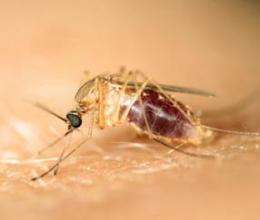
In the case of West Nile, the key players are mosquitoes and birds, which carry the virus that can cause potentially fatal encephalitis or meningitis in humans, according to Gabe Hamer, a UW-Madison postdoctoral fellow who is leading the field effort in Oak Lawn. The disease is spread to people through the bite of the mosquito, which becomes infected by feeding on birds that carry the virus.
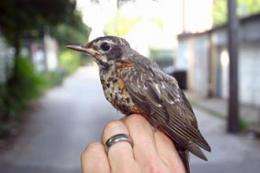
"It was found early in the discovery of West Nile virus in North America that certain bird species seemed to be important," Goldberg explains, noting that larger birds such as crows and blue jays seemed to be especially prone to infection. "It turns out that they are very susceptible to the virus, but they are not the most important species for amplifying the disease. In Chicago, there is one bird species that stands out above all others as a driver of West Nile amplification: the robin. It is the indisputable super spreader of the virus in the Chicago region."
In particular, says Goldberg, whose group is identifying blood meals of mosquitoes and using radio telemetry by mounting transmitters to robins to study their movements, it is young, recently fledged robins that seem to be the ideal hosts for the pathogen. "While they carry the virus, they seem to be more resistant to the disease than other birds, there are lots of them and they seem to be good at transmitting West Nile at just the right time of year," he says, noting that crows and jays typically die not long after infection.
Because robins can sustain the virus, they become a key reservoir of the pathogen, infecting the mosquitoes that feed on them and amplifying the cycle of infection, says Hamer.
The curious epidemiological puzzle of West Nile is that while some places in suburban Chicago seem to be hot spots for the disease, similar environments across the North American landscape have a much lower incidence of the disease.
"We see variation among cities and within cities," says Goldberg, explaining that cities such as Atlanta and Madison have many of the same environmental attributes and species affected by West Nile, but see much lower incidence of disease in people. "We see flare-ups in certain environments, but not in similar environments, or even in similar environments near a hot spot."
The goal of Goldberg's study is to ferret out the reasons why one neighborhood might be in the eye of the West Nile storm while another neighboring area is not. "We are comparing adjacent neighborhoods a few kilometers apart, which is a finer scale in urban environments than anyone has studied before," he says.
His group, which includes teams of students, postdoctoral researchers and collaborators from the University of Illinois, Michigan State University and Emory University, is tracking the movements of robins using radio transmitters and searching for their hidden nighttime roosts. They are also recording climate and weather data, as well as local patterns of vegetation, in an effort to tease out the factors that contribute to disease.
Next year, Goldberg, with the help of a group led by Ned Walker of Michigan State University, hopes to track the movement of mosquitoes across the suburban landscape using chemical isotopes found in the insects, which can pinpoint where they hatched.
The idea, says the Wisconsin researcher, is to identify the factors that cause a flare-up of disease at a particular place in time.
"If you can find those places and the reasons why disease occurs in one place and not another, that points to obvious avenues for intervention and disease prevention," argues Goldberg.
Provided by UW-Madison


