MSU scientists to design optics for new solar mission
July 24, 2009
MSU scientists to design optics for new solar mission

Enlarge

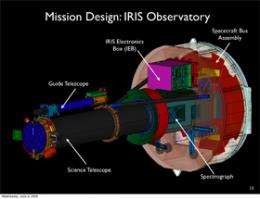
The IRIS observatory will carry an optical system developed at Montana State University. (Graphic courtesy of Charles Kankelborg).

(PhysOrg.com) -- Montana State University scientists are involved in a new space mission to figure out how energy is transferred through the sun's atmosphere.

As a partner on the IRIS team headed by Lockheed Martin, MSU will receive about $3 million to design an optical system for a telescope that could be launched on a NASA rocket in 2012, said solar physicist Charles Kankelborg. If Lockheed Martin agrees, MSU could receive another $2 million for an associated project involving MSU students.

"It is really exciting," Kankelborg said.

IRIS, short for Interface Region Imaging Spectrograph, was one of two missions that recently won NASA's Small Explorer Competition. The other was GEMS, or Gravity and Extreme Magnetism Small Explorer. When NASA announced the winners in June, it gave the go-ahead for development teams to turn IRIS and GEMS into complete missions for up to $105 million each.

The IRIS team will design its telescope to face the sun at all times, orbit the Earth at least three years and gather images from the sun's chromosphere and transition region, Kankelborg said. The sun's transition region is invisible from the ground. During a total eclipse of the sun, the chromosphere is seen as a thin red layer of atmosphere just above the bright yellow photosphere.

Dave Klumpar, director of MSU's Space Science and Engineering Laboratory, said the MSU student project, if allowed to continue, would ride on the same spacecraft as MSU's optical system. Instead of facing the sun, however, it would face away from the sun and gather information from the dust particles that scatter in space. Called the Gegenschein Imager, the instrument would be built largely by MSU undergraduates with oversight by Klumpar and Larry Springer, senior engineer and project manager for SSEL, formerly of Lockheed Martin.

"By looking at that reflected light coming off these little , we can learn a lot about how that dust gets generated, how it behaves, how it moves around, what the sources are and how it finally dissipates and if there are variations in dust distribution in time or space," Klumpar said.

The Gegenschein Imager would be about the size of a shoe box. It would include, among other things, a digital camera, electronic control box and passive shield against light and radiation, Klumpar said. He added that the project would be a "perfect opportunity for students to apply their skills, the knowledge that they get in the classroom and bring it into a real life design fabrication and operation effort that involves students from a wide variety of disciplines."

IRIS is the latest in a string of solar missions involving MSU scientists. TRACE, or Transition Region and Coronal Explorer, was the one that drew Kankelborg to MSU in 1996. The same scientist who headed that mission -- Alan Title from Lockheed Martin -- is heading the IRIS mission.

Kankelborg said Lockheed Martin scientists approached him two years ago to see if he might be interested in joining the IRIS team. After signing on, Kankelborg helped develop the concept for the mission. Nathan Pust, a postdoctoral researcher at MSU, built and tested a prototype of the optical system that would ride on IRIS.

Provided by Montana State University (news : web)

Filter


Move the slider to adjust rank threshold, so that you can hide some of the comments.


Display comments: newest first

omatumr
Jul 24, 2009

Rank: 1 / 5 (1)
THAT'S GREAT NEWS!

A better understanding of energy transfer through the Sun's atmosphere is indeed important, and I am pleased to see that Montana State University scientists will be involved.

Earth glides through the outer layer of the Sun, the heliosphere, and energy transfer there is basic to our understanding of changes in Earth's climate.

With kind regards,
Oliver K. Mnauel
Rank 5 /5 (1 vote)
Related Stories
Relevant PhysicsForums posts
  • Titan's lack of impact craters
    createdFeb 09, 2012
  • Real pictures of black hole eating a star?
    createdFeb 08, 2012
  • Hypothetical way to travel faster than light, but not technically exceed lightspeed
    createdFeb 06, 2012
  • How do scientists monitor the Sun's activity?
    createdFeb 05, 2012
  • Search patterns in observational studies
    createdFeb 05, 2012
  • Derivation of Pogson's law
    createdFeb 03, 2012
  • More from Physics Forums - General Astronomy

More news stories

Could Venus be shifting gear?

(PhysOrg.com) -- ESA’s Venus Express spacecraft has discovered that our cloud-covered neighbour spins a little slower than previously measured. Peering through the dense atmosphere in the infrared, the ...

Space & Earth / Space Exploration

created 4 hours ago | popularity 5 / 5 (4) | comments 6 | with audio podcast

Humans may have helped the decline of African rainforests 3000 years ago

(PhysOrg.com) -- Large areas of rainforests in Central Africa mysteriously disappeared over three thousand years ago, to be replaced by savannas. The prevailing theory has been that the cause was a change ...

Space & Earth / Environment

created 8 hours ago | popularity 5 / 5 (3) | comments 8 | with audio podcast report

Mars Science Laboratory computer issue resolved

(PhysOrg.com) -- Engineers have found the root cause of a computer reset that occurred two months ago on NASA's Mars Science Laboratory and have determined how to correct it.

Space & Earth / Space Exploration

created 5 hours ago | popularity 5 / 5 (5) | comments 3 | with audio podcast

Clam fields found at deep, low-temperature Mariana vents

(PhysOrg.com) -- Scientists have marveled at the unusual life forms thriving at high temperature hydrothermal vents of the deep ocean.

Space & Earth / Earth Sciences

created 4 hours ago | popularity not rated yet | comments 0 | with audio podcast

Two new moons for Jupiter

Advances in technology have lead to the discovery of new planets outside of our Solar System, and now even new moons in our own backyard.

Space & Earth / Space Exploration

created 4 hours ago | popularity not rated yet | comments 2


Hovering not hard if you're top-heavy, researchers find

Top-heavy structures are more likely to maintain their balance while hovering in the air than are those that bear a lower center of gravity, researchers at New York University's Courant Institute of Mathematical Sciences ...

Grass to gas: Researchers' genome map speeds biofuel development

Researchers at the University of Georgia have taken a major step in the ongoing effort to find sources of cleaner, renewable energy by mapping the genomes of two originator cells of Miscanthus x giganteus, a large perenn ...

Drug halts organ damage in inflammatory genetic disorder

A new study shows that Kineret (anakinra), a medication approved for the treatment of rheumatoid arthritis, is effective in stopping the progression of organ damage in people with neonatal-onset multisystem inflammatory disease ...

Cochlear implants may be safe, effective for organ transplant patients

Cochlear implants may be a safe, effective option for some organ transplant patients who've lost their hearing as an unfortunate consequence of their transplant-related drug regime, researchers report.

Researchers develop new method for creating tissue engineering scaffolds

Researchers at Northwestern University have developed a new method for creating scaffolds for tissue engineering applications, providing an alternative that is more flexible and less time-intensive than current technology.

Molecular profiling reveals differences between primary and recurrent ovarian cancers

There is a need to analyze tumor specimens at the time of ovarian cancer recurrence, according to a new study published in Molecular Cancer Therapeutics. Researchers used a diagnostic technology called molecular profiling to examine ...