What scientists know about jewel beetle shimmer
July 23, 2009
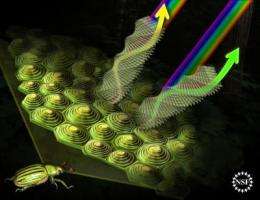
The structure of jewel beetle cells results in striking colors as light hits them from angles. Credit: Zina Deretsky, National Science Foundation
"Jewel beetles" are widely known for their glossy external skeletons that appear to change colors as the angle of view changes. Now they may be known for something else--providing a blueprint for materials that reflect light rather than absorbing it to produce colors.
Scientists at the Georgia Institute of Technology in Atlanta recently discovered jewel beetles change color because of the light-reflecting properties of the cells that make up their external skeletons, not because of unique, light-absorbing properties in their pigment. They say the finding could be important for industries such as car manufacturers that look to reflective light paints for automobiles.
The journal Science reports the finding in its July 24 issue. The National Science Foundation supports the research.
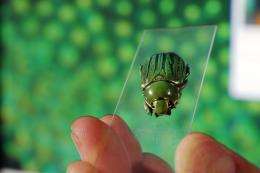
An example of the jeweled beetle used in this study, against a background closeup image of the insect’s light-reflecting structures. (Georgia Tech Photo: Gary Meek)
"The Chrysina gloriosa beetle reflects a green light," said lead researcher Mohan Srinivasarao with Georgia Tech's School of Polymer, Textile & Fiber Engineering. "This has been known for about 100 years, but we've determined the colors we see result from the beetle's physical structure rather than its biology."When light hits a surface that's difficult to see through, the surface either scatters, absorbs or reflects the light to produce colors. In the case of the jewel beetle's external skeleton, its five, six and seven sided cells spontaneously arrange themselves to reflect light at certain wavelengths that produce green, yellow and red colors.
Srinivasarao postulates that beetle cells form similar to a certain kind of liquid crystal called a 'cholesteric' liquid crystal whose free surface has cone-like structures and that has a helical arrangement of molecules.
Research suggests the cells come from spontaneous arrangement of glucose-like particles called chitin molecules that form as cones like those in a cholesteric liquid crystal. When these cones solidify, they preserve their structures and produce colors as light hits them from different angles.
The beetle's structure also forms helices similar to a cholesteric liquid crystal in that its straight cells sit on or are used to form the curved structure of its external skeleton. Research shows that when the pitch of the helix of cholesteric liquid crystals is close to the wavelength of visible light, they reflect light with specific wavelengths, leading to brilliant metallic colors.
"It's stunning how similar the two things are," said Srinivasarao.
Miniature optical devices and photonics such as those envisioned for microlasers and implantable medical sensors could benefit from the finding. Scientists already are studying ways to commercialize and apply materials that have properties similar to jewel beetles.
In one case, researchers in New Zealand are studying beetles to produce a thin, solid mineral, magnesium oxide, which can be ground into flakes and potentially used as a currency security measure.
Car companies could use the materials to paint automobiles that change color depending on a person's angle of view. More uses could include decorative paints and use on any surface requiring light reflection without light absorption.
Srinivasarao says he doesn't completely understand all the optical properties and behavior of light as it interacts with the beetle's external skeleton. He says a lot more work needs to be done, but it is something he and his team are pursuing.
Audio slideshow: http://www.nsf.gov … dia/beetles/
-
The Unusual Origin of Peacock Brown
Jun 28, 2005 |
not rated yet |
0
-
Simple Magnet Can Control Color of Liquid
Jul 03, 2007 |
not rated yet |
0
-
Beaming new light on life: From beetles to aircraft, nanoparticles aid microscope views
Feb 05, 2009 |
not rated yet |
0
-
The Photonic Beetle: Nature Builds Diamond-Like Crystals For Future Optical Computers
May 20, 2008 |
not rated yet |
0
-
Material Changes its Color, Depending on How You Look at It
Feb 04, 2008 |
not rated yet |
0
-
Engineers build first sub-10-nm carbon nanotube transistor
Feb 01, 2012 |
4.9 / 5 (32) |
30
-
Something old, something new: Evolution and the structural divergence of duplicate genes
Jan 31, 2012 |
4.6 / 5 (7) |
1
-
The hidden nanoworld of ice crystals: Revealing the dynamic behavior of quasi-liquid layers
Jan 30, 2012 |
5 / 5 (4) |
1
-
Stock market network reveals investor clustering
Jan 27, 2012 |
3.9 / 5 (23) |
8
-
Of microchemistry and molecules: Electronic microfluidic device synthesizes biocompatible probes
Jan 26, 2012 |
5 / 5 (2) |
0
-
How to determine zinc in a plant.
Feb 11, 2012
-
Stoichiometry
Feb 10, 2012
-
Boiling and melting point of impure substances
Feb 10, 2012
-
Safe nitrogen compound to decompose a 500 deg C in a furnace?
Feb 09, 2012
-
[ask]electron inside drinking water
Feb 08, 2012
-
How to avoid formation of Lithium Chromate ???
Feb 08, 2012
- More from Physics Forums - Chemistry
More news stories
Scientists discover molecular secrets of 2,000-year-old Chinese herbal remedy
For roughly two thousand years, Chinese herbalists have treated Malaria using a root extract, commonly known as Chang Shan, from a type of hydrangea that grows in Tibet and Nepal. More recent studies suggest that halofuginone, ...
2 hours ago |
5 / 5 (6) |
1
|
New method to examine batteries -- MRI from the inside
There is an ever-increasing need for advanced batteries for portable electronics, such as phones, cameras, and music players, but also to power electric vehicles and to facilitate the distribution and storage of energy derived ...
Chemistry / Analytical Chemistry
2 hours ago |
5 / 5 (2) |
0
|
Hydrogen from acidic water: Researchers develop potential low cost alternative to platinum for splitting water
A technique for creating a new molecule that structurally and chemically replicates the active part of the widely used industrial catalyst molybdenite has been developed by researchers with the Lawrence Berkeley ...
Feb 09, 2012 |
4.8 / 5 (16) |
21
|
Fool's gold may prove an unlikely alternative to overexploited catalytic materials
Catalytic materials, which lower the energy barriers for chemical reactions, are used in everything from the commercial production of chemicals to catalytic converters in car engines. However, with current catalytic materials ...
Feb 10, 2012 |
4.4 / 5 (8) |
8
|
Research provides octagonal window of opportunity for carbon capture
(PhysOrg.com) -- Filtering carbon dioxide, a greenhouse gas, from factory smokestacks is a necessary, but expensive part of many manufacturing processes. However, a collaborative research team from the National ...
Feb 08, 2012 |
5 / 5 (2) |
5
|
Lab study raises questions over nano-particle impact
Tests involving chickens have raised questions about the impact on health from engineered nano-particles, the ultra-fine grains commonly used in drugs and processed foods, scientists said on Sunday.
Google might launch Drive for cloud storage soon
(PhysOrg.com) -- Google's next big move, according to the Wall Street Journal, is a cloud storage service called Drive. Hardly first to the plate, Google is simply catching up to introducing its cloud reposi ...
A mitosis mystery solved: How chromosomes align perfectly in a dividing cell
Although the process of mitotic cell division has been studied intensely for more than 50 years, Whitehead Institute researchers have only now solved the mystery of how cells correctly align their chromosomes during symmetric ...
Starve a virus, feed a cure? Findings show how some cells protect themselves against HIV
A protein that protects some of our immune cells from the most common and virulent form of HIV works by starving the virus of the molecular building blocks that it needs to replicate, according to research published online ...
Researchers find extensive RNA editing in human transcriptome
In a new study published online in Nature Biotechnology, researchers from BGI, the world's largest genomics organization, reported the evidence of extensive RNA editing in a human cell line by analysis of RNA-seq data, demons ...
The proteins ensuring genome protection
Researchers from the University of Geneva (UNIGE), Switzerland, have discovered the crucial role of two proteins in developing a cell 'anti-enzyme shield'. This protection system, which operates at the level of molecular ...

Jul 24, 2009
Rank: not rated yet