Ancient mammal tracks found at national monument
July 24, 2009 By MIKE STARK , Associated Press Writer Ancient mammal tracks found at national monument (AP)

Enlarge

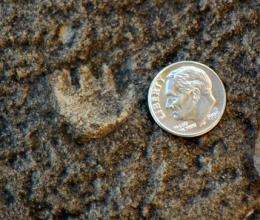
This undated photo provided by the Dinosaur National Monument shows a small fossil mammal footprint, no bigger than a dime, on the Utah-Colorado border. Hundreds of tiny footprints left by mammals some 190 million years ago have been found on a canyon wall in a remote part of Dinosaur National Monument, park officials said Thursday July 23, 2009. The tracks are a rare find, mostly because they were left at a time when the area was a hostile, vast Sahara-like desert where towering sand dunes seldom preserved signs of animal life. (AP Photo/ Dinosaur National Monument)

(AP) -- Hundreds of tiny footprints left by mammals some 190 million years ago have been found on a canyon wall in a remote part of Dinosaur National Monument, park officials said Thursday.

The tracks are a rare find, mostly because they were left at a time when the area was a hostile, vast Sahara-like desert where towering seldom preserved signs of animal life.

"It's just astonishing," Dan Chure, a at the monument, said Thursday. "We were giggling like kids."

He and paleontologist George Engelmann of the University of Nebraska at Omaha spotted the tracks July 8 while scouring the area for fossils and other evidence from the early . Dinosaur National Monument, founded because of its rich and plentiful supply of , straddles the Utah-Colorado border.

Most of the tracks are the size of a dime or smaller. A few include impressions of up to four toes. The mammals - perhaps the size of a rat - were among the few species that were able to survive between large sand dune fields where there was water, dinosaurs and a few plants, Chure said.

Because they were living in a forbidding desert environment, most animals probably came out at night, including the small mammals who left the tracks, Chure said. He said it's reasonable to assume the tracks were preserved by a layer of moisture that created a slight crust on the dune and kept the prints from blowing away.

There were likely once thousands more tracks in the area that have since been lost to erosion, Chure said.

Similar track sites have been found elsewhere, but Chure said he didn't know of any that had as many individual footprints.

It'll take more study to determine exactly what kind of left the prints behind.

Interspersed among the mammal footprints are tracks from larger animals, possibly small dinosaurs, Engelmann said.

"This was a time when the ancestors of modern mammals were losing dominance on land to the dinosaurs," Engelmann said. "It's near the beginning of a long time when ruled and our ancestors tried to stay out of the way."

Park officials aren't disclosing the exact location of the sandstone canyon wall where the tracks were found because of concerns about vandalism. The area where the tracks were found is open to the public.

The next steps will include mapping and counting the tracks and creating a cast that can be displayed at the monument's visitor center, Chure said.

The monument, which celebrates its 100th anniversary this summer, is best known for hosting the nation's premier quarry of Jurassic-period bones, some 1,500 of them.

The newly found mammal tracks predate the bones at that site by 40 million to 50 million years, Chure said.

---

On the Net:

Dinosaur National Monument: http://www.nps.gov/dino

©2009 The Associated Press. All rights reserved. This material may not be published, broadcast, rewritten or redistributed.


print this article email this article download pdf blog this article bookmark this article     Stumble it Digg this share on Facebook retweet share on Reddit add to delicious
Rate this story - 5 /5 (4 votes)


July 24, 2009 all stories

Comments: 0

5 /5 (4 votes)
  • Stumble this up

  • Digg this

  • share this

  • hide
  • Related Stories


  • hide
  • Relevant PhysicsForums posts

  • Questions about diffusion
    created 4 hours ago
  • Human Leukocyte Antigen (HLA) typing
    created 11 hours ago
  • Breeding program
    created Nov 20, 2009
  • How does a concentration gradient provide energy?
    created Nov 20, 2009
  • More from Physics Forums - Biology

Other News

Museum: Galileo's fingers, tooth are found (AP)

Museum: Galileo's fingers, tooth are found

Other Sciences / Archaeology & Fossils

created 23 hours ago | popularity 4 / 5 (1) | comments 5

(AP) -- Two fingers and a tooth removed from Galileo Galilei's corpse in a Florentine basilica in the 18th century and given up for lost have been found again and will soon be put on display, an Italian museum ...


Measure to change U. of Neb. stem-cell rule fails (AP)

Measure to change U. of Neb. stem-cell rule fails (Update 2)

Other Sciences / Other

created 23 hours ago | popularity 5 / 5 (1) | comments 0

(AP) -- The University of Nebraska's governing board on Friday voted not to place tighter restrictions on embryonic stem cell research than those outlined under federal guidelines, which were expanded after ...


Researcher: Faint writing seen on Shroud of Turin (AP)

Researcher: Faint writing seen on Shroud of Turin (Update)

Other Sciences / Archaeology & Fossils

created Nov 20, 2009 | popularity 2 / 5 (24) | comments 23

(AP) -- A Vatican researcher has rekindled the age-old debate over the Shroud of Turin, saying that faint writing on the linen proves it was the burial cloth of Jesus. Experts say the historian may be reading ...


Three of a kind

Three of a kind: Revealing language’s universal essence

Other Sciences / Social Sciences

created Nov 20, 2009 | popularity 3.9 / 5 (11) | comments 6

(PhysOrg.com) -- On the surface, English, Japanese, and Kinande, a member of the Bantu family of languages spoken in the Democratic Republic of Congo, have little in common. It is not just that the vocabularies ...


Maya

New insights into the life of the Maya

Other Sciences / Archaeology & Fossils

created Nov 16, 2009 | popularity 4.6 / 5 (15) | comments 7

(PhysOrg.com) -- Ancient artifacts are almost always concerned with rich and powerful religious and political leaders, but new excavations of an ancient Maya site have unearthed a pyramid decorated with murals ...