'Nano violin string' made of vibrating carbon nanotube (w/ Video)
July 24, 2009 'Nano violin string'

Enlarge

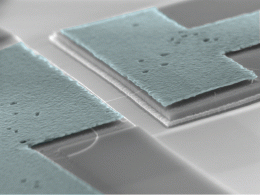
The tiny string in this electron microscope image is 800 nanometer long, which is 800 millionths of a millimeter.

Researchers at TU Delft, The Netherlands, have succeeded in measuring the influence of a single electron on a vibrating carbon nanotube. This research can be important for work such as the development of ultra-small measuring instruments.  The scientists have published their results on Thursday 23 July in the online version of the scientific journal Science.

The scientists of the Kavli Institute for at TU Delft based their project on a suspended vibrating , comparable to an ultra-small violin string. They then applied an alternating electric field to the nanotube using an antenna.

As a result of the alternating electric field, the suspended nanotube begins to vibrate at a certain frequency. Moreover, the nanotechnologists were able to vary the number of electrons on the nanotube. The number of ‘allowed’ on the nanotube causes very slight changes in the vibration behaviour of the tube. Thus the frequency at which the nanotube vibrates shifts very slightly each time an electron is added. The scientists have succeeded in charting the influence of the presence of just a single electron. The entire process took place in a measurement environment that was cooled to almost .

FLV player

When an electron is added to the nanotube, the motion of the electron hopping onto it creates a 'dip' in the measured vibration frequency. The nanotube vibrates at a rate of 140 milion times per second (Hz). For illustrative purposes that frequency is lowered here to a detectable range around 1000 Hz.

Suspended nanotubes vibrate at an extremely high frequency and thus exhibit new quantum effects. These suspended nanotubes thus form an interesting field of research; moreover, it has recently become possible to manufacture these items to a high quality.

In addition, the researchers of the Kavli Institute for Nanoscience in Delft have managed for the first time to capture a single electron in a carbon nanotube (this also led to a publication in Nature Nanotechnology). It was made possible by a new method of making ultra-clean nanotubes.

The research being conducted at TU Delft is, apart from the acquired theoretical knowledge, also important for work such as the development of NEMS (Nano Electro Mechanical Systems). These are extremely small electromechanical systems such as tiny switches and measuring instruments. NEMS are regarded as the logical successors to the slightly larger MEMS (Micro Electro Mechanical Systems) that already constitute a sector of industry that is worth billions. These MEMS are already found, for example, in the acceleration sensors of airbags in cars. In the course of time, a breakthrough to the nano-level can be expected.

The research took place at the Kavli Institute for Nanoscience at TU Delft, headed by Prof. Leo Kouwenhoven and Prof. Herre van der Zant. The primary author of the article in Science is Dr Gary Steele.

More information: Strong Coupling Between Single-Electron Tunneling and Nanomechanical Motion
G. A. Steele, A. K. Hüttel, B. Witkamp, M. Poot, H. B. Meerwaldt, L. P. Kouwenhoven, and H. S. J. van der Zant
Published online 23 July 2009 [ DOI: 10.1126/science.1176076 ] (in Science Express Reports)

Source: Delft University of Technology (news : web)


print this article email this article download pdf blog this article bookmark this article     Stumble it Digg this share on Facebook retweet share on Reddit add to delicious
Rate this story - 4.3 /5 (6 votes)

Rank Filter

Move the slider to adjust rank threshold, so that you can hide some of the comments.


Display comments: newest first

  • nuge - Jul 24, 2009
    • Rank: 5 / 5 (4)
    so, this is the famous "world's smallest violin".
  • ArtflDgr - Jul 24, 2009
    • Rank: not rated yet
    no... not the worlds smalles violin...
    its Slim pickens at the atomic scale :)
  • TJ_alberta - Jul 26, 2009
    • Rank: not rated yet
    Robert Millikan would have liked this.

July 24, 2009 all stories

Comments: 3

4.3 /5 (6 votes)
  • Stumble this up

  • Digg this

  • share this

  • hide
  • Related Stories

  • Researchers make world's smallest piano wire
    created Nov 25, 2006 | popularity not rated yet | comments 0
  • Controllable double quantum dots and Klein tunneling in nanotubes
    created May 14, 2009 | popularity not rated yet | comments 0
  • Scientists rotate electron spin with electric field
    created Nov 01, 2007 | popularity not rated yet | comments 0
  • Scientists track the influence of a cancer inhibitor on a single DNA molecule
    created Jun 25, 2007 | popularity not rated yet | comments 0
  • Researchers shine light on atomic transistor
    created Nov 22, 2006 | popularity not rated yet | comments 0


  • hide
  • Relevant PhysicsForums posts

  • Physicists in survival situation
    created 3 hours ago
  • Magnetic Oscillation Equations
    created 3 hours ago
  • US Physics Test Eligibility
    created 4 hours ago
  • Are Active Noise Control Stereo Possible?
    created 9 hours ago
  • More from Physics Forums - General Physics

Other News

Using superconducting probes to get a picture of what it's like inside CNTs

Nanotechnology / Nanophysics

created 20 hours ago | popularity 4.8 / 5 (6) | comments 0

(PhysOrg.com) -- "Carbon nanotubes are exciting for fundamental physics, and for potential technological applications," Nadya Mason tells PhysOrg.com. "However, we are generally limited in the way that we can study them. ...


When It Comes to Drug Delivery, Size Matters

Nanotechnology / Bio & Medicine

created 23 hours ago | popularity 5 / 5 (1) | comments 0

(PhysOrg.com) -- One of the great promises of nanotechnologies lies in its ability to create drug-containing nanoparticles decorated with targeting molecules that recognize and bind to cancer cells, providing drug delivery ...


Nanoparticles used in common household items caused genetic damage in mice

Nanotechnology / Bio & Medicine

created Nov 16, 2009 | popularity 4.7 / 5 (22) | comments 11

Titanium dioxide (TiO2) nanoparticles, found in everything from cosmetics to sunscreen to paint to vitamins, caused systemic genetic damage in mice, according to a comprehensive study conducted by researchers at UCLA's Jonsson ...


Nanotube defects equal better energy and storage systems

Nanotube defects equal better energy and storage systems

Nanotechnology / Nanomaterials

created Nov 19, 2009 | popularity 4.4 / 5 (9) | comments 2

(PhysOrg.com) -- Most people would like to be able to charge their cell phones and other personal electronics quickly and not too often. A recent discovery made by UC San Diego engineers could lead to carbon ...


Scientists synthesize graphene-like material: Polymer with honeycomb structure

Scientists synthesize graphene-like material: Polymer with honeycomb structure

Nanotechnology / Nanomaterials

created Nov 19, 2009 | popularity 4.5 / 5 (6) | comments 1

Two-dimensional carbon layers, so-called graphenes, are regarded as a possible substitute for silicon in the semiconductor industry. The electronic properties of these layers can be varied by "building in" ...