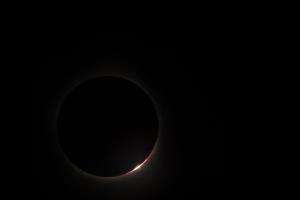
Images of Solar Eclipse as seen by Hinode Satellite
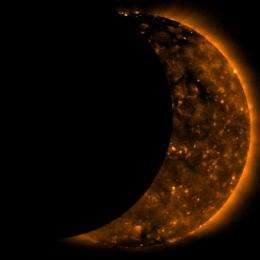
July 24, 2009 Images of Solar Eclipse as seen by Hinode Satellite

Enlarge

The Hinode satellite observing our sun captured images of the moon traversing the face of the sun during a solar eclipse this week.

On Wednesday, July 22, 2009, a total eclipse of the was visible from within a narrow corridor that traverses half of Earth. The path of the Moon's umbral shadow began in India and crossed through Nepal, Bangladesh, Bhutan, Myanmar and China. After leaving mainland Asia, the path crossed Japan's Ryukyu Islands and curved southeast through the Pacific Ocean where the maximum duration of totality reached 6 minutes and 39 seconds.

A partial eclipse is seen within the much broader path of the Moon's penumbral shadow, which includes most of eastern Asia, Indonesia, and the Pacific Ocean.
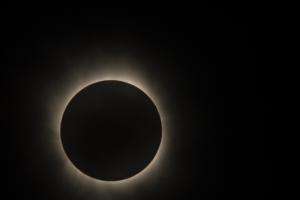
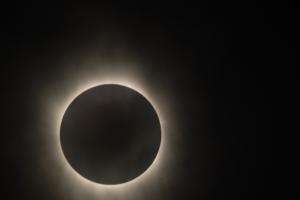
Images of Solar Eclipse as seen by Hinode Satellite
Enlarge


Images of Solar Eclipse as seen by Hinode Satellite
Enlarge


Images of Solar Eclipse as seen by Hinode Satellite
Enlarge


Provided by JPL/ (news : web)


print this article email this article download pdf blog this article bookmark this article     Stumble it Digg this share on Facebook retweet share on Reddit add to delicious
Rate this story - 4.5 /5 (4 votes)

Rank Filter

Move the slider to adjust rank threshold, so that you can hide some of the comments.


Display comments: newest first

  • omatumr - Jul 24, 2009
    • Rank: 1 / 5 (1)
    THE QUIET SUN

    The eclipse images show how quiet the solar surface is between solar cycles #23 and #24!

    With kind regards,
    Oliver K. Manuel
  • deatopmg - Jul 26, 2009
    • Rank: not rated yet
    @OKM
    YES BUT, #24 is about to start...in May,... ok, in June,.... uh, for sure in July,...no really, in August....
  • omatumr - Jul 27, 2009
    • Rank: 1 / 5 (2)
    Yes, indeed!

    God definitely has a sense sense of humor.

    All is well, if we don't take ourselves too seriously
    Oliver K. Manuel


  • RayCherry - Jul 27, 2009
    • Rank: not rated yet
    This eclipse was reported as being the longest lasting, the biggest and the most obscuring for hundreds of years.

    I think that has been accounted for by the cycle of the moon's distance from Earth, and the fact that the moon is closer during this eclipse. Therefore, the moon appeared to obscure more of the sun, and for a longer period.

    With this understanding, how can the apparent 'activity' of the surface of the sun during this eclipse be compared with that of other recent eclipses?

    When the moon is further from Earth and passes in front of the sun, doesn't the sun look more active?

    Relax ... we are all aware that the weather on the sun is not as predicted, but let's not use these eclipse photos as 'more evidence' when no more evidence is required, and this eclipse evidence is misleading.

    Also remember, learning about the sun's weather can not be expected to take less time than learning about Earth's weather ... and we have a long way to go on that subject.

    As for the links between the two ... I think less solar activity could provide a small extra window for correcting our climate maintenance policies.
  • jus10 - Jul 28, 2009
    • Rank: not rated yet
    @Ray...

    Did someone have a case of 'the Mondays'?? lol.

July 24, 2009 all stories

Comments: 5

4.5 /5 (4 votes)
  • Stumble this up

  • Digg this

  • share this

  • hide
  • Related Stories

  • See Total Solar Eclipse Tomorrow in a Different Light
    created Mar 28, 2006 | popularity not rated yet | comments 0
  • Annular Solar Eclipse On October 03
    created Sep 29, 2005 | popularity not rated yet | comments 0
  • Partial Solar Eclipse visible from the UK on the morning of 1st August
    created Jul 25, 2008 | popularity not rated yet | comments 0
  • Total Lunar Eclipse on October 27
    created Oct 03, 2004 | popularity not rated yet | comments 0
  • Longest Solar Eclipse of the 21st Century
    created Jul 21, 2009 | popularity not rated yet | comments 0


  • hide
  • Relevant PhysicsForums posts

  • Sideral question
    created Nov 21, 2009
  • Doppler shifted blackbody spectrum
    created Nov 21, 2009
  • Earth v. Moon
    created Nov 21, 2009
  • help me with coordinates and orbits
    created Nov 21, 2009
  • More from Physics Forums - General Astronomy

Other News

The shore of Deception Island in Antarctica, in 2008

Antarctic ice loss vaster, faster than thought: study

Space & Earth / Earth Sciences

created 3 hours ago | popularity 4 / 5 (5) | comments 3

The East Antarctic icesheet, once seen as largely unaffected by global warming, has lost billions of tonnes of ice since 2006 and could boost sea levels in the future, according to a new study.


Astronaut's baby daughter born as he circles Earth (AP)

Astronaut's baby daughter born as he circles Earth

Space & Earth / Space Exploration

created 3 hours ago | popularity not rated yet | comments 0

(AP) -- Astronaut Randolph Bresnik jubilantly welcomed his new daughter into the world Sunday as he floated 220 miles above it.


Denmark: 65 world leaders for UN climate summit (AP)

Denmark: 65 world leaders for UN climate summit

Space & Earth / Environment

created 3 hours ago | popularity not rated yet | comments 0

(AP) -- Sixty-five world leaders have said they will attend the Copenhagen climate summit in December, and several more have responded positively to invitations, Danish officials said Sunday.


Commuters wait on the platform shrouded by fog in London

Climate change not man-made, say majority of Britons: poll

Space & Earth / Environment

created Nov 15, 2009 | popularity 3.3 / 5 (15) | comments 46

Less than half of Britons believes that human activity is to blame for global warming, according to a poll carried out for The Times newspaper and published on Saturday.


Mysteriously warm times in Antarctica

Mysteriously warm times in Antarctica

Space & Earth / Earth Sciences

created Nov 18, 2009 | popularity 4.2 / 5 (21) | comments 31

(PhysOrg.com) -- A new study of Antarctica's past climate reveals that temperatures during the warm periods between ice ages (interglacials) may have been higher than previously thought. The latest analysis ...