Hollywood places biggest 3-D bet yet on 'Avatar'
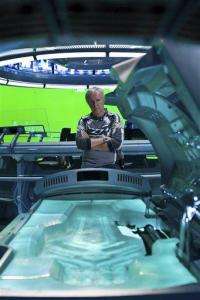
(AP) -- When James Cameron directed his first 3-D film, "Terminator 2: 3-D," for Universal Studios theme parks more than a decade ago, the bulky camera equipment made some shots awkward or impossible.
The 450-pound contraption - which had two film cameras mounted on a metal frame - was so heavy that producers had to jury-rig construction equipment to lift it off the ground for shots from above. The cameras, slightly set apart, had to be mechanically pointed together at the subject, then locked into place like an unwieldy set of eyes to help create the 3-D effect.
At $60 million, the 12-minute film was the most expensive frame-for-frame production ever.
Now, five months from its release, Cameron's "Avatar," the first feature film he has directed since "Titanic" (1997), promises to take 3-D cinematography to an unrivaled level, using a more nimble 3-D camera system that he helped invent.
Cameron's heavily hyped return also marks Hollywood's biggest bet yet that 3-D can bolster box office returns. News Corp.'s 20th Century Fox has budgeted $237 million for the production alone of "Avatar."
The movie uses digital 3-D technology, which requires audience members to wear polarized glasses. It is a vast improvement on the sometimes headache-inducing techniques that relied on cardboard cutout glasses with red and green lenses and rose and fell in popularity in the 1950s.
"Avatar" also raises the bar on "performance capture" technology, which creates computerized images from real human action. The movie depicts an ex-soldier's interactions with 10-foot-tall aliens on the luminous planet of Pandora.
"I'm speechless," said Nahum Villalobos, a 19-year-old Navy recruit from Vista, Calif., who watched 25 minutes of exclusive footage of "Avatar" along with 6,500 people at the Comic-Con convention in San Diego on Thursday. "It's more extraordinary than any other movie that is out there, or has been."
The $237 million production is not as expensive as some 2-D fare such as "Spider-Man 3" (2007), which was made for $258 million. But it blows away "Monsters vs. Aliens" (2009), a 3-D animation movie made for $175 million.
Then again, Cameron's last film grossed $1.84 billion worldwide. "Titanic" is the highest grossing film ever.
"If you know Jim Cameron, it's all about pushing the envelope," said Vince Pace, who helped him develop the 3-D camera system used in "Avatar."
Cameron tweaked his cameras through two 3-D documentaries he made for IMAX theaters, "Ghosts of the Abyss" (2003) and "Aliens of the Deep" (2005).
His camera rig is now lighter - up to only 50 pounds - and the two camera lenses can dynamically converge on a focal point with the help of a computer, which is crucial for sweeping camera moves and action sequences.
In some of the "Avatar" footage released at Comic-Con, humans filmed with his 3-D camera rig are mixed with the computer-generated images of the movie's avatars - beings created with mixed human and alien DNA.
Cameron said he wanted to have the filmmaking techniques fade into the background as the story took over.
"The ideal movie technology is so advanced that it waves a magic wand and makes itself disappear," he said.
Cameron himself was behind the lens in many scenes that were framed using a "virtual camera" - a handheld monitor that lets the director walk through the computer-enhanced 3-D scene and record it as if he were the cameraman. The effect on screen is a "shaky cam" effect that makes action sequences seem up close and sometimes focuses the audience's gaze at something in particular.
"It allows Jim to approach this process with the same sensibilities that he would have approached live-action filming," said producer Jon Landau.
The ability to capture human emotions in computerized 3-D has also advanced.
Unlike past methods that captured dots placed on human faces to trace movements that are reconstructed digitally, now each frame is analyzed for facial details such as pores and wrinkles that help re-create a moving computerized image.
"It's all going to advance the whole concept of 3-D one leap higher," said Marty Shindler, a filmmaking consultant with The Shindler Perspective Inc.
Yet even with four years of preparation and the attention surrounding "Avatar," there will not be enough U.S. screens adapted to the technology for a full wide release only in 3-D.
Of the 38,800 movie screens in the U.S., about 2,500 are capable of showing digital 3-D movies. Theater chains have been adding about 90 to 100 per month this year, but they're still short of the 4,000-plus screens that have been used for major event movies.
With the conversion costing $100,000 a pop, theater owners are wary of moving too quickly, said Patrick Corcoran, director of media and research for the National Association of Theatre Owners.
"The successes of `Monsters vs. Aliens' and `Ice Age (Dawn of the Dinosaurs) in 3-D' aside, this is still really early days for this format," he said.
Studios are pushing theater owners to convert more screens, partly because people pay about $2 more per ticket and cram theaters for 3-D releases. Revenue per screen is up to three times higher than for the same movie's 2-D version.
Walt Disney Co.'s chief executive, Bob Iger, said this week that his studio has 17 3-D films in development, including "A Christmas Carol." That movie, directed by Robert Zemeckis, adopted many of the same performance-capture techniques used in "Avatar" but comes out a month earlier, in November.
Jovan Cohn, a 43-year-old systems engineer from Newport Beach, Calif., watched the "Avatar" preview at Comic-Con and expects to line up with his son for another free look on Aug. 21, when some IMAX theaters will show 15 minutes of the film. Cohn also plans to catch the full movie's release Dec. 18.
"It takes you into a new world of moviegoing and we really think that it's going to be a hit," he said. "No question on that. James Cameron just hit another home run."
©2009 The Associated Press. All rights reserved. This material may not be published, broadcast, rewritten or redistributed.


