Ants more rational than humans
July 24, 2009
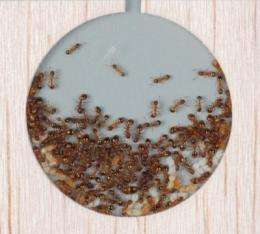
Ants are more rational collective decision makers than humans. Credit: Stephen Pratt/Arizona State University
In a study released online on July 22 in the journal Proceedings of the Royal Society: Biological Sciences, researchers at Arizona State University and Princeton University show that ants can accomplish a task more rationally than our - multimodal, egg-headed, tool-using, bipedal, opposing-thumbed - selves.
This is not the case of humans being "stupider" than ants. Humans and animals simply often make irrational choices when faced with very challenging decisions, note the study's architects Stephen Pratt and Susan Edwards.
"This paradoxical outcome is based on apparent constraint: most individual ants know of only a single option, and the colony's collective choice self-organizes from interactions among many poorly-informed ants," says Pratt, an assistant professor in the School of Life Sciences in ASU's College of Liberal Arts and Sciences.
The authors' insights arose from an examination of the process of nest selection in the ant, Temnothorax curvispinosus. These ant colonies live in small cavities, as small as an acorn, and are skillful in finding new places to roost. The challenge before the colony was to "choose" a nest, when offered two options with very similar advantages.
What the authors found is that in collective decision-making in ants, the lack of individual options translated into more accurate outcomes by minimizing the chances for individuals to make mistakes. A "wisdom of crowds" approach emerges, Pratt believes.
"Rationality in this case should be thought of as meaning that a decision-maker, who is trying to maximize something, should simply be consistent in its preferences." Pratt says. "For animals trying to maximize their fitness, for example, they should always rank options, whether these are food sources, mates, or nest sites, according to their fitness contribution."
"Which means that it would be irrational to prefer choice 'A' to 'B' on Tuesday and then to prefer 'B' to 'A' on Wednesday, if the fitness returns of the two options have not changed."
"Typically we think having many individual options, strategies and approaches are beneficial," Pratt adds, "but irrational errors are more likely to arise when individuals make direct comparisons among options."
Studies of how or why irrationality arises can give insight into cognitive mechanisms and constraints, as well as how collective decision making occurs. Insights such as Pratt's and Edward's could also translate into new approaches in the development of artificial intelligence.
"A key idea in collective robotics is that the individual robots can be relatively simple and unsophisticated, but you can still get a complex, intelligent result out of the whole group," says Pratt. "The ability to function without complex central control is really desirable in an artificial system and the idea that limitations at the individual level can actually help at the group level is potentially very useful." Pratt is a member of Heterogeneous Unmanned Networked Team (HUNT), a project funded by the Office of Naval Research (ONR) to enable to development of bio-inspired solutions to engineering problems.
What do these findings potentially say about understanding human social systems?
"It is hard to say. But it's at least worth entertaining the possibility that some strategic limitation on individual knowledge could improve the performance of a large and complex group that is trying to accomplish something collectively," Pratt says.
-
How house-hunting ants choose the best home
Apr 22, 2009 |
not rated yet |
0
-
Insects inspire robotics research
Aug 21, 2006 |
not rated yet |
0
-
Ants on the brain
Feb 25, 2009 |
not rated yet |
0
-
No place like home: Ant navigation skills used in robot navigation
Apr 04, 2006 |
not rated yet |
0
-
Can an ant be employee of the month?
Nov 18, 2008 |
not rated yet |
0
-
Fast photon control brings quantum photonic technologies closer
31 minutes ago |
5 / 5 (2) |
0
-
Engineers build first sub-10-nm carbon nanotube transistor
Feb 01, 2012 |
4.9 / 5 (33) |
30
-
Something old, something new: Evolution and the structural divergence of duplicate genes
Jan 31, 2012 |
4.6 / 5 (7) |
1
-
The hidden nanoworld of ice crystals: Revealing the dynamic behavior of quasi-liquid layers
Jan 30, 2012 |
5 / 5 (5) |
1
-
Stock market network reveals investor clustering
Jan 27, 2012 |
3.9 / 5 (23) |
8
-
Factors affecting beet root cell membrane
Feb 12, 2012
-
Stem cell question.
Feb 10, 2012
-
Protease cleavage
Feb 10, 2012
-
Pertubance in a model
Feb 10, 2012
-
Cancer drugs and Alzheimer's, Oh my!
Feb 09, 2012
-
Squishing cells
Feb 09, 2012
- More from Physics Forums - Biology
More news stories
Big Society could threaten biodiversity conservation
A study of the Moray Firth Seal Management Plan (MFSMP), in north-east Scotland, identified four key conditions for long-term success, three of which pointed to the importance of direct government involvement.
40 minutes ago |
not rated yet |
0
Biobased approaches examined in fight against zebra chip
Thanks to investigations by scientists-turned-detectives with the U.S. Department of Agriculture (USDA) and other agencies, potato growers in the western United States and abroad now know the identities of ...
1 hour ago |
not rated yet |
0
New molecule has potential to help treat genetic diseases and HIV
(PhysOrg.com) -- Chemists at The University of Texas at Austin have created a molecule that's so good at tangling itself inside the double helix of a DNA sequence that it can stay there for up to 16 days before ...
3 hours ago |
5 / 5 (2) |
0
|
Integrated pest management recommendations for the southern pine beetle
The southern pine beetle, Dendroctonus frontalis Zimmermann, is a chronic insect pest within pine forests in the southeastern United States. Under favorable environmental and host conditions, it is an agg ...
6 hours ago |
not rated yet |
0
A mitosis mystery solved: How chromosomes align perfectly in a dividing cell
Although the process of mitotic cell division has been studied intensely for more than 50 years, Whitehead Institute researchers have only now solved the mystery of how cells correctly align their chromosomes during symmetric ...
20 hours ago |
4.5 / 5 (24) |
0
|
Fast photon control brings quantum photonic technologies closer
(PhysOrg.com) -- Using photons instead of electrons to transmit information could lead to faster and more secure ways to communicate, among other advantages. Now a team of physicists has taken another step toward realizing ...
Planck mission steps closer to the cosmic blueprint
(PhysOrg.com) -- ESA's Planck mission has revealed that our Galaxy contains previously undiscovered islands of cold gas and a mysterious haze of microwaves. These results give scientists new treasure to mine ...
New ability to regrow blood vessels holds promise for treatment of heart disease
(Medical Xpress) -- University of Texas at Austin researchers have demonstrated a new and more effective method for regrowing blood vessels in the heart and limbs a research advancement that could have ...
Nanostructured electrodes for rechargeable sodium-Ion batteries
Highly efficient 3V cathodes for rechargeable sodium-ion batteries have been developed by users from Argonne National Laboratory's Materials Science, Chemical Sciences & Engineering, and X-ray Sciences Divisions, ...
A lost world? How zooarchaeology can inform biodiversity conservation
A new study of tropical forests will provide a 50,000-year perspective on how animal biodiversity has changed, explored through an archaeological investigation of animal bones.
Myths and shame keep many from seeking bankruptcy protection
(PhysOrg.com) -- Two interesting facts that may counter modern ideas about bankruptcy: The overwhelming majority of U.S. filings belong to individuals rather than corporations or entities, and most of these ...
Jul 24, 2009
Rank: 5 / 5 (2)
Jul 24, 2009
Rank: 5 / 5 (2)
I am not surprised. :)
Jul 24, 2009
Rank: 4.5 / 5 (2)
It can be rational within a context to behave in a seemingly irrational way because of the message that sends to an opponent.
Jul 25, 2009
Rank: 1 / 5 (1)
Jul 25, 2009
Rank: 1 / 5 (1)
In other words, we are lucky that single Neuron is stupid.
What I mean that bunch of ants should be compared to single human, since Neuron kind of represents single ant.
Jul 25, 2009
Rank: 1 / 5 (1)
Jul 25, 2009
Rank: 4 / 5 (1)
At Microsoft the opposite occurred for a long time. Engineers in small groups would often charge ahead of management direction. One of the factors in Windows out competing IBM's OS/2 was that engineers went ahead and solved problems management didn't think could or even should be solved, until they were handed the solution.
In both cases limited info made for greater flexibility, better solutions.
Jul 27, 2009
Rank: 5 / 5 (1)
their aim is to remove the middle, while complaining that this gap is getting wider. when this is done, you will have eternal slaves on the bottom reinforced by genetics as they adapt to their prisons, and the elite on the top. that dark age will continue till the poor get wealthy again to force kings to be beuracrats again.
Jul 27, 2009
Rank: 1 / 5 (1)