Airway cells use 'tasting' mechanism to detect and clear harmful substances
July 24, 2009 Airway cells use 'tasting' mechanism to detect and clear harmful substances

Enlarge

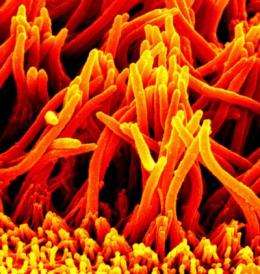
This is a scanning electron microscopy image of cilia from mouse airway epithelia culture. Credit: Thomas Moninger, University of Iowa

The same mechanism that helps you detect bad-tasting and potentially poisonous foods may also play a role in protecting your airway from harmful substances, according to a study by scientists at the University of Iowa Roy J. and Lucille A. Carver College of Medicine. The findings could help explain why injured lungs are susceptible to further damage.

The study, published online July 23 in Science Express, shows that for bitter compounds that are found in taste buds on the tongue also are found in hair-like protrusions on . In addition, the scientists showed that, unlike taste cells on the tongue, these airway cells do not need help from the nervous system to translate detection of bitter taste into an action that expels the harmful substance.

The hair-like , called motile cilia, were already known to beat in a wave-like motion to sweep away mucus, bacteria and other foreign particles from the lungs.

The study is the first to show that motile cilia on airway cells not only have this "clearing" function, but also use the receptors to play a sensory role. The researchers also found that when the receptors detect bitter compounds, the cilia beat faster, suggesting that the sensing and the motion capabilities of these are linked.

"On the tongue, bitter substances trigger taste cells to stimulate , which then evoke a response -- the perception of a bitter taste. In contrast, the airway cells appear to use a different mechanism that does not require nerves," said Alok Shah, a UI graduate student and co-first author of the study. "In the airways, bitter substances both activate the receptors and elicit a response -- the increased beating of the cilia -- designed to eliminate the offending material."

Shah and co-first author Yehuda Ben-Shahar, Ph.D., an assistant professor of biology at Washington University who was a postdoctoral fellow at the UI when the study was conducted, worked in the lab of senior study author Michael Welsh, M.D., UI professor of internal medicine and molecular physiology and biophysics, who holds the Roy J. Carver Chair of Internal Medicine and Physiology and Biophysics. Welsh also is a Howard Hughes Medical Institute investigator.

"These findings suggest that we have evolved sophisticated mechanisms to guard ourselves from harmful environmental stimuli," Ben-Shahar said. "Our work also suggests that losing cilia in the lungs, due to smoking or disease, would result in a reduced general ability to detect harmful inhaled chemicals, increasing the likelihood of further damaging an injured lung."

More information: http://www.sciencemag.org/cgi/content/abstract/1173869

Source: University of Iowa (news : web)


print this article email this article download pdf blog this article bookmark this article     Stumble it Digg this share on Facebook retweet share on Reddit add to delicious
Rate this story - 5 /5 (3 votes)


July 24, 2009 all stories

Comments: 0

5 /5 (3 votes)
  • Stumble this up

  • Digg this

  • share this

  • hide
  • Related Stories

  • Food peptides activate bitter taste receptors
    created Jan 22, 2008 | popularity not rated yet | comments 0
  • Scientists Solve Sour Taste Proteins
    created Aug 07, 2006 | popularity not rated yet | comments 0
  • Scientists Discover How We Detect Sour Taste
    created Aug 23, 2006 | popularity not rated yet | comments 0
  • Bitter Taste Identifies Poisons in Foods
    created Sep 18, 2006 | popularity not rated yet | comments 0
  • Scientists study cilia -- microscopic hair
    created May 05, 2006 | popularity not rated yet | comments 0


  • hide
  • Relevant PhysicsForums posts

  • Has the H1N1 vaccine been scientifically proven to work?
    created 18 hours ago
  • nesfatin
    created Nov 22, 2009
  • Obsessive Compulsive Disorder
    created Nov 20, 2009
  • West's zone 2 starling resistor respiratory physiology
    created Nov 18, 2009
  • More from Physics Forums - Medical Sciences

Other News

Dentistry, a high-tech version: Robots not far off, doctor says

Medicine & Health / Health

created 1hour ago | popularity not rated yet | comments 0

Robots may practice dentistry one day, but there will always be humans telling you to open wide, said a teacher on the cutting edge of tooth care.


High salt intake directly linked to stroke and cardiovascular disease

Medicine & Health / Health

created 4 hours ago | popularity 4.7 / 5 (3) | comments 0

High salt intake is associated with significantly greater risk of both stroke and cardiovascular disease, concludes a study published in the BMJ today.


Early protein processes crucial to formation and layering of myelin membrane

Medicine & Health / Research

created 9 hours ago | popularity not rated yet | comments 0

New findings from an international team of researchers probing the nerve-insulating myelin sheath were bolstered by the work of Boston College biologists, who used x-rays to uncover how mutations affect the structure of myelin, ...


Six bad reactions to swine flu vaccine in Canada: official (Update)

Medicine & Health / Medications

created 16 hours ago | popularity 3.7 / 5 (6) | comments 4

Six severe allergic reactions to swine flu vaccinations have been observed in Canada, health authorities said Tuesday, adding that all of the individuals are feeling better.


'Too fat to be a princess?' Study shows young girls worry about body image

Medicine & Health / Psychology & Psychiatry

created 13 hours ago | popularity 4 / 5 (2) | comments 2

Even before they start school, many young girls worry that they are fat. But a new study suggests watching a movie starring a stereotypically thin and beautiful princess may not increase children's anxieties.