Huge telescope opens in Spain's Canary Islands
July 24, 2009 By CARLOS MORENO , Associated Press Writer
Huge telescope opens in Spain's Canary Islands (AP)

Enlarge

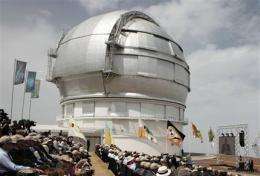
The Gran Telescopio Canarias, one of the the world's largest telescopes is seen at the Roque de los Muchachos Observatory in the Canary Island of La Palma, Spain, Friday July 24, 2009. The euro130 million (US$179 million) telescope, designed to take advantage of pristine, clear skies at the Roque de los Muchachos observatory atop the Atlantic island of La Palma, was inaugurated Friday. (AP Photo/Carlos Moreno)

(AP) -- One of the world's most powerful telescopes opened its shutters for the first time Friday to begin exploring faint light from distant parts of the universe. The Gran Telescopio Canarias, a euro130 million ($185 million) telescope featuring a 34-foot (10.4-meter) reflecting mirror, sits atop an extinct volcano. Its location above cloud cover takes advantage of the pristine skies in the Atlantic Ocean.

Planning for the began in 1987 and has involved more than 1,000 people from 100 companies. It was inaugurated Friday by King Juan Carlos.

The observatory is located at 2,400 meters (7,870 feet) above sea-level where prevailing winds keep the atmosphere stable and transparent, the Canary Islands Astrophysics Institute said.

The institute, which runs the telescope, said it will capture the birth of stars, study characteristics of and decipher some of the chemical components of the Big Bang.

The telescope is composed of 36 separate mirrors that began slowly focusing in July 2007 to eventually act as a single large reflecting surface that directs light onto a central camera point.

Among those who have done research at La Palma is Brian May, lead guitarist of rock group Queen, who studied there for part of his doctorate in astrophysics at the institute.

May, who published "BANG! The Complete History of the Universe" with astronomers Patrick Moore and Chris Lintott, composed a musical score for the telescope's inauguration.

Large reflecting telescopes began making major contributions to astronomical research when Edwin Hubble perfected the technique of capturing photographic exposures of space with the then-massive 200-inch mirror at Mount Palomar Observatory, in north San Diego County, California in Jan. 1949.

----

Associated Press Writer Harold Heckle in Madrid contributed to this report.
©2009 The Associated Press. All rights reserved. This material may not be published, broadcast, rewritten or redistributed.

4.5 /5 (15 votes)  

Filter


Move the slider to adjust rank threshold, so that you can hide some of the comments.


Display comments: newest first

otto1923
Jul 24, 2009

Rank: not rated yet
No canaries were harmed in the construction of this telescope (probably not).
TJ_alberta
Jul 24, 2009

Rank: not rated yet
canaries? what are you thinking otto?

why can't I find Brian May's music for the opening on youtube?
otto1923
Jul 25, 2009

Rank: not rated yet
Canary islands. Large telescopes. Mauna Loa environmentalists. Humor. Brian who? Otto knows only black metal. Try golgoroth.
otto1923
Jul 25, 2009

Rank: not rated yet
What happens when the flank of the La Palma volcano collapses? Won't this screw up collimation?
bluehigh
Jul 25, 2009

Rank: not rated yet
... pristine clear skies .... above cloud cover ...

It must have been the one bad day when the photo was taken!
otto1923
Jul 25, 2009

Rank: not rated yet
Must be fireworks... or a burnt offering to the mountaingods. Should try that in Hawaii for new scopes or Pele might belch-
daveib6
Jul 25, 2009

Rank: not rated yet
Its location above cloud cover takes advantage of the pristine skies in the Atlantic Ocean.

Check out the picture! How's that working out? Hmmmmm... Me thinks somebody has miscalculated the Cloud line.
Rank 4.5 /5 (15 votes)
Relevant PhysicsForums posts
  • Is Venus Slowing Down?
    created1 hour ago
  • Never ending outer space.....
    createdFeb 11, 2012
  • Neutron Star fragments?
    createdFeb 11, 2012
  • stationary or not?
    createdFeb 11, 2012
  • Scale of the Universe
    createdFeb 10, 2012
  • Titan's lack of impact craters
    createdFeb 09, 2012
  • More from Physics Forums - General Astronomy

More news stories

Transforming galaxies

(PhysOrg.com) -- Many of the Universe's galaxies are like our own, displaying beautiful spiral arms wrapping around a bright nucleus. Examples in this stunning image, taken with the Wide Field Camera 3 on ...

Space & Earth / Astronomy

created 48 minutes ago | popularity 5 / 5 (1) | comments 0 | with audio podcast

A continent ablaze in auroral and manmade light

The North American continent is literally set ablaze in a confluence of Auroral and Manmade light captured in spectacular new videos snapped by the astronauts serving aboard the International Space Station ...

Space & Earth / Space Exploration

created 41 minutes ago | popularity not rated yet | comments 0

A better picture of clouds

Some of us look at clouds and see animal shapes. Scientists are looking beyond. For the first time, a team of scientists led by Pacific Northwest National Laboratory used actual measurements of clouds and ...

Space & Earth / Earth Sciences

created 43 minutes ago | popularity not rated yet | comments 0

Scientists drill two miles down to ancient Lake Vostok

(PhysOrg.com) -- Russian scientists last week finished penetrating more than two miles through the Antarctic ice sheet to Lake Vostok, a huge freshwater lake that has been buried under the ice for millions ...

Space & Earth / Earth Sciences

created 32 minutes ago | popularity 5 / 5 (1) | comments 0

Earth-facing sunspot doubles in size

The latest sunspot region to traverse the face of the Sun has nearly doubled in size as it aims Earthward, as seen in the animation above from NASA’s Solar Dynamics Observatory. (Click image to play the ...

Space & Earth / Space Exploration

created 1 hour ago | popularity not rated yet | comments 0


'Smart' microcapsules in a single step

(PhysOrg.com) -- A new, single-step method of fabricating microcapsules, which have potential commercial applications in industries including medicine, agriculture and diagnostics, has been developed by researchers ...

New ability to regrow blood vessels holds promise for treatment of heart disease

(Medical Xpress) -- University of Texas at Austin researchers have demonstrated a new and more effective method for regrowing blood vessels in the heart and limbs — a research advancement that could have ...

Ethanol mandate not the best option

Many people are willing to pay a premium for ethanol, but not enough to justify the government mandate for the corn-based fuel, a Michigan State University economist argues.

Nanostructured electrodes for rechargeable sodium-Ion batteries

Highly efficient 3V cathodes for rechargeable sodium-ion batteries have been developed by users from Argonne National Laboratory's Materials Science, Chemical Sciences & Engineering, and X-ray Sciences Divisions, ...

New tumor suppressor gene identified

A recent study published in Clinical Cancer Research suggests that the protein hVps37A suppresses tumor growth in ovarian cancer. The work, which was funded by the Austrian Science Fund FWF, shows, for th ...

A lost world? How zooarchaeology can inform biodiversity conservation

A new study of tropical forests will provide a 50,000-year perspective on how animal biodiversity has changed, explored through an archaeological investigation of animal bones.