5 ancient Roman shipwrecks found off Italy coast
July 25, 2009 By ALESSANDRA RIZZO , Associated Press Writer 5 ancient Roman shipwrecks found off Italy coast (AP)

Enlarge

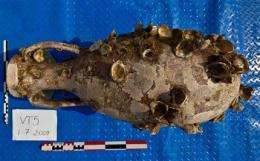
This photo taken in June 2009 and made available on Friday, July 24, 2009 by the Italian Culture Ministry and the Aurora Trust, shows amphorae, believed to be of Spanish origin and dating back to the 1st century A.D., after it was found with other objects off the coast of Ventotene, a tiny island part of an archipelago between Rome and Naples, Italy. Archaeology officials say they have found five well-preserved Roman shipwrecks off a small Mediterranean island, with their cargo of amphorae, pots and other objects largely intact. They date from the 1st century B.C. to the 4th century and carried wine amphorae, kitchen tools and some metal and glass objects that have yet to be identified, Italy's Culture Ministry said. (AP Photo/Courtesy of the Italian Culture Ministry and the Aurora Trust, ho) NO SALES

(AP) -- Archaeologists have found five well-preserved Roman shipwrecks deep under the sea off a small Mediterranean island, with their cargo of vases, pots and other objects largely intact, officials said Friday.

The ships are submerged between 100 and 150 meters (about 330 to 490 feet) off Ventotene, a tiny island that is part of an archipelago off Italy's west coast between Rome and Naples.

The ships, which date from between the 1st century B.C. and the 4th century, carried amphorae - vases used for holding wine, olive oil and other products - as well as kitchen tools and metal and glass objects that have yet to be identified, Italy's Culture Ministry said. The spot was highly trafficked, and hit by frequent storms and dangerous sea currents.

The discovery is part of a new drive by archaeological officials to scan deeper levels of the sea and prevent looting of submerged treasures.

Discoveries of shipwrecks are not unusual in the Mediterranean, but these ships are far better preserved than most, which are often found scattered in fragments, said Annalisa Zarattini, the head of the ministry's office for underwater . Because the ships sank at a deeper lever than most known wrecks, they were not exposed to destructive underwater currents, she said.

The ships also sank without capsizing, allowing researchers to observe their cargo largely as it had been loaded, Zarattini said.

"It is like an underwater museum," Zarattini said. The finding also sheds light on the trade routes of ancient Rome, marking the area as a major commercial crossroads, she said.

Treasure hunters usually dive down to about 30 meters (about 100 feet) underwater, but new and fast-spreading technology will make it increasingly easier for them to dive deep, Zarattini said. "It's important to arrive first," she added.

The ships were found during explorations concluded earlier this month by the ministry and the AURORA Trust, a U.S. group that gathers maritime researchers and provides equipment to explore the sea.

The researchers used sonar technology to provide imagery of the seabed and then employed remotely operated vehicles, the Culture Ministry and the AURORA Trust said.

The oldest of the has a cargo of wine amphorae from southern Italy, some stacked in their original position, AURORA said. Another one was carrying moratoria, large bowls used to grind grains. Another was loaded with African amphorae carrying garum, a fish sauce that was a delicacy in ancient Rome.

The largest wreck measures more than 20 meters (65 feet).

A handful of objects were taken out to be studied and will be put on display in Ventotene.

©2009 The Associated Press. All rights reserved. This material may not be published, broadcast, rewritten or redistributed.


print this article email this article download pdf blog this article bookmark this article     Stumble it Digg this share on Facebook retweet share on Reddit add to delicious
Rate this story - 4.8 /5 (5 votes)

Rank Filter

Move the slider to adjust rank threshold, so that you can hide some of the comments.


Display comments: newest first

  • frajo - Jul 25, 2009
    • Rank: not rated yet
    The photo doesn't show amphorae; it shows one single amphora only.

July 25, 2009 all stories

Comments: 1

4.8 /5 (5 votes)
  • Stumble this up

  • Digg this

  • share this

  • hide
  • Related Stories

  • Deep-sea robot photographs ancient Greek shipwreck
    created Feb 02, 2006 | popularity not rated yet | comments 0
  • 2,200-year old amphoras contained wine
    created Apr 09, 2007 | popularity not rated yet | comments 0
  • 4 more historic ships found off R.I.
    created May 15, 2006 | popularity not rated yet | comments 0
  • Archaeology Team Discovers Oldest Remains of Sea-faring Ships in the World
    created Feb 27, 2006 | popularity not rated yet | comments 0
  • Archaeologists Hot on the Trail of Columbus' Sunken Ships
    created Jul 27, 2006 | popularity not rated yet | comments 0


  • hide
  • Relevant PhysicsForums posts

  • Human Leukocyte Antigen (HLA) typing
    created 2 hours ago
  • Breeding program
    created Nov 20, 2009
  • How does a concentration gradient provide energy?
    created Nov 20, 2009
  • Eyesight and Neural Damage from Electronics
    created Nov 19, 2009
  • More from Physics Forums - Biology

Other News

Museum: Galileo's fingers, tooth are found (AP)

Museum: Galileo's fingers, tooth are found

Other Sciences / Archaeology & Fossils

created 14 hours ago | popularity not rated yet | comments 5

(AP) -- Two fingers and a tooth removed from Galileo Galilei's corpse in a Florentine basilica in the 18th century and given up for lost have been found again and will soon be put on display, an Italian museum ...


Measure to change U. of Neb. stem-cell rule fails (AP)

Measure to change U. of Neb. stem-cell rule fails (Update 2)

Other Sciences / Other

created 14 hours ago | popularity 5 / 5 (1) | comments 0

(AP) -- The University of Nebraska's governing board on Friday voted not to place tighter restrictions on embryonic stem cell research than those outlined under federal guidelines, which were expanded after ...


Researcher: Faint writing seen on Shroud of Turin (AP)

Researcher: Faint writing seen on Shroud of Turin (Update)

Other Sciences / Archaeology & Fossils

created Nov 20, 2009 | popularity 1.7 / 5 (22) | comments 23

(AP) -- A Vatican researcher has rekindled the age-old debate over the Shroud of Turin, saying that faint writing on the linen proves it was the burial cloth of Jesus. Experts say the historian may be reading ...


Three of a kind

Three of a kind: Revealing language’s universal essence

Other Sciences / Social Sciences

created Nov 20, 2009 | popularity 3.5 / 5 (8) | comments 6

(PhysOrg.com) -- On the surface, English, Japanese, and Kinande, a member of the Bantu family of languages spoken in the Democratic Republic of Congo, have little in common. It is not just that the vocabularies ...


Maya

New insights into the life of the Maya

Other Sciences / Archaeology & Fossils

created Nov 16, 2009 | popularity 4.6 / 5 (15) | comments 7

(PhysOrg.com) -- Ancient artifacts are almost always concerned with rich and powerful religious and political leaders, but new excavations of an ancient Maya site have unearthed a pyramid decorated with murals ...