Europe fast-tracking swine flu vaccine
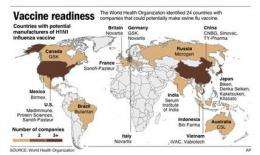
(AP) -- In a drive to inoculate people against swine flu before winter, many European governments say they will fast-track the testing of a new flu vaccine, arousing concern among some experts about safety issues and proper vaccine doses.
The European Medicines Agency, the EU's top drug regulatory body, is accelerating the approval process for swine flu vaccine, and countries such as Britain, Greece, France and Sweden say they'll start using the vaccine after it's greenlighted - possibly within weeks.
In an interview with The Associated Press, Dr. Keiji Fukuda, the World Health Organization's flu chief, warned about the potential dangers of untested vaccines, although he stopped short of criticizing Europe's approach outright.
"One of the things which cannot be compromised is the safety of vaccines," he said Friday. "There are certain areas where you can make economies, perhaps, but certain areas where you simply do not try to make any economies."
Flu vaccines have been used for 40 years, and many experts say extensive testing is unnecessary, since the swine flu vaccine will simply contain a new ingredient: the swine flu virus.
But European officials won't know if the new vaccine causes any rare side effects until millions of people get the shots. Still, they say the benefit of saving lives is worth the gamble.
"Everybody is doing the best they can in a situation which is far from ideal," said Martin Harvey-Allchurch, a spokesman for the European Medicines Agency. "With the winter flu season approaching, we need to make sure the vaccine is available."
In Europe, flu vaccines are usually tested on hundreds of people for several weeks or months, to ensure the immune system produces enough antibodies to fight the infection.
But to ensure swine flu vaccine is available as soon as possible, the European Medicines Agency is allowing companies to skip testing in large numbers of people before the vaccine is approved.
The main issue is probably that without thorough testing it's difficult to gauge the effective dosage - meaning Europeans might get too weak a vaccine. It's unlikely the vaccine would endanger anyone, but until it is used in large numbers of people, no one will know for sure.
Europeans appear ready to use the vaccine widely before conducting any big studies to prove it is safe and effective. Neither the vaccine makers nor the European Medicines Agency would specify what basic safety tests are being done.
The U.S. is taking a more cautious approach: the government called Wednesday for several thousand volunteers to be injected with the swine flu vaccine in tests beginning in August to assess the vaccine's safety. American officials said results should be ready by the time the U.S. plans to roll out a vaccination campaign in October.
Results from the U.S. tests will be of limited use to Europe, since countries like Britain plan to start vaccinating as early as August - before any American trial data is available. The vaccines used in the U.S. will also be different from those in Europe.
Some experts favor urgent action.
"The consequences of not having a vaccine if this virus gets worse are very high," said Leonard Marcus, a public health expert at Harvard University. "If (regulatory authorities) took all the time that was necessary to make sure there are no side effects, ironically, in the effort to save a few lives, many lives could be lost."
But critics say dangers lurk in any strategy to vaccinate without robust testing.
Scant information exists on flu vaccines with adjuvants, a component used to stretch the active ingredient that is commonly found in European flu vaccines. There are no licensed flu vaccines with the ingredient in the U.S.
There is also limited or no data on the safety and effectiveness of vaccines with adjuvants in children under 3 and pregnant women - two of the most vulnerable groups in a pandemic - a global outbreak.
Mass swine flu vaccination campaigns will also take place in the shadow of the 1976 swine flu disaster, when hundreds of people in the U.S. developed Guillain-Barre syndrome, a paralyzing disorder, after being vaccinated.
Experts don't know why that happened, but say modern vaccine production techniques have improved since 1976. To avoid a similar episode, some say comprehensive testing before the vaccine is rolled out is essential.
"I can't see any possible excuse to not test it for safety before it's given to anyone," said George Annas, a bioethics expert at Boston University.
If the vaccine turns out to have dangerous side effects, it could generate a public backlash, particularly in a country like Britain, where many people remain suspicious of vaccines because of unsubstantiated allegations linking the measles, mumps and rubella vaccine to autism. That could lead to millions of people refusing vaccination.
When the bird flu crisis hit several years ago, the European Medicines Agency designed a special protocol to approve a vaccine for use in a pandemic as soon as possible.
The agency let companies submit data for a "mock-up" vaccine, using H5N1 bird flu. The idea was to do most of the testing before the global epidemic hit so when it did, drugmakers could insert the pandemic virus into the vaccine at the last minute.
When the first swine flu vaccine doses are ready, the European Medicines Agency will approve them largely based on data from the bird flu vaccine, since both will have the same basic ingredients.
If the agency thinks the bird flu data predicts how the swine flu virus will work, they will approve it, said spokesman Harvey-Allchurch.
The agency will then require regular reporting of the vaccine's effects as it is being administered - monitoring that is normally done beforehand.
WHO's Fukuda said everyone involved in making the vaccine, from manufacturers to regulatory agencies, is looking at what steps can be taken to streamline the process.
"But there is no one who disagrees that one of the absolutes is that there can't be any question whether the vaccine is safe or not," he said.
WHO reported that the swine flu viruses aren't producing enough of a key vaccine ingredient, which may limit how much vaccine is available. Its laboratory network is now working to produce a new set of viruses that it hopes will work better.
Drugmakers including Baxter International, GlaxoSmithKline PLC, Novartis and Sanofi-Pasteur, however, insist they will be able to start shipping the first batches of vaccine soon.
British health officials have repeatedly said they will start vaccinating in August, as soon as the vaccine is approved. Other European countries, including Greece, France, Sweden, say they will use the vaccine after it gets the green light from the European agency, but none other than Britain expect to start the shots next month.
---
Associated Press writers Frank Jordans in Geneva, Malin Rising in Stockholm, Jenny Barchfield in Paris, and Derek Gatopoulos in Athens contributed to this report.
©2009 The Associated Press. All rights reserved. This material may not be published, broadcast, rewritten or redistributed.


