Hydrocarbons in the deep Earth?
July 26, 2009
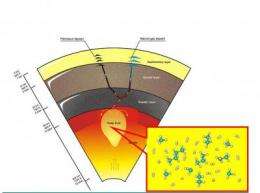
This artistic view of the Earth's interior shows hydrocarbons forming in the upper mantle and transported through deep faults to shallower depths in the Earth's crust. The inset shows a snapshot of the methane dissociation reaction studied in this work. Credit: Image courtesy A. Kolesnikov and V. Kutcherov
The oil and gas that fuels our homes and cars started out as living organisms that died, were compressed, and heated under heavy layers of sediments in the Earth's crust. Scientists have debated for years whether some of these hydrocarbons could also have been created deeper in the Earth and formed without organic matter. Now for the first time, scientists have found that ethane and heavier hydrocarbons can be synthesized under the pressure-temperature conditions of the upper mantle —the layer of Earth under the crust and on top of the core. The research was conducted by scientists at the Carnegie Institution's Geophysical Laboratory, with colleagues from Russia and Sweden, and is published in the July 26, advanced on-line issue of Nature Geoscience.
Methane (CH4) is the main constituent of natural gas, while ethane (C2H6) is used as a petrochemical feedstock. Both of these hydrocarbons, and others associated with fuel, are called saturated hydrocarbons because they have simple, single bonds and are saturated with hydrogen. Using a diamond anvil cell and a laser heat source, the scientists first subjected methane to pressures exceeding 20 thousand times the atmospheric pressure at sea level and temperatures ranging from 1,300 F° to over 2,240 F°.
These conditions mimic those found 40 to 95 miles deep inside the Earth. The methane reacted and formed ethane, propane, butane, molecular hydrogen, and graphite. The scientists then subjected ethane to the same conditions and it produced methane. The transformations suggest heavier hydrocarbons could exist deep down. The reversibility implies that the synthesis of saturated hydrocarbons is thermodynamically controlled and does not require organic matter.
The scientists ruled out the possibility that catalysts used as part of the experimental apparatus were at work, but they acknowledge that catalysts could be involved in the deep Earth with its mix of compounds.
"We were intrigued by previous experiments and theoretical predictions," remarked Carnegie's Alexander Goncharov a coauthor. "Experiments reported some years ago subjected methane to high pressures and temperatures and found that heavier hydrocarbons formed from methane under very similar pressure and temperature conditions. However, the molecules could not be identified and a distribution was likely. We overcame this problem with our improved laser-heating technique where we could cook larger volumes more uniformly. And we found that methane can be produced from ethane."
The hydrocarbon products did not change for many hours, but the tell-tale chemical signatures began to fade after a few days.
Professor Kutcherov, a coauthor, put the finding into context: "The notion that hydrocarbons generated in the mantle migrate into the Earth's crust and contribute to oil-and-gas reservoirs was promoted in Russia and Ukraine many years ago. The synthesis and stability of the compounds studied here as well as heavier hydrocarbons over the full range of conditions within the Earth's mantle now need to be explored. In addition, the extent to which this 'reduced' carbon survives migration into the crust needs to be established (e.g., without being oxidized to CO2). These and related questions demonstrate the need for a new experimental and theoretical program to study the fate of carbon in the deep Earth."
Source: Carnegie Institution


Glad to see some research supporting the alternate method of production.
The inventory of radiogenic and primordial noble gases (He, Ne, Ar, Kr and Xe) in the Earth and its atmosphere indicate that the Earth formed in layers, i.e., heterogeneously, beginning with the formation of its iron core from abundant iron meteorites near the Sun [See "The noble gas record of the terrestrial planets, " Geochemical Journal 15 (1981) 247-267].
According to that scenario, lightweight elements like H, C, and N were added as a late veneer and would not likely exist in the deep interior of the Earth.
See also http://www.physor...740.html
With kind regards,
Oliver K. Manuel
http://www.omatumr.com
You assume a great deal. Bureaucracies are rarely that intelligent and the right hand never knows what the left is doing.
However, there have been Russian (former Soviet era 1950s until present) geo-scientists saying this for decades. See abiogenic petroleum origin.
A third alternative is that some/most of the hydrocarbon in the lithosphere were brought by meteors.
Neither of these methods preclude a biogenic origin for petroleum.
And in response to Mr Manuel above; the planet probably accreted over 3 or 4 hundred million years and remained completely, or nearly, molten for several 10s of millions of years after accretion was completed. This was sufficient time for the majority of heavy elements to stratify.
When the Mars sized body struck the proto-earth, forming the Moon, it caused the entire planet to become molten, again. The impact blasted away most of theproto-earth's light rocky crustal material and left much of the impactors heavy elements behind (see composition of Luna), which sunk into the outer core. Again more stratification of Earth.
The late heavy bombardment at 3.9Gya probably remelted the lithosphere, causing yet more stratification of light and heavy elements.
Yet, the mantle contain a minimum of several world oceans of H2O in it structure. This does not fit your description of events, but at least it is a testable theory (unlike others often presented here).
There is oil coming from vents in the Sea of Cortez that is less than 2000 years old. However, most petroleum is so old that the Carbon 14 has long since decayed into Nitrogen (half life of 5730 years).
Xpst was referring to C12:C13 ratios, as it is well known that plants preferentially fix carbon 12 during photosynthesis.
Not at all!
That scenario is directly falsified by quantitative data on primordial and radiogenic noble gas isotopes in air and still remaining inside planet Earth today, especially:
1. Primordial He-3 and Ne-20 still inside the Earth, and
2. Radiogenic Ar-40 from the decay of K-40,
___Radiogenic Xe-129 from the decay of extinct I-129, and
___Fissiogenic-Xe from the decay of U and extinct Pu-244
In air and inside the Earth today.
See "The noble gas record of the terrestrial planets " [Geochemical Journal 15 (1981) 247-267]. http://tinyurl.com/2k8ds3
With kind regards,
Oliver K. Manuel
http://www.omatumr.com
Mars was molten for at least 100 million years after accretion.
Mars molten past - UC Davis http://www.news.u...?id=8436
Earth was molten longer.
(3/2)kT ~ M ~ volume ~ r^3
The rate at which the planet can cool is proportional to the surface area from which it can radiate away that heat to outer space, and surface area for any object is proportional the radius squared.
Cooling rate ~ surface area ~ r^2
So, if you consider larger and larger planets, r3 certainly rises faster than r2 and therefore larger planets will cool slower. The earth is the largest inner planet, and we would then expect that the earth would be cooling the slowest and have retained the largest fraction of its initial heat.
Good day
The vast majority of these drill operations have been successful in finding oil.
Western drill operations are predicated upon scarcity and then pricing and control via oil corporations. As well, they are predicated upon 100 year old thinking about biomass creating oil. Talk about old unproven science keeping reign on people's thinking and maintain scarcity and control. On all levels. Think about it.
Thus, in the western world of science and corporations, the western world would be the last to know or understand that the earth itself forms oil. In a method similar to that of the creation of acetone and similar. Good old standard alchemy.
You know--chemistry. The soviets got it right.
Now that the oil shale and the oil in Montana, etc (100 trillion barrels) have been found, they'll have to find another way to control us.
Yes, the ever ambiguous 'they'. They exist - and do so in every generation. Start looking for them, punkass.
Sorry, Shootis. You are wrong about Mars too.
Read the paper cited above, Shootist, and perhaps you will understand that it discusses the noble gas record of MARS as well as EARTH.
See "The noble gas record of the terrestrial planets " [Geochemical Journal 15 (1981) 247-267]. http://tinyurl.com/2k8ds3
With kind regards,
Oliver K. Manuel
http://www.omatumr.com
-Two hands- one brain. Easily-obtainable petroleum is a strategically dangerous commodity. It needed to be consumed down to levels where it could only be collected using western technologies. That is almost complete, and now we see new info and new technologies emerging.
No disruptive, destabilizing technologies will be released before their time. Obviously. Either Pons and Fleishman were naive, or they werent; but now the Navy finds neutrons from deuterium and palladium. A Season for everything under the Sun.
Physicist Thomas Gold championed this some time ago and he was preceded by Soviet scientists. Of course, he was largely derided until his death. He published a book in 1999 called "Deep Hot Biosphere - the Myth of Fossil Fuels". Nice to see his clear thinking getting its due even if it is posthumously.
"Ants More Rational Than Humans?
July 25, 2009 Researchers now show that ants can accomplish a task more rationally than our -- multimodal, egg-headed, tool-using, bipedal, opposing-thumbed -- selves."
-Socialism is the future. We just need to fix all the human defects which make them want to take advantage of it and make forced competition necessary; sloth, greed, jealosy, gluttony, etc- 7 total.
Yellowstone is about as direct connection to deep earth as you can get. Hawaii is another direct connection. No oil in either one. This theory is just non-sense.