Scientists closer to making implantable bone material
July 26, 2009 Scientists closer to making implantable bone material

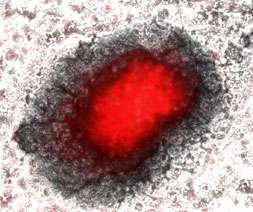
Calcium in the the bone-like nodules are fluorescent red in this image captured by the Imperial team.

(PhysOrg.com) -- Scientists are closer to understanding how to grow replacement bones with stem cell technology, thanks to research published today in the journal Nature Materials.

Many scientists are currently trying to create bone-like materials, derived from stem cells, to implant into patients who have damaged or fractured bones, or who have had parts of diseased bones removed. The idea is that, ultimately, these bone-like materials could be inserted into so that real bone could meld with it and repair the bone.

So far, scientists have found they can grow small 'nodules' of what appeared to be bone-like material in the laboratory from different types of bone cells and stem cells. All of these cell types are attracting considerable interest as promising candidates for future implants in people with clinical trials already underway. However, scientists still need to thoroughly explore and understand the in-depth chemical properties and structure of the bone-like materials they are growing.

Now, scientists from Imperial College London have compared the 'bone-like' material grown from three different commonly used clinically relevant cell types and have discovered significant differences between the quality of bone-like material that these can form.

For example, the researchers have discovered that the 'bone-like' materials that were grown from bone cells from mouse skull and mouse stem cells successfully mimicked many of the hallmarks of real bone, which include . However, they found that the 'bone-like' material grown from mouse was much less stiff and less complex in its mineral composition when compared to the other materials. The researchers suggest that further research is now needed to explore the implications of these results for different stem cell therapies.

Professor Molly Stevens, from the Department of Materials and the Institute of Biomedical Engineering at Imperial College London, says: "Many patients who have had bone removed because of tumours or accidents live in real pain. By repairing bone defect sites in the body with bone-like material that best mimics the properties of their real bone we could improve their lives immeasurably. Our study provides an important insight into how different cell sources can really influence the quality of bone that we can produce. It brings us one step closer to developing materials that will have the highest chance of success when implanted into patients."

To carry out their analysis, researchers used laser-based raman spectroscopy to understand the detailed chemical make-up of live cells as they grew and multivariate statistical analysis techniques, which enabled them to compare and analyse data about the growth of different cell populations. They also used a nano-indenter and high resolution electron microscopy, which allowed the researchers to probe the samples so that they could understand how stiff the bone-like materials were and what their structure was at a microscopic level.

More information: "Comparative materials differences revealed in engineered as a function of cell-specific differentiation" , Sunday 26 July 2009.

Source: Imperial College London (news : web)


print this article email this article download pdf blog this article bookmark this article     Stumble it Digg this share on Facebook retweet share on Reddit add to delicious
Rate this story - 4.3 /5 (4 votes)

Rank Filter

Move the slider to adjust rank threshold, so that you can hide some of the comments.


Display comments: newest first

  • TJ_alberta - Jul 26, 2009
    • Rank: not rated yet
    cartilage would also be good. many people need replacement cartilage in their joints.

July 26, 2009 all stories

Comments: 1

4.3 /5 (4 votes)
  • Stumble this up

  • Digg this

  • share this

  • hide
  • Related Stories

  • Bioactive cement scaffold aids bone grafts
    created Apr 17, 2006 | popularity not rated yet | comments 0
  • Molecule dictates how stem cells travel
    created Jan 14, 2006 | popularity not rated yet | comments 0
  • Turning on adult stem cells may help repair bone
    created Jan 25, 2008 | popularity not rated yet | comments 0
  • Scientists call up stem cell troops to repair the body using new drug combinations
    created Jan 08, 2009 | popularity not rated yet | comments 0
  • Layered approach may yield stronger, more successful bone implants
    created Aug 17, 2007 | popularity not rated yet | comments 0


  • hide
  • Relevant PhysicsForums posts

  • Putting every element in a box
    created 5 hours ago
  • a question in Lewis structure???
    created 12 hours ago
  • Paint Technology
    created Nov 24, 2009
  • About pH, Metallic electrodes
    created Nov 24, 2009
  • More from Physics Forums - Chemistry

Other News

Blocking biofilms: Alzheimer's research sheds light on potential treatments for urinary tract infections

Chemistry / Biochemistry

created 10 hours ago | popularity 5 / 5 (1) | comments 0

(PhysOrg.com) -- Research into Alzheimer's disease seems an unlikely approach to yield a better way to fight urinary tract infections (UTIs), but that's what scientists at Washington University School of Medicine in St. Louis ...


Chemists get custom-designed microscopic particles to self-assemble in liquid crystal

Chemists get custom-designed microscopic particles to self-assemble in liquid crystal

Chemistry / Materials Science

created 10 hours ago | popularity 5 / 5 (5) | comments 0

(PhysOrg.com) -- The scientists anticipate their "LithoParticles" will have significant applications in photonics, optical communications and other areas.


Study shows flavanol antioxidant content of US chocolate and cocoa-containing products

Chemistry / Other

created 12 hours ago | popularity 1 / 5 (2) | comments 0

A recent study confirms that the antioxidants and other plant-based nutrients in chocolate and cocoa products are highly associated with the amount of non-fat cocoa-derived ingredients in the product. The study expands on ...


Sandia CR5

Machine Converts CO2 into Gasoline, Diesel, and Jet Fuel

Chemistry / Biochemistry

created Nov 23, 2009 | popularity 4.6 / 5 (30) | comments 19

(PhysOrg.com) -- Researchers at Sandia National Laboratories have built a machine that uses the sun's energy to convert carbon dioxide waste from power plants into transportation fuels such as gasoline, diesel, ...


New hydrogen-storage method discovered

New hydrogen-storage method discovered

Chemistry / Materials Science

created Nov 22, 2009 | popularity 4.3 / 5 (41) | comments 15

Scientists at the Carnegie Institution have found for the first time that high pressure can be used to make a unique hydrogen-storage material. The discovery paves the way for an entirely new way to approach ...