NASA patches air-purifying system on space station
July 26, 2009 By MARCIA DUNN , AP Aerospace Writer
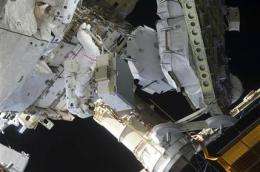
In this photo provided by NASA, almost lost to the vision among tons of space hardware, astronauts Christopher Cassidy, partially in frame at upper left, and Tom Marshburn, mission specialists for STS-127, share duties on the fourth spacewalk of Endeavour's current mission and its crew's joint activities with the space station. Eleven astronauts and cosmonauts remained inside the international space station and the shuttle to which it was docked, while the two continued work on the orbital outpost, Friday, July 24, 2009. (AP Photo/NASA)
(AP) -- A space station air purifier was working again Sunday after it shut down at the worst possible time, when company was still visiting and had swollen the on-board crowd to a record 13.
The repair by flight controllers, albeit temporary, came as a great relief to NASA.
Even if the carbon dioxide-removal system had remained broken, shuttle Endeavour would not have had to undock early from the international space station, said flight director Brian Smith. But the system needs to work to support six station residents over the long term, he said.
The machine for cleansing the station atmosphere, on the U.S. side of the sprawling outpost, failed Saturday when it got too hot and tripped a circuit breaker.
Flight controllers managed to get the unit up and running again 8 1/2 hours later in manual mode. That means extra people are needed in Mission Control - six each day - to handle the approximately 50 computer commands that need to be sent up every few hours.
Normally, the system runs automatically. Smith said engineers hopefully will come up with a software solution soon to have the system back in automatic.
An air-cleansing system on the Russian side of the station is working fine. In addition, the station has about three weeks' worth of canisters for removing the carbon dioxide exhaled by six crew members. The astronauts would have relied on those canisters to prevent an early undocking of Endeavour, if the U.S. carbon-dioxide removal machine not been coaxed back into operation.
The shuttle and its crew of seven will depart Tuesday, as originally planned.
Before leaving, the shuttle astronauts have their fifth and final spacewalk to perform.
During Monday's spacewalk, Christopher Cassidy and Thomas Marshburn will rearrange some power cable hookups, fold down a piece of popped-up insulation on the station's smaller, dexterous robotic arm, and install TV cameras on the brand new porch of Japan's space station lab.
A spare carbon-dioxide removal system, meanwhile, will be launched at the end of August on the next shuttle flight, a plan put in place long before this weekend's trouble.
NASA has wrapped up extensive testing of the foam insulation on the fuel tank for that mission, and so far everything looks to be in good shape. Engineers wanted to make sure that the insulation was attached properly after considerable foam was lost during Endeavour's July 15 launch. The tests delayed Discovery's mission by a week.
Liftoff is now targeted for Aug. 25 at the earliest.
---
On the Net:
NASA: http://www.nasa.gov/mission(underscore)pages/shuttle/main/index.html
©2009 The Associated Press. All rights reserved. This material may not be published, broadcast, rewritten or redistributed.
-
Astronauts install fresh batteries on spacewalk 4
Jul 24, 2009 |
not rated yet |
0
-
All 13 astronauts enjoy first day off in 11 days
Jul 26, 2009 |
not rated yet |
0
-
Astronauts cut spacewalk short due to suit trouble (Update)
Jul 22, 2009 |
not rated yet |
0
-
More storms threaten Monday shuttle launch attempt
Jul 13, 2009 |
not rated yet |
0
-
Thunderstorms cause 5th delay for space shuttle
Jul 13, 2009 |
not rated yet |
0
-
Engineers build first sub-10-nm carbon nanotube transistor
Feb 01, 2012 |
4.9 / 5 (33) |
30
-
Something old, something new: Evolution and the structural divergence of duplicate genes
Jan 31, 2012 |
4.6 / 5 (7) |
1
-
The hidden nanoworld of ice crystals: Revealing the dynamic behavior of quasi-liquid layers
Jan 30, 2012 |
5 / 5 (4) |
1
-
Stock market network reveals investor clustering
Jan 27, 2012 |
3.9 / 5 (23) |
8
-
Of microchemistry and molecules: Electronic microfluidic device synthesizes biocompatible probes
Jan 26, 2012 |
5 / 5 (2) |
0
-
Never ending outer space.....
Feb 11, 2012
-
Neutron Star fragments?
Feb 11, 2012
-
stationary or not?
Feb 11, 2012
-
Scale of the Universe
Feb 10, 2012
-
Titan's lack of impact craters
Feb 09, 2012
-
Real pictures of black hole eating a star?
Feb 08, 2012
- More from Physics Forums - General Astronomy
More news stories
Salvage workers begin pumping fuel from Italian shipwreck
Salvage workers Sunday began pumping fuel from the shipwrecked Italian cruise liner Costa Concordia, a day ahead of schedule, officials said.
9 hours ago |
5 / 5 (1) |
0
Latin America mining boom clashes with conservation
Latin America is experiencing a mining boom as prices rise fuelled by a hike in global demand, but the region is also being hit by a wave of violent protests, strikes and rallies by environmentalists.
17 hours ago |
5 / 5 (1) |
1
Political leaders play key role in how worried Americans are by climate change: study
More than extreme weather events and the work of scientists, it is national political leaders who influence how much Americans worry about the threat of climate change, new research finds.
Feb 06, 2012 |
5 / 5 (7) |
73
NASA budget will axe Mars deal with Europe: scientists
US President Barack Obama's budget proposal to be submitted next week for 2013 will cut NASA's budget by 20 percent and eliminate a major partnership with Europe on Mars exploration, scientists said Thursday.
Space & Earth / Space Exploration
Feb 10, 2012 |
5 / 5 (3) |
58
Humans may have helped the decline of African rainforests 3000 years ago
(PhysOrg.com) -- Large areas of rainforests in Central Africa mysteriously disappeared over three thousand years ago, to be replaced by savannas. The prevailing theory has been that the cause was a change ...
Scientists discover molecular secrets of 2,000-year-old Chinese herbal remedy
For roughly two thousand years, Chinese herbalists have treated Malaria using a root extract, commonly known as Chang Shan, from a type of hydrangea that grows in Tibet and Nepal. More recent studies suggest that halofuginone, ...
New method to examine batteries -- MRI from the inside
There is an ever-increasing need for advanced batteries for portable electronics, such as phones, cameras, and music players, but also to power electric vehicles and to facilitate the distribution and storage of energy derived ...
Google might launch Drive for cloud storage soon
(PhysOrg.com) -- Google's next big move, according to the Wall Street Journal, is a cloud storage service called Drive. Hardly first to the plate, Google is simply catching up to introducing its cloud reposi ...
A mitosis mystery solved: How chromosomes align perfectly in a dividing cell
Although the process of mitotic cell division has been studied intensely for more than 50 years, Whitehead Institute researchers have only now solved the mystery of how cells correctly align their chromosomes during symmetric ...
Lab study raises questions over nano-particle impact
Tests involving chickens have raised questions about the impact on health from engineered nano-particles, the ultra-fine grains commonly used in drugs and processed foods, scientists said on Sunday.
Starve a virus, feed a cure? Findings show how some cells protect themselves against HIV
A protein that protects some of our immune cells from the most common and virulent form of HIV works by starving the virus of the molecular building blocks that it needs to replicate, according to research published online ...