Humans lend a hand to critically endangered waterbird
July 27, 2009 Humans lend a hand to critically endangered waterbird

Enlarge

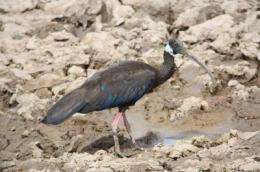
A white-shouldered ibis in Cambodia. Human impact on this critically endangered bird can be beneficial rather than destructive, and could even save it from extinction. Credit: Hugh Wright

Human impact on one of the world's most threatened bird species can be beneficial rather than destructive - and could even save it from extinction - according to counterintuitive new findings by the University of East Anglia (UEA).

Published today in the peer-reviewed journal Animal Conservation, the study by UEA conservation experts explores the exact reasons behind the decline of the critically endangered white-shouldered ibis.

Funded by the Royal Society for the Protection of Birds (RSPB) and the Natural Environment Research Council (NERC), the new study was carried out in Western Siem Pang Important Bird Area (IBA), northern Cambodia, where 160-200 of the birds survive - around half of the global population.

Working in partnership with BirdLife International, the researchers found that the ibis prefer to forage in open and accessible sites with low vegetation and bare soil. This is believed to be because it makes it easier to find prey, aids take-off and landing, and improves detection of approaching danger.

Traditional small-scale farming by local communities is therefore crucial to the ibis' survival because grazing livestock and burning of the forest understorey opens up these habitats making them suitable for the birds.

"Our findings show that this critically endangered species is largely dependent on the local farmers for their survival," said lead author Hugh Wright, of UEA's School of Environmental Sciences. "This is a fascinating outcome as we tend to assume that human activity always has a negative impact on the natural world."

Not all human influence is positive for the endangered ibis, however. Western Siem Pang - currently an unprotected site - is under imminent threat from large-scale development which would destroy the birds' habitats entirely, along with the local farming communities.

"The Forestry Administration in Cambodia is supportive of a proposal to make the area a protected forest and we believe that this - along with the continuation of local farming methods practiced for generation after generation - will be crucial in saving this once common species from extinction," added Hugh.

With fewer than 500 individuals remaining, mainly in Cambodia, the white-shouldered ibis has undergone the most rapid decline of all South-East Asia's large waterbirds and is now the most threatened. Once common in Myanmar, Thailand, Laos, Cambodia, Vietnam and Indonesia, the precise causes behind the bird's continuing decline have until now been poorly understood, which has hindered conservation efforts.

More information: 'Dry season habitat use by critically endangered white-shouldered ibis in northern Cambodia' by H Wright (UEA), D Buckingham (RSPB) and P Dolman (UEA) is published online on Monday July 27 2009 by .

Source: University of East Anglia


print this article email this article download pdf blog this article bookmark this article     Stumble it Digg this share on Facebook retweet share on Reddit add to delicious
Rate this story - 4 /5 (1 vote)


July 27, 2009 all stories

Comments: 0

4 /5 (1 vote)
  • Stumble this up

  • Digg this

  • share this

  • hide
  • Related Stories

  • Ibis triumph raises hopes for rarest bird
    created Oct 13, 2006 | popularity not rated yet | comments 0
  • Wild red ibis found in northwest China
    created Jan 03, 2006 | popularity not rated yet | comments 0
  • Asian waterbirds stage remarkable comeback
    created Apr 03, 2008 | popularity not rated yet | comments 0
  • Extinction alert issued for 800 species
    created Dec 13, 2005 | popularity not rated yet | comments 0
  • Group says 3 more birds close to extinction
    created May 14, 2009 | popularity not rated yet | comments 0


  • hide
  • Relevant PhysicsForums posts

Other News

Whiteflies sabotage alarm system of plant in distress

Whiteflies sabotage alarm system of plant in distress

Biology / Plants & Animals

created 1hour ago | popularity not rated yet | comments 0

(PhysOrg.com) -- When spider mites attack a bean plant, the plant responds by producing odours which attract predatory mites. These predatory mites then exterminate the spider mite population, thus acting ...


Knockouts in human cells point to pathogenic targets

Knockouts in human cells point to pathogenic targets

Biology / Cell & Microbiology

created 18 minutes ago | popularity not rated yet | comments 0

(PhysOrg.com) -- Whitehead researchers have developed a new approach for genetics in human cells and used this technique to identify specific genes and proteins required for pathogens.


RNA on the move

RNA on the move

Biology / Cell & Microbiology

created 1hour ago | popularity not rated yet | comments 0

In the fruit fly Drosophila, oskar mRNA, which is involved in defining the animal’s body axes, is produced in the nuclei of nurse cells neighbouring the oocyte, and must be transported to the oocyte and along ...


Variable Temperatures Leave Insects wtih a Frosty Reception

Biology / Plants & Animals

created 17 hours ago | popularity not rated yet | comments 0

(PhysOrg.com) -- For the first time, scientists at The University of Western Ontario have shown that insects exposed to repeated periods of cold will trade reproduction for immediate survival.


When camouflage is a plant's best protection

Rare woodland plant uses 'cryptic coloration' to hide from predators

Biology / Plants & Animals

created 20 hours ago | popularity 4.3 / 5 (3) | comments 0

It is well known that some animal species use camouflage to hide from predators. Individuals that are able to blend in to their surroundings and avoid being eaten are able to survive longer, reproduce, and ...