GM crop trials start again in Britain in 'secret': report
July 27, 2009 Genetically modified crops are being grown in Britain for the first time in 12 months

Enlarge

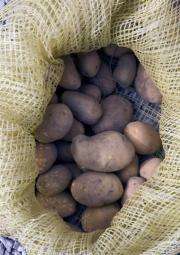
Photo illustration of potatoes. Genetically modified crops are being grown in Britain for the first time in 12 months after controversial trials were resumed without alerting the public, a newspaper reported Monday.

Genetically modified crops are being grown in Britain for the first time in 12 months after controversial trials were resumed without alerting the public, a newspaper reported Monday.

Cultivation of a field of designed to be resistant to was abandoned more than a year ago when environmental protesters ripped up the crop, the Daily Telegraph said.

But, without alerting the public, the project near Tadcaster in northern England has been restarted, prompting warnings from green groups that local farms and residents could be put at risk, the newspaper said.

One group accused the government of trying to "slip it under the radar."

The Department for the Environment, Food and Rural Affairs said the potatoes would be grown in a safe environment, where there is no risk of contamination. They would not be used for human or animal consumption, it said.

The trial, run by Leeds University, is looking at potatoes that are resistant to a parasite worm that costs British millions of pounds a year in lost and damaged .

Genetically-modified crops have a gene, or genes, inserted into them in the lab so that they acquire traits that are useful to farmers.

They are widely grown in North America, South America and China.

But in Europe they have run into fierce resistance, led by green groups who say the crops carry risks through cross-pollination, potentially creating "super-weeds" that are impervious to herbicides.

Only a handful of genetically modified crops have been approved for cultivation in the European Union, but of them only MON810, approved in 1998, is so far being grown.

France this month rejected a report by the European Union's food safety watchdog that said a controversial strain of genetically-modified corn was safe.

(c) 2009 AFP


print this article email this article download pdf blog this article bookmark this article     Stumble it Digg this share on Facebook retweet share on Reddit add to delicious
Rate this story - 5 /5 (1 vote)


July 27, 2009 all stories

Comments: 0

5 /5 (1 vote)
  • Stumble this up

  • Digg this

  • share this

  • hide
  • Related Stories

  • GMO maize strain safe: EU food agency
    created Jun 30, 2009 | popularity not rated yet | comments 0
  • Some GM crops legal in the U.K.
    created Aug 08, 2005 | popularity not rated yet | comments 0
  • EU decides against uniform GM rules
    created Mar 09, 2006 | popularity not rated yet | comments 0
  • GM crop creates a 'superweed'
    created Jul 25, 2005 | popularity not rated yet | comments 0
  • GM rice from U.S. found in EU
    created Sep 13, 2006 | popularity not rated yet | comments 0


  • hide
  • Relevant PhysicsForums posts

  • What is transpulmonary pressure?
    created Nov 24, 2009
  • Is there a gay gene?
    created Nov 23, 2009
  • Super quick question about Starling forces?
    created Nov 22, 2009
  • Questions about diffusion
    created Nov 22, 2009
  • More from Physics Forums - Biology

Other News

Destruction spreads 'like a disease'

Biology / Ecology

created 18 minutes ago | popularity not rated yet | comments 0

(PhysOrg.com) -- People have cleared more than a quarter of the world’s forests and half of its grasslands, according to a paper published today in the Proceedings of the Royal Society by researchers from The University of Que ...


When camouflage is a plant's best protection

Rare woodland plant uses 'cryptic coloration' to hide from predators

Biology / Plants & Animals

created 1hour ago | popularity not rated yet | comments 0

It is well known that some animal species use camouflage to hide from predators. Individuals that are able to blend in to their surroundings and avoid being eaten are able to survive longer, reproduce, and ...


'Safety valve' protects photosynthesis from too much light

Biology / Cell & Microbiology

created 2 hours ago | popularity not rated yet | comments 0

Photosynthetic organisms need to cope with a wide range of light intensities, which can change over timescales of seconds to minutes. Too much light can damage the photosynthetic machinery and cause cell death. Scientists ...


Cells defend themselves from viruses, bacteria with armor of protein errors

Biology / Cell & Microbiology

created 2 hours ago | popularity 5 / 5 (4) | comments 0

When cells are confronted with an invading virus or bacteria or exposed to an irritating chemical, they protect themselves by going off their DNA recipe and inserting the wrong amino acid into new proteins to defend them ...


Researchers discover biological basis of 'bacterial immune system'

Biology / Cell & Microbiology

created 3 hours ago | popularity 4 / 5 (1) | comments 0

Bacteria don't have easy lives. In addition to mammalian immune systems that besiege the bugs, they have natural enemies called bacteriophages, viruses that kill half the bacteria on Earth every two days.