Teasing apart T helper cells
July 27, 2009 Teasing apart T helper cells

Enlarge

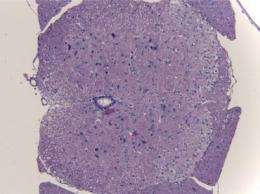
According to Nowak et al., IL-9R deficiency ameliorates the severity of EAE, a Th17-driven autoimmune disease that models multiple sclerosis. Credit: Nowak, E.C., et al. 2009. J. Exp. Med. doi:10.1084/jem.20090246

The cytokine IL-9 promotes a multiple sclerosis-like disease in mice, according to a new study by Nowak et al. published online on July 13th in the Journal of Experimental Medicine. In a related Commentary, Richard Locksley discusses the molecular and genetic regulation of cytokine production by CD4+ T helper (Th) cells and the plasticity among different Th subsets. The Commentary will be published online in the Journal of Experimental Medicine on Monday, July 27th.

Since the late 1980s, when the concept of Th1 and -2 were first introduced, several new subsets have arisen, including Th17 cells and regulatory T (T reg) cells. Recent attention has focused on a putative new Th cell subset with the propensity to secrete IL-9. But whether these "Th9" cells are truly a unique subset or whether many Th cell subsets can produce IL-9 under the right circumstances has been a matter of debate.

Nowak and colleagues now show that a Th17-driven CNS disease was blunted in lacking IL-9. In vitro studies showed that IL-9 was produced primarily by Th17 and T reg cells—subsets that depend on TGF-beta for their differentiation. Thus IL-9 production may go hand-in-hand with the presence of TGF-beta rather than with a defined Th cell subset.

More information:

Locksley, R.M., et al. 2009. J. Exp. Med. doi:10.1084/jem.200doi:10.1084/jem.20090246owak, E.C., et al. 2009. J. Exp. Med. doi:10.1084/jem.20090246

Source: Rockefeller University (news : web)


print this article email this article download pdf blog this article bookmark this article     Stumble it Digg this share on Facebook retweet share on Reddit add to delicious
Rate this story - not rated yet


July 27, 2009 all stories

Comments: 0

not rated yet
  • Stumble this up

  • Digg this

  • share this

  • hide
  • Related Stories


  • hide
  • Relevant PhysicsForums posts

  • 23 Years in a Vegetative State....or not?
    created Nov 25, 2009
  • Has the H1N1 vaccine been scientifically proven to work?
    created Nov 24, 2009
  • nesfatin
    created Nov 22, 2009
  • Obsessive Compulsive Disorder
    created Nov 20, 2009
  • More from Physics Forums - Medical Sciences

Other News

Coma recovery case attracts doubters

Medicine & Health / Other

created 9 hours ago | popularity 5 / 5 (1) | comments 1

(AP) -- Rom Houben's mother remembers her son's amazement when he finally started communicating again after spending 23 years locked in a paralyzed body that was misdiagnosed as vegetative.


Girl's progress after pioneering brain surgery gives hope to other parents

Medicine & Health / Other

created 9 hours ago | popularity 5 / 5 (3) | comments 0

Lexi Haas is awakening into a world of new possibilities. Miracle by tiny miracle, she is making her body do what she wants -- instead of her body always controlling her. She looked up at her mother a few weeks ago, pursed ...


Physician-scientist proves stem cells heal lungs of newborn animals

Medicine & Health / Research

created 10 hours ago | popularity 5 / 5 (1) | comments 0

Dr. Bernard Thébaud lives in two very different worlds. As a specialist in the Stollery Children's Hospital's Neonatal Intensive Care Unit at the Royal Alexandra Hospital, he cares for tiny babies, many of whom struggle ...


Heavy drinkers exercise to burn off alcohol: British study

Medicine & Health / Health

created 11 hours ago | popularity not rated yet | comments 0

More than a quarter of drinkers in England who exercise regularly do so in an attempt to make up for bingeing on alcohol, according to a survey published Thursday.


WHO says Tamiflu still works against swine flu

Medicine & Health / Medications

created 11 hours ago | popularity not rated yet | comments 0

(AP) -- The World Health Organization says isolated cases of drug-resistant swine flu in Britain and the United States have not changed the agency's assessment of the disease.