The Mighty Mississippi Basin and Gulf Suffocating: Inertia Not An Option
July 27, 2009 by Mary Anne Simpson
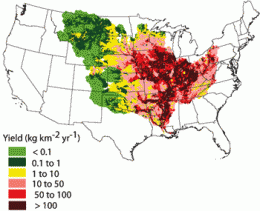
Phosphorous Delivered to Gulf of Mexico. Courtesy of USGS
The Water Science and Technology Board, (WTSB), Division on Earth and Life Sciences of the National Research Council has released for publication its study for improving water quality in the Mississippi River Basin and Northern Gulf of Mexico. The purpose of the study was to create an action plan for reducing nutrient load in the effected areas causing low levels of oxygen and creating a condition called hypoxia.
Hypoxia is caused by an excess discharge of nutrients, in particular phosphorous and nitrogen into a waterway. A chain of naturally occurring events take place which include widespread algae blooms and ends with the decomposition of the dead algae blooms which in turn depletes dissolved oxygen from the water column causing hypoxia in the Northern Gulf of Mexico and Mississippi River Basin.
The hypoxic conditions and related nutrient pollutants in the basin region literally chokes the oxygen from the waterway causing fish kills and potential toxic effects to humans and fish alike. The problem has increased dramatically over the past decades for varying reasons including changing land use,urbanization and the introduction of new varieties of agricultural products.
According to the study, "Nutrient Control Actions for Improving Water Quality in the Mississippi River Basin and Northern Gulf of Mexico, 2009" data compiled since 1985 of the region is complicated by the fact that the source of phosphorous and nitrogen discharges are attributable to numerous watersheds and tributaries involving a huge land mass spanning 31 states, covering approximately 41-percent of the conterminous land in the United States with multiple governmental authorities responsible for managing the Mississippi River Basin leading to the Gulf of Mexico. Cooperative efforts between state, federal and cross-discipline regulatory schemes (ie. water quality and nutrient control) was key in the assessment of downstream effects and analysis of decades of data in order to create the WTSB recommendations.
The plan for implementation was produced by the National Research Council, WTSB at the behest of the U.S. Environmental Protection Agency and Department of Agriculture with the objective of implementing the Clean Water Act. The specific charge of the request was to advise the EPA in the following areas: 1) initiate nutrient pollutant control programs; 2) identifying alternatives for allocating nutrient load reductions across the river basin and 3) documenting the effectiveness of pollutant loading reduction strategies on the gulf hypoxic zone and state designated uses. Special committees were formed and met during the last half of 2008 under the auspices of the WTSB.
The final report and study recommends a long terms solution to the hypoxic conditions present in the Mississippi River Basin and the Northern Gulf of Mexico. The proposed plan to reduce nutrient discharges across the river basin and ecological water will take up to a decade to realize a difference in water quality downstream in the gulf. Nine states; Arkansas, Illinois, Indiana, Iowa, Kentucky, Mississippi, Missouri, Ohio and Tennessee contribute three-fourths of the phosphorous and nitrogen discharged into the Gulf of Mexico, according to the American Chemical Society study by Anderson et. al. 2008.
WTSB recommends a targeted approach to curb nutrient discharges by prioritizing intervention at the highest nutrient loading areas by directing conservation in watershed areas located in the river basin area. As a corollary objective the EPA and Department of Agriculture should identify specific areas within watersheds where the expenditure of funds and resources will have the highest probability of achieving a positive result.
WTSB suggests EPA and the Department of Agriculture establish a Nutrient Control Implementation Initiative, (NCII) and a new Mississippi River Basin Water Quality Center. The WTSB further recommends certain goals for evaluating, demonstrating and creating an institutional model for local, state and federal counterparts to share research and their efforts to control nutrient discharges. WTSB recommends that Municipal and industrial point dischargers should be required as a condition to their permit under the National Pollutant Discharge Elimination System to monitor phosphorous and nitrogen levels. Further,WTSB recommends a cost analysis of community and governmental efforts of various nutrient control actions. Lastly, conduct a pilot project and compile and disseminate a best practices guidelines.
According to the report, the most significant task for improving water quality everywhere, but in particular the Mississippi River Basin comes from nonpoint source pollutants derived from runoff flowing across agricultural land, forests, urban lawns, streets and other paved areas. The primary culprit for this region is the use of nitrogen and phosphorous based fertilizers used in agriculture. A relatively recent change in land use including subsurface drainage, increase demand for commodities and use of fertilizers with added boosts of phosphorous and nitrogen has made the most significant impact in nutrient pollution in the region.
Row crops like soybeans and corn contribute 25-percent phosphorous and 52-percent nitrogen of all nutrients in the Gulf of Mexico. Pasture and range land is the next highest source of nutrient discharge with a combined discharge of 42-percent, 'other crops' discharge approximately 32-percent of all nutrients with 'urban and population' contributing 21-percent. The least nutrient discharger is 'natural land' and atmospheric conditions contribute only nitrogen at a rate of about 16-percent.
The report states that unequivocal and decisive action is necessary for the implementation of its recommendations. For years the region has languished in a state of inertia due to a variety of reasons. Some reasons simply lack awareness of the current scientific knowledge gathered by the USGS SPARROW modeling team identifying sources and related work developing an adaptive management paradigm. More importantly, the expansive, complex, ecosystem combined with an ever fluctuating human factor will never have a perfect approach. The quest for perfection has in effect resulted in no action whatsoever to ameliorate the deteriorating conditions.
Other objections by some include a lack of knowledge of the level of reduction of nutrient discharges it would take to improve water quality. The report finds that whether the recommended Mississippi River Basin Water Quality Center uses the EPA's 45-percent reduction of nutrient discharges or 20 to 30-percent reduction in nutrient discharges is not the pivotal question. A dramatic reduction in phosphorous and nitrogen is necessary now. Other objections include state and federal conflicts, leadership and other bureaucratic turf wars for funding.
The report concludes that the Clean Water Act has broad authority and overlapping authority with the states concerning nutrient use and discharge into the region. Governmental agencies and non-profit association do have access to resources including conservation and remediation funding. The recommended Mississippi River Water Quality Center would serve as the vehicle to incorporate federal, state, private sector, NGOs and interested citizens in the creation of an overall plan of action. The report indicates that the current state of inertia is not an option.
Source:
Nutrient Control Actions for Improving Water Quality in the Mississippi River Basin and Northern Gulf of Mexico (2009),Water Science and Technology Board (WSTB)
© 2009 PhysOrg.com
-
Stronger EPA leadership needed to improve water quality in Mississippi River
Oct 16, 2007 |
not rated yet |
0
-
Large dead zones predicted for Gulf, Chesapeake Bay
Jul 14, 2008 |
not rated yet |
0
-
Researchers warn Gulf of Mexico 'dead zone' could grow
Oct 31, 2007 |
not rated yet |
0
-
US rush to produce corn-based ethanol will worsen 'dead zone' in Gulf of Mexico
Mar 10, 2008 |
not rated yet |
0
-
Government plan to revive 'Dead Zone' in Gulf of Mexico could backfire
Nov 05, 2007 |
not rated yet |
0
-
Engineers build first sub-10-nm carbon nanotube transistor
Feb 01, 2012 |
4.9 / 5 (30) |
30
-
Something old, something new: Evolution and the structural divergence of duplicate genes
Jan 31, 2012 |
4.6 / 5 (7) |
1
-
The hidden nanoworld of ice crystals: Revealing the dynamic behavior of quasi-liquid layers
Jan 30, 2012 |
5 / 5 (3) |
1
-
Stock market network reveals investor clustering
Jan 27, 2012 |
3.9 / 5 (23) |
8
-
Of microchemistry and molecules: Electronic microfluidic device synthesizes biocompatible probes
Jan 26, 2012 |
5 / 5 (1) |
0
-
Discrepancy between oxygen and carbon-dioxide levels
15 hours ago
-
where gems are found in the world
18 hours ago
-
Wind Waves in Reservoir ~ Wind run-up and Wind set-up
Feb 08, 2012
-
Balance of oxygen in the atmosphere
Feb 01, 2012
-
The case for a methanol-based economy
Jan 30, 2012
-
Weather in a rotating cylinder
Jan 25, 2012
- More from Physics Forums - Earth
More news stories
Could Venus be shifting gear?
(PhysOrg.com) -- ESAs Venus Express spacecraft has discovered that our cloud-covered neighbour spins a little slower than previously measured. Peering through the dense atmosphere in the infrared, the ...
Space & Earth / Space Exploration
3 hours ago |
5 / 5 (4) |
4
|
Humans may have helped the decline of African rainforests 3000 years ago
(PhysOrg.com) -- Large areas of rainforests in Central Africa mysteriously disappeared over three thousand years ago, to be replaced by savannas. The prevailing theory has been that the cause was a change ...
Clam fields found at deep, low-temperature Mariana vents
(PhysOrg.com) -- Scientists have marveled at the unusual life forms thriving at high temperature hydrothermal vents of the deep ocean.
Space & Earth / Earth Sciences
4 hours ago |
not rated yet |
0
|
Mars Science Laboratory computer issue resolved
(PhysOrg.com) -- Engineers have found the root cause of a computer reset that occurred two months ago on NASA's Mars Science Laboratory and have determined how to correct it.
Space & Earth / Space Exploration
4 hours ago |
5 / 5 (5) |
2
|
Two new moons for Jupiter
Advances in technology have lead to the discovery of new planets outside of our Solar System, and now even new moons in our own backyard.
Space & Earth / Space Exploration
3 hours ago |
not rated yet |
2
New understanding of DNA repair could eventually lead to cancer therapy
A research group in the Faculty of Medicine & Dentistry at the University of Alberta is hoping its latest discovery could one day be used to develop new therapies that target certain types of cancers.
Hovering not hard if you're top-heavy, researchers find
Top-heavy structures are more likely to maintain their balance while hovering in the air than are those that bear a lower center of gravity, researchers at New York University's Courant Institute of Mathematical Sciences ...
Grass to gas: Researchers' genome map speeds biofuel development
Researchers at the University of Georgia have taken a major step in the ongoing effort to find sources of cleaner, renewable energy by mapping the genomes of two originator cells of Miscanthus x giganteus, a large perenn ...
Night, weekend delivery OK for babies with birth defects
Weekday delivery is no better than night or weekend delivery for infants with birth defects, according to a new study presented today at The Pregnancy Meeting, the Society for Maternal-Fetal Medicine's annual conference. ...
Sonic Cradle lands spot in TED exhibition
A Simon Fraser University graduate student project that melds music, meditation and modern technology has landed a rare spot as an exhibit at TEDActive 2012 in Palm Springs, California this month.
Drug halts organ damage in inflammatory genetic disorder
A new study shows that Kineret (anakinra), a medication approved for the treatment of rheumatoid arthritis, is effective in stopping the progression of organ damage in people with neonatal-onset multisystem inflammatory disease ...
Jul 27, 2009
Rank: 2.8 / 5 (4)
Jul 27, 2009
Rank: 3.3 / 5 (3)
Care to back that up?
Organic farms suffer from the same things traditional farms suffer from, weather variation, pests, soil degradation.
How does using an organic method address any of the above issues for an extended period of time?
Jul 27, 2009
Rank: 3.4 / 5 (5)
I say "organic" because all farming is organic. After all we don't eat in-organic. And whether or not the Nitrogen comes from Ammonia (long dead sea creatures) or Earthworm casings (poop), they are the chemically identical element, N.
Hence, the same chemicals would end up, in the same place and in the same amounts
Remember America feeds the world.
Jul 27, 2009
Rank: 5 / 5 (4)
Then we go entirely to no-till agriculture. In no-till, there is very little run-off of rain or chemicals. The cover crop acts as a sponge, where the permanent root system allows easy access for water into the subsoil, and the cellulose in the biomass literally soaks up water like a sponge throughout much of the year.
Then we plant vegetative barrier strips between chemically treated fields and waterways to absorb more of the chemicals-- not just fertilizer but herbicides and pesticides as well. The proper mix of plant species will extract these chemicals effectively (as well as providing wildlife habitat). The waterways themselves should be allowed to go back to their natural state-- along which many wetlands species will continue the purification process.
As a lifelong family farmer and amateur scientist, I have dozens of solutions to the many problems the human race faces in sustaining agriculture in such a way as to keep up with what must also be drastically reduced rates of global population increase-- birth control and a moratorium on all urban sprawl are two first steps.
Jul 28, 2009
Rank: 3 / 5 (2)
America feeds the world, says Shootist, but for how much longer can America exploit its natural resources, (and make its profit from exporting much of the produce), without returning those fertile lands and abundant rivers to their original conditions? Is it even possible to do, while America now supports such a domestic population?
Mandan, the old ways of returning land to the wild seem incompatible with modern living, even if common sense screams that it is necessary. I grew up in a semi-rural envirnment on the borders of a city, and watched distractedly as the farms lost the ability to produce enough 'profit' and turned to ever more rapid production methods, until the soil died. Next the farm would be sold for 'development', and natural water ways were rerouted and the land drained, prepared for concrete covering and more profitable land use as residential units and commercial centres. Which was seen as good, because the city 'grew' and more people could 'live' and work there: "Human Farming" if you like.
Meanwhile, fewer traditional farms, facing more competition for technology that could produce more crops more rapidly, with calendars oriented to commercial demand instead of natural cycles. Hence, even the most extensive and 'rich' farm lands become involved in modern commercialy driven processes that allow nothing to go 'wild' or 'seemingly unproductive', less - God forbid - unprofitable.
How many species of animal goes extinct on this planet each week? What part did they play in the natural cycles of life before humans supplanted them with artificial alternatives?
How long with those artificial alternatives last, given that the processes for replacing them have been made 'extinct' by commercially driven political policy?
I sat at a table in an esplanade in a tree lined street in the centre of Lisbon, Portugal with a coleague from work last week and noted something to him that did not trouble him as much as I, (the age difference, not the indifference), there were no birds flying between the trees making there chattering noise as they squabbled for mates, nesting locations or bread crumbs. Even the fat pidgeons have been 'population controlled' to lessen the inconvience to the merchants and their clients.
I fell into a short shock as my mind replayed the sounds of the tree-lined streets I grew up with.
They're gone.
The Mississippi is not a problem. It is an alarm bell that nobody wants to listen to, and all of America is pressing 'Snooze' ... let's sleep on it.
Jul 28, 2009
Rank: 2.3 / 5 (3)
Jul 28, 2009
Rank: 3.5 / 5 (2)
Malthusians are funny.
Malthus didn't claim that birth control was impossible, he argued that it is immoral and it would be the lesser of evils to have huge population booms and busts.
Another fact that tends to make malthusians chafe is the fact that population growth isn't even linear anymore, much less exponential, and "exploitative capitalist pigs" lifting people out of poverty is what brought this situation about.
I make a distiniction between the various green movements though. The "deep greens"(that's what they've chosen to call themselves) are the ones who are generally composed of various anti-humanists scum that see peak oil as their last great hope to kill off humanity and return to some dystopian hunter-gatherer society.
Jul 28, 2009
Rank: not rated yet
And these two comments from people I thought of as thinkers. I had to look up Malthus(ians) though, thank you for that Velanarris. Seems that manually adding nutrients from some other source to the soil certainly delayed the predicted problems, permitting Malthus to die and become ridiculed.
Generalisationism is bad politics. I take back my last paragraph above, and suggest that too few Americans want to listen. If listening makes you 'green' then Grinch me up ...
As for Soylent's "deep greens", thank you for that new knowledge too. Malthus apparently believed in the non-linear population growth model, so that's hardly new, Soylent. That some people relish the diminishing of the human population to provide some 'balance' to the natural systems upon which we depend, is hardly surprising or new. Ask any farmer who has to go to the city.
The idea that when other food sources become depleted there is still plenty of human meat to eat, is also not new: cannibalism is being studied at many historical and pre-historical sites around the world. "Soylent Green is people"
The apparent (but unpopular) alternative is getting off this rock and colonising the next one as soon as possible, preferably while we are at this (as far as we know unprecedented) peak of technology. Cave-dwelling Cannibals did not have the knowledge, skills or resources that we have, (but that is not to say that all of their ancestors did not).
Third (and all too obvious) alternative, ignore the predictable consequences of current human activity and wait for nature to do her thing ... and label all those who differ with this solution as Cassandra Syndrome sufferers.
Jul 28, 2009
Rank: 4.5 / 5 (2)
Human beings, like all other animals, can only reproduce to a level that suits their continued existence. Malthus assumed that human beings would continually replicate without thought or concern for resources. We now know that to be completely false. This is an example of the "rabbit theory".
Rabbits will reproduce "like rabbits", meaning as quickly as possible to fill the entire ecological niche resulting in both a greater amount of surviving offspring, and lack of competition through out competing in situ species. What was determined about rabbits was that this reproduction will stop as soon as resources start to wane, at which point in time more senior male rabbits will cull the herd of offspring to ensure continued survival.
With man the mechanism isn't as clear cut but it still exists. Education reduces reproduction as when educated, women typically opt to have fewer children, and invest more resources into those fewer children.
If you want to stop a food crisis, educate the women of the world.
Jul 28, 2009
Rank: 5 / 5 (1)
Do you have a BS degree? What is your expertise in the carrying capacities of land for food production? If it took till 1800 AD for the human global population to reach 1 billion, 100 more years to reach 2 billion, another sixty years to reach 3 billion, thirty more years after that to reach 6 billion-- all through the practice of unsustainable resource gluttony such as rapid soil erosion, fossil water depletion, fertilizer/herbicide/pesticide over-application, burning cheap (supposedly) petroleum, what is your point? Did you just get back from having your hind-end signed by Captain Kirk at ComicCon or something? Will the Federation save us by bringing us replicaters and allow our population to grow indefinitely?
RayCherry,
Where I live, wildlife is coming back in droves. There are song and fieldbirds everywhere-- we have one of the premier small bird-watching State Parks in the US nearby. This spring the lake in that park had two dozen pelicans on it for several weeks-- a first in recorded memory. I see birds eating berries in the cedar trees outside my kitchen window every day-- some species which I have never seen before.
Numerous wildlife species-- especially the pronghorn antelope, jackrabbit, badger, burrowing owl, and even the mountain lion-- which were once rare to see I now see everytime I drive into the Smoky Hill River valley (I haven't seen a mountain lion yet but I've seen wildcats. For the big cats the evidence comes from livestock attacks, footprints, and eyewitness accounts). The Smoky Hill is tributary of the Kansas, which flows into the Missouri, which flows into the Mississippi. I am fortunate to live near such a beautiful and living place.
I do not advocate taking the land back to a "natural" state. I do not even know what that means for sure. When I advocate "natural" rivers, I mean as few dams and dikes as possible, allowing flood plains to serve their function, ensuring native plants and animals are protected and grow along the banks, allowing gravity to take water to the sea by whatever means, with no Army Corps of Engineers touching the deltas, beaches and barrier islands. Humans have been changing the balance of "nature" for tens of thousands of years, if not hundreds of thousands or millions of years. Humans, in fact, are "natural". Our minds evolved "naturally". Our tool use, our invention of weapons, our cultural developments are all "natural". Agriculture is "natural". Even GM crops are "natural", since no "artificial" genes have yet been developed but only moved "artificially" between species. But if one thing should be left alone as much as possible, it should be our water.
I advocate maintaining as much diversity of existing native plants and animals as possible in the context of feeding as many human beings as possible. This will be difficult, as costs for fuel, fertilizer, and all other inputs go up, soil is eroded, fossil water depleted, and precipitation levels become more erratic with global climate shift, the tendency will be towards more long-term destruction in the name of short-term profit. And monoculture is certain death. Genetic diversity is being lost at an astonishing rate. This is suicide-- we are inviting pandemics and supply collapses.
Things are changing, but things have always changed. But there are a variety of reasons why central North America stands a better chance than other parts of the world, however. Did you know that the Mississippi River Basin is unique among all the world's great rivers of actually having a 22% increase in output due to increased precipitation levels since 1948? I will discuss the geographical/climatic reasons for this and my other ideas with you if you'd like. I call my plans 'Redoubt North America'. By using Mexican fuel and labor in the short term, US technology and agriculture to support Manhattan Project/Apollo Program dwarfing R&D initiatives, while preserving Canada's untouched wilderness all will play important roles as we develop floodwater sequestration/diversion systems, sustainable agriculture, resource efficient/low impact manufacturing, alternative energy technologies, transformations in transportation systems, and wholesale re-configuration of inefficient, resource-wasting urban sprawl zones.
The upside of all this? Jobs, jobs, jobs-- sustainable, renewable jobs. Resource stewardship. A future for the species. You call that Malthusian, Soylent? Then I guess I'm Malthusian. And Soylent (Green) is ostrich.
Jul 28, 2009
Rank: not rated yet
As soon as a minimal degree of civilization, rule of law and surplus production developed. It was now in the interest of everyone to invest more in their future. Cannibalism was replaced by the institution of slavery because with the longer time preference that person was worth much more alive than dead.
Only very recently has division of labour become so deep and specialization so vital to productivity that even to the prospective slave owner it is economically rational to abolish slavery.
Child labour followed a similar trajectory. In subsistence farming societies children are put to work when they are just a few years old. There was very little surplus production and they had to pull their weight, time preference was shifted towards the present. This held true right through the cottage industry period and the early industrial revolution(it's interesting to note how people with a strong socialist bent tend to glorify child labour in the cottage industries and demonize it in the factories). At some point in the 19th century it became economically rational for industrializing nations to invest in their children, defer present consumption in favour of allowing children an education that would allow them to more than pay back that investment.
In countries where children sow soccer balls for 5 cents per ball this is a symptom of the high time preference of their parents.
Velanarris. Education of women is only part of the answer. You also need enough prosperity to afford effective birth control and enough prosperity that you don't need to have 10 children with the hope that some can support you in your old age.
Jul 28, 2009
Rank: not rated yet
It's more so that if you have 2 children they'll both survive as opposed to being 2 out of 10 who were lucky enough to survive.
Jul 28, 2009
Rank: not rated yet
Way more respect after your last post. I was going to tell you earlier, but for some reason have been having problems accessing physorg.com for several hours. I still don't agree with everything you say, however.
First of all, for someone as down on Marx as you appear to be (people with a strong socialist bent), your outline shows a pretty strong hisorical materialist methodology.
Additionally, I would be interested in seeing your historical examples of when slaveowners ever willingly abolished slavery for reasons of economics?
Finally, I wish someone had told my dad all those fine ideas about child labor when I was a child. We had plenty of surplus production, but I still had a long row to hoe, among other chores.
Jul 29, 2009
Rank: 5 / 5 (1)
Soylent ... please revise your knowledge of cannibalism. It has been practiced recently in surprisingly large scales after natural and warfare disasters, and has been driven by starvation. We have been surprised locally, (Lisbon), to find a mass grave dating to the earthquake of 1755 where the remains show signs of cannibalism. I am sure that you will find many similar cases in terrifying circumstances that cause 'civilisation' to fall to the most base/primal behaviours in extremely short periods. Like the Arctic ice sheet, civilisation may show signs of existence stretching back over many thousands of years, but adverse conditions can melt it all away in an alarmingly short time.
Mandan ... your message about the return of natural conditions in your local area was very encouraging, and made me smile with your sincerity about your pride and pleasure in seeing this 'progressive devolution'. No irony or patronisation intended, honestly. However, isolated nature reserves around the world grow at a much slower rate than the cities, and this situation must change soon.
As for the increased rainfall in the Mississippi Delta, please also consider this in context of global picture. The changes are 'beneficial' for areas in Southern Africa and most of Northen Russia too, but much of the planet is witnessing a rapid increase in deserts. California was enjoying becoming a global wine producer over recent decades, but the desert conditions are encroaching on that fertile territory as they are in Southern Europe, Northern Africa and inner China. Ocean level rises also threaten the fertile belts, including the Mississippi Delta. As I think you understand well, too much water can be as harmful as too little.
Natural/Artificial? :-) An old debate. Survival is programmed deep into each individual of this species, (although to greatly varying degrees, and even with the immense capacity of altruism in extreme circumstances). Awareness of the 'global tribe' is something relatively new, according to the evidence, and so the next 'rational' evolutionary step is incorporating that awareness into each individual, and altering 'human nature' to synchronise more closely with 'all nature'. In terms of what may be defined as artificial it can be said that those articles and behaviours that would be highly unlikely to exist without human intervention.
Jul 29, 2009
Rank: not rated yet
Not sex education, I'm talking full on education.
Would you listen to someone telling you to stop having sex if it was one of the only joys you had in your life?
As for your point on longevity, there's preliminary correlative figures on the increase in longevity moving in lockstep with the increase in infertility. I can't state that as a fact or theory, but a hypothesis that needs much further testing.
Jul 29, 2009
Rank: not rated yet
So, before thinking organic farming wouldn't solve this...think of the time before these areas were settled. There was no problems then...hmm, what could it be I wonder?
If it's not a problem of chemicals, alterations, and greed, then what is it? It's those dang organic farmers, supplying healthy, tastier, and environmentally sound food to us, they're so selfish. I wanted to die fat, diseased, and in the midst of chemicals and carnage.
Jul 30, 2009
Rank: not rated yet
There's no physical difference between organic and inorganic foods with the exception that your organics won't last as long, certainly aren't prettier, and cost more.
Stop propagandizing. If you prefer organic, good for you. If you prefer standard method production, which includes PROPER use of fertilizers and pesticides, then good for you on that as well.
Just so you're aware, the "chemicals" added to most food crops are of the exact same composition that your "organic" method fertilizers and pesticides are. The difference is where it was created.
Nitrates due to manure decomposition and nitrates in Potassium Nitrate fertilizers are both KNO3, NO3, NO2, NH3, NH4, and Urea. So if the elements don't change, the methodology is effectively the same. Don't be mad just because they used a lab.
Jul 31, 2009
Rank: not rated yet
%u0634%u0627%u062A
Jul 31, 2009
Rank: 5 / 5 (1)
Organic farms commonly use pesticides that are MORE harmful to the soil and water table than our well refined and targeted pesticides and fertilizers.
Aug 02, 2009
Rank: not rated yet