New supercomputer to reel in answers to some of Earth's problems (w/ Video)
July 27, 2009
New supercomputer to reel in answers to some of Earth's problems

Enlarge

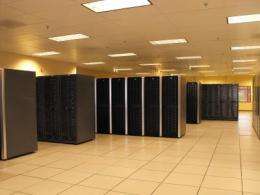
Chinook is a high performance computer that has been tailored to meet the current and future operational needs of Department of Energy EMSL users and can perform more than 160 trillion calculations per second. Credit: PNNL

The newest supercomputer in town is almost 15 times faster than its predecessor and ready to take on problems in areas such as climate science, hydrogen storage and molecular chemistry. The $21.4 million Chinook supercomputer was built by HP, tested by a variety of researchers, and has now been commissioned for use by Pacific Northwest National Laboratory and the Department of Energy.

Housed at EMSL, DOE's Environmental Molecular Sciences Laboratory on the PNNL campus, Chinook can perform more than 160 trillion calculations per second, ranking it in the top 40 fastest computers in the world (see the Top 50). Its predecessor, EMSL's MPP2, could run 11.2 trillion calculations per second.

The Office of Biological and Environmental Research within DOE's Office of Science funded EMSL's upgrade. Although housed at the Pacific Northwest National Laboratory, scientists the world over can use Chinook, competing for time through a peer review process. Users generally conduct research that supports the DOE's missions in energy, the environment, or national security.

This video is not supported by your browser at this time.

EMSL News presents the building of its newest supercomputer. Credit: EMSL

"When combined with EMSL's experimental capabilities, the new Chinook supercomputer will provide scientists from academia, national laboratories, and industry with an unprecedented research tool," said Anna Palmisano, DOE Associate Director for Biological and Environmental Research. "This new supercomputer will allow scientists to develop a molecular-level understanding of the complex biological, chemical and physical processes that underlie the environmental and energy challenges facing DOE and the nation."

Chinook is fast and dexterous. Its designers tailored its architecture to handle scientific problems whose complexity require more than just power or speed. For example, climate scientists who are trying to understand the tiniest particles in the atmosphere or chemists watching how atoms tug at each other in a molecule need a different kind of supercomputer than physicists studying questions like the birth of the universe.

Chinook's top job is to run NWChem, a computational chemistry program that allows researchers to simulate and predict the chemistry within and between molecules. But a wide variety of programs can run on the supercomputer. Scientists are using Chinook to tackle problems such as:

Gas hydrates: Pockets of fuels such as methane are often found deep under the sea, trapped in a lattice of water molecules. Researchers hope to understand these gas hydrates both as a fuel source and as a way to store fuels. But for such a simple molecule, water has pretty complex chemistry. Researchers are using Chinook to help understand how water molecules form stable clusters. The work also gives researchers insight into how small particles in the air form clouds or break them up.

Bacterial transformers: Communities of bacteria live and grow in the soil. And some bacteria have a taste for metals, a talent that can be used to clean up toxic substances in contaminated ground. Researchers use Chinook to understand the inner workings of these bacteria and how they form communities in order to take advantage of their clean-up skills.

Green plastics: Industrial chemists can turn propane gas into plastics and generate only water as a byproduct with the help of compounds called catalysts. Chinook is helping scientists develop a new catalytic material based on small clusters of platinum atoms that does this at least 40 times more efficiently than older materials.

Unlike a consumer buying a PC, EMSL purchased a custom-made machine from HP specifically designed for the demands of computational chemistry. After the computer's delivery and set up (see Chinook being set up here), EMSL asked its users to test the system during a period of time called acceptance testing.

The many dozens of researchers who helped test the machine allowed Chinook's handlers to work out the bugs. Because there are so few clusters of this size, the testing was a vital part of the process, and the more realistic the testing, the better.

"If you just have a few people running large jobs, the amount of communication back and forth between the nodes is very different than if you have a hundred people running calculations of various sizes and in various places on the machine," said PNNL's Erich Vorpagel, who manages all research projects on Chinook at EMSL.

Chinook has 4620 Quad-core processors built into 2310 nodes. Each node can be thought of as the equivalent of four personal computers. But Chinook's nodes are more like supercharged PCs: the Quad-cores give each node the equivalent of eight processor-cores and 32 gigabytes of memory.

Source: DOE/Pacific Northwest National Laboratory

Filter


Move the slider to adjust rank threshold, so that you can hide some of the comments.


Display comments: newest first

jimbo92107
Jul 28, 2009

Rank: 5 / 5 (1)
Finally, a computer that can play Halo at a decent resolution...
docknowledge
Jul 28, 2009

Rank: 5 / 5 (1)
I keep telling my programmers -- optimize your code. But do they listen? Noooooo. Some programmers I know would need Chinook to create a tic-tac-toe game that had reasonable performance. lol.
RayCherry
Jul 28, 2009

Rank: not rated yet
doc ... perhaps this computer could run a decent IDE with a full version control and realtime stream merging with background integration testing ... and monitoring to see which of your programmers are actually working. Anyhow ... back to Halo
dirk_bruere
Jul 29, 2009

Rank: not rated yet
I wish that standard industry words were used.
Is that 160 teraFLOPS?
Note that top of the range graphics cards can execute in the teraFLOPS region. If I was building a machine like that I would go for 100 PCs each with two CUDA enabled graphics cards in SLI and optimised for grid computing. Cost - around $500k
Rank 4 /5 (9 votes)
Related Stories
Relevant PhysicsForums posts
  • How to tilt a object
    created4 hours ago
  • How to calculate total compressibility in liquid porous solid system
    created9 hours ago
  • Need help reading 3-D
    createdFeb 11, 2012
  • A way to send and receive wireless data
    createdFeb 11, 2012
  • Calling function with no input argument
    createdFeb 10, 2012
  • Force free body diagram problem on gym equipment
    createdFeb 10, 2012
  • More from Physics Forums - General Engineering

More news stories

Japan scientist makes 'Avatar' robot

A Japanese-developed robot that mimics the movements of its human controller is bringing the Hollywood blockbuster "Avatar" one step closer to reality.

Electronics / Robotics

created Feb 10, 2012 | popularity 5 / 5 (9) | comments 12

Intel packs performance and reliability into its latest SSD 520 series

Intel Corporation announced today its fastest, most robust client/consumer solid-state drive (SSD) to date, the Intel Solid-State Drive 520 Series (Intel SSD 520), a 6 gigabit-per-second (gbps) SATA III SSD ...

Electronics / Hardware

created Feb 07, 2012 | popularity 5 / 5 (1) | comments 4

Google rumored to have built Heads-Up-Display glasses prototype

(PhysOrg.com) -- 9to5Google is reporting that they have received a tip from someone they believe to be a reliable source saying that Google is working on a Heads-Up-Display (HUD) pair of eye-glasses. The per ...

Electronics / Consumer & Gadgets

created Feb 08, 2012 | popularity 4.3 / 5 (9) | comments 2 | with audio podcast weblog

New Kindle Touch is an impressive e-reader

When it comes to reading digital books, tablets are all the rage. But there's a lot to like about simple e-readers, which over the past year have become both a lot cheaper and a lot less clunky.

Electronics / Consumer & Gadgets

created Feb 09, 2012 | popularity 5 / 5 (4) | comments 1

Apple to debut 'iPad 3' in March: report

Apple will unveil a new version of its market-ruling iPad table computer in March, according to a report in Dow Jones-owned technology blog All Things D.

Electronics / Consumer & Gadgets

created Feb 09, 2012 | popularity 1.9 / 5 (21) | comments 0


Scientists discover molecular secrets of 2,000-year-old Chinese herbal remedy

For roughly two thousand years, Chinese herbalists have treated Malaria using a root extract, commonly known as Chang Shan, from a type of hydrangea that grows in Tibet and Nepal. More recent studies suggest that halofuginone, ...

New method to examine batteries -- MRI from the inside

There is an ever-increasing need for advanced batteries for portable electronics, such as phones, cameras, and music players, but also to power electric vehicles and to facilitate the distribution and storage of energy derived ...

A mitosis mystery solved: How chromosomes align perfectly in a dividing cell

Although the process of mitotic cell division has been studied intensely for more than 50 years, Whitehead Institute researchers have only now solved the mystery of how cells correctly align their chromosomes during symmetric ...

Google might launch Drive for cloud storage soon

(PhysOrg.com) -- Google's next big move, according to the Wall Street Journal, is a cloud storage service called Drive. Hardly first to the plate, Google is simply catching up to introducing its cloud reposi ...

Lab study raises questions over nano-particle impact

Tests involving chickens have raised questions about the impact on health from engineered nano-particles, the ultra-fine grains commonly used in drugs and processed foods, scientists said on Sunday.

Starve a virus, feed a cure? Findings show how some cells protect themselves against HIV

A protein that protects some of our immune cells from the most common and virulent form of HIV works by starving the virus of the molecular building blocks that it needs to replicate, according to research published online ...