Nanophysics: Serving up Buckyballs on a silver platter
July 27, 2009
Nanophysics: Serving up Buckyballs on a silver platter

Enlarge

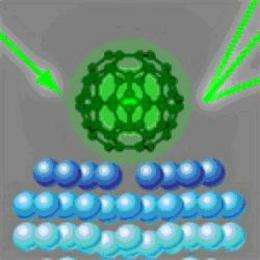
Scientists have imaged the complete structure of C60 molecules on a silver surface with electron diffraction. Credit: Image copyright American Physical Society [Illustration: Alan Stonebraker after H. I. Li et al.]

Scientists at Penn State University, in collaboration with institutes in the US, Finland, Germany and the UK, have figured out the long-sought structure of a layer of C60 - carbon buckyballs - on a silver surface. The results, which could help in the design of carbon nanostructure-based electronics are reported in Physical Review Letters and highlighted in the July 27th issue of APS's on-line journal Physics.

Ever since the 1985 discovery of C60, this molecule, with its perfect geodesic dome shape has fascinated scientists, physicists, and chemists alike. Like a soccer ball, the molecule consists of 20 carbon hexagons and 12 carbon pentagons. The of C60 are very unusual, and there is a massive research effort toward integrating it into molecular scale like transistors and logic gates.

To do this, researchers need to know how the molecule forms bonds with a metal substrate, such as silver, which is commonly used as an electrode in devices. Now, Hsin-I Li, Renee Diehl, and colleagues have determined the geometry of C60 on a silver surface using a technique called low-energy electron diffraction.

They find that the silver atoms rearrange in such a way - namely, by forming a 'hole' beneath each C60 molecule - that reinforces the bonding between the structure and the silver surface.

The measurements push the limits of surface science because the molecules and the re-arrangement of the underlying silver atoms are quite complex. The measurements thus open the door to studies of a large number of technologically and biologically important on surfaces.

More information: physics.aps.org

Source: American Physical Society


Rank 4 /5 (2 votes)
Relevant PhysicsForums posts

More news stories

Lab study raises questions over nano-particle impact

Tests involving chickens have raised questions about the impact on health from engineered nano-particles, the ultra-fine grains commonly used in drugs and processed foods, scientists said on Sunday.

Nanotechnology / Bio & Medicine

created 4 hours ago | popularity 5 / 5 (5) | comments 0

New kind of solar cell could capture significantly more energy than current cells

New solar cells could increase the maximum efficiency of solar panels by over 25%, according to scientists from the University of Cambridge.

Nanotechnology / Nanophysics

created Feb 08, 2012 | popularity 4.5 / 5 (13) | comments 14 | with audio podcast

Nanoshell whispering galleries improve thin solar panels

Visitors to Statuary Hall in the U.S. Capitol Building may have experienced a curious acoustic feature that allows a person to whisper softly at one side of the cavernous, half-domed room and for another on ...

Nanotechnology / Nanomaterials

created Feb 07, 2012 | popularity 4.4 / 5 (7) | comments 6 | with audio podcast

'Dark plasmons' transmit energy

Microscopic channels of gold nanoparticles have the ability to transmit electromagnetic energy that starts as light and propagates via "dark plasmons," according to researchers at Rice University.

Nanotechnology / Nanophysics

created Feb 09, 2012 | popularity 4.8 / 5 (10) | comments 1 | with audio podcast

Revealing how a battery material works

Since its discovery 15 years ago, lithium iron phosphate (LiFePO4) has become one of the most promising materials for rechargeable batteries because of its stability, durability, safety and ability to deliver ...

Nanotechnology / Nanomaterials

created Feb 08, 2012 | popularity 5 / 5 (6) | comments 0 | with audio podcast


Google might launch Drive for cloud storage soon

(PhysOrg.com) -- Google's next big move, according to the Wall Street Journal, is a cloud storage service called Drive. Hardly first to the plate, Google is simply catching up to introducing its cloud reposi ...

Overeating may double risk of memory loss

New research suggests that consuming between 2,100 and 6,000 calories per day may double the risk of memory loss, or mild cognitive impairment (MCI), among people age 70 and older. The study was released today and will be ...

Scientists discover molecular secrets of 2,000-year-old Chinese herbal remedy

For roughly two thousand years, Chinese herbalists have treated Malaria using a root extract, commonly known as Chang Shan, from a type of hydrangea that grows in Tibet and Nepal. More recent studies suggest that halofuginone, ...

New method to examine batteries -- MRI from the inside

There is an ever-increasing need for advanced batteries for portable electronics, such as phones, cameras, and music players, but also to power electric vehicles and to facilitate the distribution and storage of energy derived ...

Injured boomers beware: Know when to see doctor

(AP) -- It happened to nurse Jane Byron years after an in-line skating fall, business owner Haralee Weintraub while doing "men's" push-ups, and avid cyclist Gene Wilberg while lifting a heavy box.

A mitosis mystery solved: How chromosomes align perfectly in a dividing cell

Although the process of mitotic cell division has been studied intensely for more than 50 years, Whitehead Institute researchers have only now solved the mystery of how cells correctly align their chromosomes during symmetric ...