University has grand designs to build a house of straw (w/ Video)
July 27, 2009
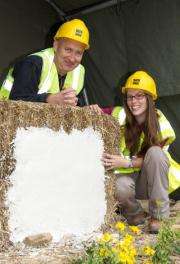
Professor Pete Walker and Dr. Katharine Beadle are investigating the use of straw bales as a low carbon building material. Credit: Nic Delves-Broughton, University of Bath
Could straw houses be the buildings of the future? That's what researchers at the University of Bath will be testing this summer by constructing a "BaleHaus" made of prefabricated straw bale and hemp cladding panels on campus.
And people around the world will be able to watch its progress online via "Strawcam" from Monday 20 July at: www.bath.ac.uk/features/balehaus/
- part of a site which will also feature blogs, videos, photos and lots of other information about the project.
Straw is the ultimate environmentally-friendly building material since it is renewable and is a by-product of farming.
The crop used for the straw can be grown locally, and because it absorbs carbon dioxide as it grows, buildings made from it can be seen as having zero, or even a negative carbon footprint.
This video is not supported by your browser at this time.
Could straw houses be the buildings of the future? That's what researchers at the University of Bath will be testing this summer by constructing a "BaleHaus" made of prefabricated straw bale and hemp cladding panels on campus. Straw is the ultimate environmentally friendly building material since it is renewable and is a by-product of farming. The crop used for the straw can be grown locally, and because it absorbs carbon dioxide as it grows, buildings made from it can be seen as having zero, or even a negative carbon footprint. Credit: Sacha Goodwin & Myra Lee, University of Bath
Also, due to its high insulating properties, houses made of straw bales need almost no conventional heating, keeping running costs low and minimising environmental impact.The research team will be assessing straw bales and hemp as building materials so that they can be used more widely in the building industry for housing, helping the UK achieve its targets for reducing carbon emissions.
The two storey BaleHaus to be built on campus will be made using 'ModCell' - pre-fabricated panels consisting of a wooden structural frame infilled with straw bales or hemp and rendered with a breathable lime-based system.
ModCell is the creation of White Design in Bristol and Integral Structural Design in Bath. Other partners on the research project are Agrifibre Technologies, Lime Technology, Eurban, the Centre for Window & Cladding Technology and Willmott Dixon.
Some of the building has already appeared in the media spotlight. Last year the team helped Kevin McCloud, presenter of Channel 4's Grand Designs programme, to build an eco-friendly house in six days using ModCell panels for the Grand Designs Live exhibition.
All the wall panels used for the ground floor of the Grand Designs house are being reused for the BaleHaus at Bath.
Professor Pete Walker, Director of the BRE Centre in Innovative Construction Materials at the University of Bath, said: "Up to this point straw bales have not really been seen as a credible building material by much of the industry, even though straw has always been used in building for centuries, and straw bales have been used for about 100 years.
"Straw bales are an agricultural by-product and the material can be re-grown so is totally sustainable and renewable. The straw can be grown on a farm that is local to the construction site which saves on transport and minimises the carbon footprint of the building.
"Standard bales are 450 mm thick and provide very high levels of insulation so you need very little additional heating."
The BaleHaus at Bath, due to be completed in the late summer, will be monitored for a year for its insulating properties, humidity levels, air tightness and sound insulation qualities.
Dr Katharine Beadle, the principle researcher on the project, explained: "We're putting sensors into the walls to monitor temperature and humidity levels, and using technology to simulate the heat and moisture generated by people."
Craig White, Director of White Design and ModCell said: "The Zero Carbon Housing challenge the industry faces is not going to be met with conventional design and materials.
"BaleHaus at Bath is an entirely new and renewable way to construct homes fit for the challenge.
"Made from natural materials that are beautiful, affordable and sustainable, BaleHaus is a living, breathing home that is cool in summer and warm in winter, helps families reduce their CO2 footprint without compromising how they choose to live their lives and sets a new and very different benchmark for sustainable homes in the 21st century."
-
Hemp could be key to zero-carbon houses
Apr 09, 2009 |
not rated yet |
0
-
Rice in your gas tank: Boosting biofuel production from rice straw
May 26, 2008 |
not rated yet |
0
-
Opening day for a home of the future
Jan 28, 2008 |
not rated yet |
0
-
Simple insulation could combat heat, cold and noise
Jul 02, 2008 |
not rated yet |
0
-
Of Rice and Hen: Fashions from the Farm
Sep 12, 2006 |
not rated yet |
0
-
Engineers build first sub-10-nm carbon nanotube transistor
Feb 01, 2012 |
4.9 / 5 (30) |
30
-
Something old, something new: Evolution and the structural divergence of duplicate genes
Jan 31, 2012 |
4.6 / 5 (7) |
1
-
The hidden nanoworld of ice crystals: Revealing the dynamic behavior of quasi-liquid layers
Jan 30, 2012 |
5 / 5 (3) |
1
-
Stock market network reveals investor clustering
Jan 27, 2012 |
3.9 / 5 (23) |
8
-
Of microchemistry and molecules: Electronic microfluidic device synthesizes biocompatible probes
Jan 26, 2012 |
5 / 5 (1) |
0
-
Empirical data regarding shower heads and water
6 hours ago
-
feed hold button on CNC lathe
Feb 09, 2012
-
RFAC in Fortran
Feb 09, 2012
-
dynamics 2/32
Feb 08, 2012
-
dynamics
Feb 08, 2012
-
Vibration Absorbtion Problem
Feb 08, 2012
- More from Physics Forums - General Engineering
More news stories
New error-correcting codes guarantee the fastest possible rate of data transmission
Error-correcting codes are one of the triumphs of the digital age. Theyre a way of encoding information so that it can be transmitted across a communication channel such as an optical fiber o ...
Technology / Computer Sciences
13 minutes ago |
5 / 5 (1) |
0
|
US video game sales fall 34 percent in January
(AP) -- U.S. retail sales of video game hardware, software and accessories fell 34 percent in January from a year earlier to $751 million due to the lack of new game titles, according to market researcher NPD Group.
2 hours ago |
not rated yet |
0
Zynga partners with toy maker Hasbro
Old school toy maker Hasbro and online social game star Zynga on Thursday announced a partnership to mesh the Internet firm's hits with real-world products.
2 hours ago |
not rated yet |
0
Digital photos could put kids at risk
A study published in the International Journal of Electronic Security and Digital Forensics this month suggests that parents and carers could be putting children at risk if they upload digital photos that are automatically "geota ...
20 hours ago |
5 / 5 (1) |
3
New battery could lead to cheaper, more efficient solar energy
A joint research project between the University of Southampton and lithium battery technology company REAPsystems has found that a new type of battery has the potential to improve the efficiency and reduce the cost of solar ...
Technology / Energy & Green Tech
20 hours ago |
5 / 5 (3) |
2
High school students test best with 7 hours' rest
(Medical Xpress) -- Whether or not you know any high school students that actually get nine hours of sleep each night, thats what federal guidelines currently prescribe.
Soccer -- the link between managers and captains
Soccer managers regard their captains as an extension of themselves, according to new research from Northumbria University, which could explain why Fabio Capello quit as England manager following the FA row ...
Using economic evaluations for drug reimbursement decisions - what have we achieved?
Researchers at the University of York perform evaluations of the clinical and cost-effectiveness of drugs for the National Institute for Health and Clinical Excellence (NICE).
Humans may have helped the decline of African rainforests 3000 years ago
(PhysOrg.com) -- Large areas of rainforests in Central Africa mysteriously disappeared over three thousand years ago, to be replaced by savannas. The prevailing theory has been that the cause was a change ...
Japan scientist makes 'Avatar' robot
A Japanese-developed robot that mimics the movements of its human controller is bringing the Hollywood blockbuster "Avatar" one step closer to reality.
Protein libraries in a snap
(PhysOrg.com) -- A Rice University undergraduate will depart with not only a degree but also a possible patent for his invention of an efficient way to create protein libraries, an important component of biomolecular ...
Jul 27, 2009
Rank: not rated yet
I first read about this in the 'Earthship' book series published in 1990.
Why are we constantly reinventing things that were proven to work decades ago?
I can remember at least 4 times seeing 'new invention turns trash into oil' in the headlines over the last 10 years, referring to thermal depolymerization.
Jul 27, 2009
Rank: not rated yet
Jul 29, 2009
Rank: not rated yet
We've been living in our home since Dec 2002 and have had no problems with pests, rodents or fires! The walls are encased with lime, they are in-filled not load bearing and the house temps are very well regulated. We also have double glazed windows, roof insulation and can tell you that in our regional conditions of extreme heat and cold this house outperforms anything else in this area by far!
I have some photos of construction phase that I am more than happy to share if anyone's interested and also a chart of a week in mid-winter that shows internal and external temps, ( without any form of heating inside).
Good luck to the folk @ Bath Uni for promoting a very viable building method, I can attest to it's abilities, it's character and costs.
Dee.
Oh and by the way - hay is for horses, straw is for houses! ;-)