Researchers capture bacterial infection on film (w/ Video)
July 27, 2009 Researchers capture bacterial infection on film

Enlarge

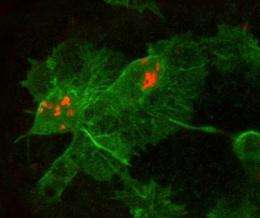
Confocal microscope image showing insect immune cells (green) containing fluorescently labelled E.coli (red). Credit: University of Bath

(PhysOrg.com) -- Researchers have developed a new technique that allows them to make a movie of bacteria infecting their living host.

Whilst most studies of bacterial are done after the death of the infected organism, this system developed by scientists at the University of Bath and University of Exeter is the first to follow the progress of infection in real-time with living organisms.

The researchers used developing fruit fly embryos as a model organism, injecting fluorescently tagged bacteria into the and observing their interaction with the insect's immune system using time-lapse confocal microscopy.

The researchers can also tag individual bacterial proteins to follow their movement and determine their specific roles in the infection process.

FLV player

The insect immune cells known as hemocytes (green) rapidly engulf the bacteria following infection and this can be studied in real-time using timelapse microscopy. Credit: Isabella Vlisidou, University of Bath

The scientists are hoping to use this system in the future with human pathogens such as Listeria and Trypanosomes. By observing how these bacteria interact with the , researchers will gain a better understanding of how they cause an infection and could eventually lead to better antibacterial treatments.

Dr Will Wood, Research Fellow in the Department of Biology & Biochemistry at the University of Bath, explained: " often behave very differently once they have been taken out of their natural environment and cultured in a petri dish.

"In the body, immune surveillance cells such as hemocytes (or macrophages in vertebrates) are exposed to a battery of signals from different sources. The cells integrate these signals and react to them accordingly.

"Once these cells are removed from this complex environment and cultured in a petri dish these signals are lost. Therefore it is really important to study whole organisms to fully understand how bacteria interact with their host."

Dr Nick Waterfield, co-author on the study and Research Officer at the University of Bath, said: "To be able to film the microscopic battle between single bacterial cells and immune cells in a whole animal and in real time is astounding.

"It will ultimately allow us to properly understand the dynamic nature of the infection process."

Professor Richard Ffrench-Constant, Professor of Molecular Natural History at the University of Exeter, added: "For the first time this allows us to actually examine infection in real time in a real animal - it's a major advance!"

The study has been published in PLoS .

Source: University of Bath (news : web)


print this article email this article download pdf blog this article bookmark this article     Stumble it Digg this share on Facebook retweet share on Reddit add to delicious
Rate this story - 5 /5 (3 votes)


July 27, 2009 all stories

Comments: 0

5 /5 (3 votes)
  • Stumble this up

  • Digg this

  • share this

  • hide
  • Related Stories


  • hide
  • Relevant PhysicsForums posts

  • Selenocysteine in pH=7
    created Nov 26, 2009
  • What is the formula for calculating the speed of thought?
    created Nov 26, 2009
  • What does word "absorption" mean in the intestine?
    created Nov 26, 2009
  • What is transpulmonary pressure?
    created Nov 24, 2009
  • More from Physics Forums - Biology

Other News

Golden Oldie: Key Role for Ancient Protein in Algae Photosynthesis

Golden Oldie: Key Role for Ancient Protein in Algae Photosynthesis

Biology / Biotechnology

created 4 hours ago | popularity not rated yet | comments 1

The discovery that an ancient light harvesting protein plays a pivotal role in the photosynthesis of green algae should help the effort to develop algae as a biofuels feedstock. Researchers with the Lawrence ...


Hammerhead shark

Wide heads give hammerheads exceptional stereo view

Biology / Plants & Animals

created 13 hours ago | popularity 4.4 / 5 (5) | comments 4

Hammerhead sharks are some of the Ocean's most distinctive residents. 'Everyone wants to understand why they have this strange head shape,' says Michelle McComb from Florida Atlantic University. One possible ...


Indonesia rejects Bali plan for turtle sacrifices (AP)

Indonesia rejects Bali plan for turtle sacrifices

Biology / Ecology

created 10 hours ago | popularity not rated yet | comments 0

(AP) -- Indonesia has rejected a push by the resort island of Bali for rare turtles to be legally slain in Hindu ceremonies, siding with conservationists of the protected reptiles against religious advocates, ...


Tough yet stiff deer antler is materials scientist's dream

Biology / Plants & Animals

created 13 hours ago | popularity 3 / 5 (1) | comments 2

Prized for their impressive antlers, red deer have been caught in the hunters' sights for generations. But a deer's antlers are much more than decorative. They are lethal weapons that stags crash together when duelling. John ...


Ecologists sound out new solution for monitoring cryptic species

Biology / Ecology

created 13 hours ago | popularity not rated yet | comments 0

Ecologists have at last worked out a way of using recordings of birdsong to accurately measure the size of bird populations. This is the first time sound recordings from a microphone array have been translated into accurate ...