121 breeding tigers estimated to be found in Nepal
July 27, 2009
121 breeding tigers estimated to be found in Nepal

Enlarge

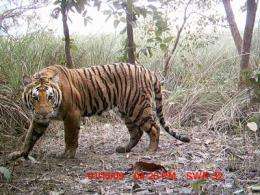
This Bengal tiger (Panthera tigris tigris) was caught on a camera trap in Nepal's Terai Arc Landscape as part of an estimate of tiger populations. Credit: Government of Nepal

The first ever overall nation-wide estimate of the tiger population brought a positive ray of hope among conservationists. The figures announced by the Nepal Government's Department of National Parks and Wildlife Conservation (DNPWC) shows the presence of 121 (100 - 194) breeding tigers in the wild within the four protected areas of Nepal. The 2008 tiger population estimate was jointly implemented by the DNPWC, Department of Forests (DOF), WWF, National Trust for Nature Conservation (NTNC) with support from Save The Tiger Fund (STF), WWF-US, WWF-UK, WWF International and US Fish and Wildlife Service (USFWS).

The 2008 nation-wide tiger population was initiated on 15 November 2009 in the Terai Arc Landscape (TAL) of Nepal both inside and outside the protected areas of Nepal. [TAL encompasses the Terai region of Nepal and into tiger range states across the border into India.]

"To obtain reliable population estimates of wide ranging species like the tiger, it is important to undertake the survey simultaneously in all potential habitats," says Dr. Rinjan Shrestha, Conservation Biologist with WWF Nepal. Previous studies had been undertaken in different time periods and at different spatial scales.

"To derive information on both abundance and distribution of tigers, the current survey employed two methods - Camera Trapping method inside the protected areas and Habitat Occupancy survey both inside and outside the protected areas."
121 breeding tigers estimated to be found in Nepal
Enlarge

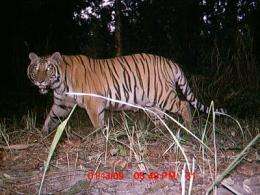
This Bengal Tiger (Panthera tigris tigris) was caught on a camera trap in Nepal's Terai Arc Landscape as part of an estimate of tiger populations. Credit: Government of Nepal

According to WWF Global Tiger Network Initiative, the wild tiger population is at a tipping point. Tigers are experiencing a range collapse, occupying 40 per cent less habitat than was estimated just one decade ago. The estimated number of tigers in important range countries is frighteningly low, with a recent government census suggesting there may be as few as 1,300 tigers left in India, the species' stronghold. And tigers are facing an epidemic of poaching and habitat loss across their range.

The main reason for the decline of tiger populations has been attributed to poaching and illegal trade. This is linked to the illegal international trade in tiger parts and derivatives (skin, bones, meat in some cases although not reported in Nepal) and use in traditional Chinese Medicines (TCM). Apart from these, sporadic cases of retaliatory killing from irate communities have been reported. Other important reasons of tiger population decline are habitat shrinkage and fragmentation due to human intervention, loss/decline of prey species.

"The numbers have increased in Chitwan but decreased in Bardia and Shuklaphanta," said Mr. Anil Manandhar, Country Representative, WWF Nepal.

"In spite of the decade long insurgency, encroachment, poaching and illegal trade, the present numbers is a positive sign, but we can't remain unworried. The declining numbers in western Nepal has posed more challenges, needing a concerted effort to save this charismatic endangered species focusing on anti-poaching and illegal wildlife trade."

The Government of Nepal has approved and launched the 'Tiger Action Plan 2008- 2012'. A comprehensive management plan has been devised in which the target is to increase the population of tigers by 10 per cent within the first 5 year period of the plan implementation.

"Tigers can not be saved by the effort of a single individual or a single organization," said Mr. Gopal Prasad Upadhyay, Director General, DNPWC. "The transboundary relation with India needs to be strengthened further and all organizations should work together to conserve tigers."

Source: World Wildlife Fund


Rank not rated yet
Related Stories
Relevant PhysicsForums posts
  • Stem cell question.
    createdFeb 10, 2012
  • Protease cleavage
    createdFeb 10, 2012
  • Pertubance in a model
    createdFeb 10, 2012
  • Cancer drugs and Alzheimer's, Oh my!
    createdFeb 09, 2012
  • Squishing cells
    createdFeb 09, 2012
  • Any books/articles for evolutionary stable strategy models in humans?
    createdFeb 09, 2012
  • More from Physics Forums - Biology

More news stories

Entire genome of extinct human decoded from fossil

(PhysOrg.com) -- In 2010, Svante Pääbo and his colleagues presented a draft version of the genome from a small fragment of a human finger bone discovered in Denisova Cave in southern Siberia. The ...

Biology / Biotechnology

created Feb 07, 2012 | popularity 4.7 / 5 (58) | comments 45 | with audio podcast

Why are there so few fish in the Earth's oceans?

(PhysOrg.com) -- A Stony Brook University researcher has found that, contrary to popular belief, there are not plenty of fish in the sea.

Biology / Plants & Animals

created Feb 08, 2012 | popularity 4.3 / 5 (17) | comments 26 | with audio podcast

Miami battling invasion of giant African snails

No one knows how they got there. But an invasion of African giant snails has southern Florida in a panic over potential crop damage, disease and general yuckiness surrounding the slimy gastropods.

Biology / Ecology

created Feb 10, 2012 | popularity 4.5 / 5 (2) | comments 5

Deciding to go left or right: Researchers use device to determine that lower animals can navigate too

For decades, scientists have associated binary decision making — opting to go left or right — with higher-ranking animals, including humans. A team of Harvard researchers, however, is rewriting that ...

Biology / Plants & Animals

created Feb 09, 2012 | popularity 4 / 5 (1) | comments 4 | with audio podcast

Study shows chimps able to understand needs of others

(PhysOrg.com) -- By setting up a unique experiment, a small team of researchers has found that chimpanzees are able to understand need in other chimps, despite their general disinclination to offer aid when ...

Biology / Plants & Animals

created Feb 07, 2012 | popularity 5 / 5 (2) | comments 4 | with audio podcast report


Google might launch Drive for cloud storage soon

(PhysOrg.com) -- Google's next big move, according to the Wall Street Journal, is a cloud storage service called Drive. Hardly first to the plate, Google is simply catching up to introducing its cloud reposi ...

Latin America mining boom clashes with conservation

Latin America is experiencing a mining boom as prices rise fuelled by a hike in global demand, but the region is also being hit by a wave of violent protests, strikes and rallies by environmentalists.

Walney offshore wind farm is world's biggest (for now)

(PhysOrg.com) -- The Walney wind farm on the Irish Sea--characterized by high tides, waves and windy weather--officially opened this week. The farm is treated in the press as a very big deal as the Walney ...

Love a click away in Indonesia's Twitter Republic

He was a geeky kid from Yogyakarta, she a glamorous city girl in Jakarta. In a country with one of the world's most vibrant social networking scenes they fell in love on Twitter.

GPS court ruling leaves US phone tracking unclear

A US Supreme Court decision requiring a warrant to place a GPS device on the car of a criminal suspect leaves unresolved the bigger issue of police tracking using mobile phones, legal experts say.

Europeans protest controversial Internet pact

Tens of thousands of people marched in protests in more than a dozen European cities Saturday against a controversial anti-online piracy pact that critics say could curtail Internet freedom.