New study sheds light on earthquake hazard along San Andreas Fault
July 27, 2009 Scripps-led study sheds light on earthquake hazard along San Andreas Fault

Enlarge

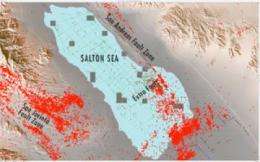
A seismic map of the Salton Sea area reveals the grid covered by the CHIRP instrument (green lines), faults (black lines) and bomb target sites (gray boxes). The red dots represent earthquakes that have taken place in the area since 1983. Credit: Scripps Institution of Oceanography, UC San Diego

New research by a team of scientists from Scripps Institution of Oceanography at UC San Diego and the U.S. Geological Survey (USGS) offers new insight into the San Andreas Fault as it extends beneath Southern California's Salton Sea. The team discovered a series of prominent faults beneath the sea, which transfer motion away from the San Andreas Fault as it disappears beneath the Salton Sea. The study provides new understanding of the intricate earthquake faults system beneath the sea and what role it may play in the earthquake cycle along the southern San Andreas Fault.

"The stretch of the San Andreas Fault that extends into the Salton Sea is an important part of the overall fault system but it remains poorly understood," said Danny Brothers, a Scripps graduate student and lead author on the study. "Our results provide crucial information on how deformation is transferred from the to the Imperial Fault and how young basins along strike-slip faults, such as the Salton Sea, evolve through time."
Scripps-led study sheds light on earthquake hazard along San Andreas Fault
Enlarge

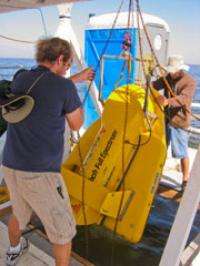
Scripps researchers deploy the CHIRP image profiler. Credit: Scripps Institution of Oceanography, UC San Diego

In a study published in the July 26 early online edition of the journal Nature Geoscience, the Scripps-led research team including Brothers, Neal Driscoll, Graham Kent, Alistair Harding, Jeff Babcock and Rob Baskin, from the USGS, used geophysical methods to image the faults beneath the Salton Sea. This study offers new information on the location of faults and how they communicate tectonic deformation with neighboring faults located onshore.

]The Salton Sea is flanked by two major faults - the San Andreas and San Jacinto - and recent studies have revealed that the region has experienced magnitude-7 earthquakes roughly every 200 years for the last thousand years. Previous studies conducted by researchers at San Diego State University and Cal Tech indicate that it has been approximately 300 years since the last rupture.
Scripps-led study sheds light on earthquake hazard along San Andreas Fault
Enlarge

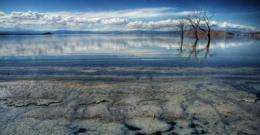
Tranquil waters of the Salton Sea mirror the sky overhead. Credit: Tyler Huston

"We discovered a series of prominent faults near Bombay Beach during pilot studies in 2006 and 2007, and went on to survey the area more comprehensively in 2008 and 2009," researchers stated in the journal's "backstory" commentary section. The highlight of the expedition was when the team discovered the first previously unknown fault in the Salton Sea, just miles offshore from Bombay Beach, Calif.

The research team used a high-resolution seismic imaging technique, known as CHIRP, to image the layers of sediments beneath the lake that have been offset by the motion of faults. Scripps' Neal Driscoll developed the digital CHIRP profiler to provide high-quality imagery of the sediments below oceans and lakes to offer a comprehensive view of underwater faults.

Source: University of California - San Diego (news : web)


print this article email this article download pdf blog this article bookmark this article     Stumble it Digg this share on Facebook retweet share on Reddit add to delicious
Rate this story - 3.7 /5 (3 votes)

Rank Filter

Move the slider to adjust rank threshold, so that you can hide some of the comments.


Display comments: newest first

  • out7x - Jul 30, 2009
    • Rank: 1 / 5 (1)
    CHIRP shows layers to a few hundred feet depth. This is a very shallow survey.

July 27, 2009 all stories

Comments: 1

3.7 /5 (3 votes)
  • Stumble this up

  • Digg this

  • share this

  • hide
  • Related Stories


  • hide
  • Relevant PhysicsForums posts

  • The IPCC and the term "most"
    created 16 hours ago
  • Is global warming a fact?
    created 17 hours ago
  • Random variability of wind patterns
    created Nov 23, 2009
  • Record precipitation in the UK
    created Nov 22, 2009
  • More from Physics Forums - Earth

Other News

From Greenhouse to Icehouse

From Greenhouse to Icehouse

Space & Earth / Earth Sciences

created 31 minutes ago | popularity not rated yet | comments 0

A new study that reconstructed ocean temperatures from millions of years ago could provide new insight into how the Earth responds to climate change.


Humanity would need five Earths to create the resources needed if everyone lived as like Americans, a report has stated

Mankind using Earth's resources at alarming rate

Space & Earth / Environment

created 23 minutes ago | popularity not rated yet | comments 1

Humanity would need five Earths to produce the resources needed if everyone lived as profligately as Americans, according to a report issued Tuesday.


Kepler Mission Manager Update

Space & Earth / Space Exploration

created 50 minutes ago | popularity not rated yet | comments 0

(PhysOrg.com) -- Kepler experienced a safe mode event on Nov. 18, 2009.


'Cosmic fruit machine' matches collisions

'Cosmic fruit machine' matches collisions

Space & Earth / Astronomy

created 2 hours ago | popularity not rated yet | comments 0

(PhysOrg.com) -- A new website will give everyone the chance to contribute to science by playing a 'cosmic fruit machine' and compare images of colliding galaxies with millions of simulated images of galactic ...


Astronauts rest up after 3 spacewalks

Space & Earth / Space Exploration

created 1hour ago | popularity not rated yet | comments 0

(AP) -- The astronauts aboard the orbiting shuttle-station complex are resting after their three successful spacewalks.