Transparent aluminium is 'new state of matter'
July 27, 2009
Transparent aluminium is 'new state of matter'

Enlarge

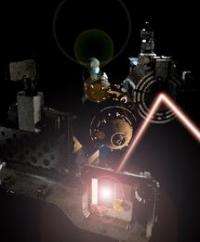
Experimental set-up at the FLASH laser used to discover the new state of matter.

(PhysOrg.com) -- Oxford scientists have created a transparent form of aluminium by bombarding the metal with the world’s most powerful soft X-ray laser. 'Transparent aluminium' previously only existed in science fiction, featuring in the movie Star Trek IV, but the real material is an exotic new state of matter with implications for planetary science and nuclear fusion.

In this week’s Nature Physics an international team, led by Oxford University scientists, report that a short pulse from the FLASH laser ‘knocked out’ a core electron from every atom in a sample without disrupting the metal’s crystalline structure. This turned the aluminium nearly invisible to extreme ultraviolet radiation.

''What we have created is a completely new state of matter nobody has seen before,’ said Professor Justin Wark of Oxford University’s Department of Physics, one of the authors of the paper. ‘Transparent aluminium is just the start. The physical properties of the matter we are creating are relevant to the conditions inside large planets, and we also hope that by studying it we can gain a greater understanding of what is going on during the creation of 'miniature stars' created by high-power laser implosions, which may one day allow the power of to be harnessed here on Earth.’

The discovery was made possible with the development of a new source of radiation that is ten billion times brighter than any synchrotron in the world (such as the UK’s Diamond Light Source). The FLASH laser, based in Hamburg, Germany, produces extremely brief pulses of soft X-ray light, each of which is more powerful than the output of a power plant that provides electricity to a whole city.

The Oxford team, along with their international colleagues, focused all this power down into a spot with a diameter less than a twentieth of the width of a human hair. At such high intensities the aluminium turned transparent.

Whilst the invisible effect lasted for only an extremely brief period - an estimated 40 femtoseconds - it demonstrates that such an exotic state of matter can be created using very high power X-ray sources.

Professor Wark added: ‘What is particularly remarkable about our experiment is that we have turned ordinary aluminium into this exotic new material in a single step by using this very powerful laser. For a brief period the sample looks and behaves in every way like a new form of matter. In certain respects, the way it reacts is as though we had changed every aluminium atom into silicon: it’s almost as surprising as finding that you can turn lead into gold with light!’

The researchers believe that the new approach is an ideal way to create and study such exotic states of matter and will lead to further work relevant to areas as diverse as planetary science, astrophysics and nuclear fusion power.

A report of the research, 'Turning solid aluminium transparent by intense soft X-ray photoionization', is published in . The research was carried out by an international team led by Oxford University scientists Professor Justin Wark, Dr Bob Nagler, Dr Gianluca Gregori, William Murphy, Sam Vinko and Thomas Whitcher.


Join PhysOrg.com on Facebook!
Follow PhysOrg.com on Twitter!
Provided by Oxford University (news : web)

4.3 /5 (106 votes)  

Filter


Move the slider to adjust rank threshold, so that you can hide some of the comments.


Display comments: newest first

jaggspb
Jul 27, 2009

Rank: 1.5 / 5 (8)
How do we know he didn't invent the thing?
earls
Jul 27, 2009

Rank: 2.5 / 5 (8)
"nearly invisible to extreme ultraviolet radiation."

*yaaaaaaaaaaaaaaaaaawn*
OregonWind
Jul 27, 2009

Rank: 2.7 / 5 (6)
'How do we know he didn't invent the thing? "

That was an entire team. Hard to fake this type of claim.

I remember that in Star Trek when Scott gave to a guy the formula to create transparent aluminum or aluminium. Who could imagine that something, even if not exactly like that, would be possible? I am teaching science to my kids but also motivate them to read science fiction stories.

rustyrufus
Jul 27, 2009

Rank: 3.8 / 5 (8)
Is anyone here knowledgeable enough to explain how it is possible to determine that a form of matter is transparent when it only exists for 40 femtoseconds?
h0dges
Jul 27, 2009

Rank: 3.4 / 5 (8)
Why choose aluminium that's my question. They sooooooo went for the headline.
WithOneT
Jul 27, 2009

Rank: 2.1 / 5 (11)
This is not new. There is a company in the US that has been producing this product for the military for a while.
Mr_Frontier
Jul 27, 2009

Rank: 3.8 / 5 (13)
Most radiation detection technology is quick enough, in the order of femtoseconds, to photomultiply and record quanta this small/fast. If a thin enough sheet of aluminium is placed in front of a UV source, the laser bombarding the sheet would render the spot irradiated "transparent" to the source behind it, which they claim isn't opaque anymore to a certain wavelength of UV. A fast detector could absolutely record a 40 femtosecond blip that will hit the detector on the opposing side of the sheet from which the laser is incident on. The UV can be confirmed on a calibrated oscilloscope. However, this is a totally general way to assume how experiment was performed, but the lack of detail in most of these articles creates assumptions like this; common. I hope this technique helps some people on here fill in the assumptions. Any other ideas?
Mr_Frontier
Jul 27, 2009

Rank: 2.6 / 5 (5)
A possible use for this is a 40 femtosecond cycle optical transistor that may possibly even conduct electrical information to other components while its cycling/processing information optically.
GrayMouser
Jul 27, 2009

Rank: 1.9 / 5 (15)
Scientist have been known for many years to make
up and fudge data to support their most important
research,,,,,,,,more money !

Except for AGW. They would NEVER falsify their data or models just to get their share of $17B (since 1988.)
Frostfire
Jul 27, 2009

Rank: 2.8 / 5 (6)
A possible use for this is a 40 femtosecond cycle optical transistor that may possibly even conduct electrical information to other components while its cycling/processing information optically.


How quickly science fiction becomes science fact.

A possible use, someone is already thinking about making it, useful.

rustyrufus
Jul 27, 2009

Rank: 3 / 5 (5)
Mr Frontier, thanks for taking time to offer an answer to my question. Appreciated. :-)
Ivan2
Jul 27, 2009

Rank: 1.5 / 5 (4)
"Any other ideas?":

Is the aluminium decompressed or compressed? What happens when you decompress it?

(doesn't "mean" anything, it's just a hunch!)
fhtmguy
Jul 27, 2009

Rank: 1.8 / 5 (12)
____________________________________________
The FLASH laser, based in Hamburg, Germany, produces extremely brief pulses of soft X-ray light, each of which is more powerful than the output of a power plant that provides electricity to a whole city.
__________________________________________________


Now that we have created transparent aluminum that lasts for "no time at all" maybe we should take the power from this INCREDIBLE "Laser" and power a city with the "short flash" instead of creating the illusive invisible metal.
Arikin
Jul 27, 2009

Rank: 2.5 / 5 (6)
fhtmguy,
Simple answer is that we can study the material and the laser implosion to help understand miniature stars. For example nuclear fusion that would provide almost unlimited power.

We need to try and explore to move forward...
Ivan2
Jul 27, 2009

Rank: 2.3 / 5 (6)
"maybe we should take the power from this INCREDIBLE "Laser" and power a city with the "short flash" instead of creating the illusive invisible metal":


What if Scottie was right? What if there is a way to stabilize "invisible" aluminium?
QubitTamer
Jul 27, 2009

Rank: 3.6 / 5 (8)
computer.... cooooommmmmpuuuuuuuterrrrrrr? Oh a keyboard!! How Quaint!
iledius
Jul 28, 2009

Rank: 2 / 5 (6)
I can't but wonder if this kind of research really is the best way to use energy, money and expertise of the researchers? A whole city worth electricity for 40 femtosecond effect to study a phenomenon that MAYBE could prove useful SOMEDAY, when we could use the energy, money and expertise to improve the quality of life for all people and preserve the environment with the technology that we have available NOW?

I don't want to sound ignorant towards this kind of research, it's just that lately I've been wondering is it really necessary right here and right now?
ShotmanMaslo
Jul 28, 2009

Rank: 4.4 / 5 (7)
iledius and others - This laser cannot power a city, and it doesnt even use a lot of energy. It uses that much power, but only for 40 femtoseconds. I doubt you want to power a city for 40 femtoseconds.
Remember, power is different thing than energy.
iledius
Jul 28, 2009

Rank: 3.3 / 5 (3)
ShotmanMaslo: Thanks for clearing that up, I stand corrected. :)
WithOneT
Jul 28, 2009

Rank: 2.5 / 5 (4)
I saw a feature about a company in Mass on the Discovery channel that has this product on the market already. Why is this "breakthrough" any different?

Hey everyone I just invented the wheel, come and look!
antialias
Jul 28, 2009

Rank: 3.4 / 5 (5)
Now that we have created transparent aluminum that lasts for "no time at all" maybe we should take the power from this INCREDIBLE "Laser" and power a city with the "short flash" instead of creating the illusive invisible metal.


Because it would power the city only for 40 femtoseconds (Power is not equal to Energy).

Lasers of this kind are decidedly NOT built for continuous operation. The actual energy used in the experiment is rather small - just like a flash of lightning has a lot of POWER, but not a lot of ENERGY.


Example: At 10 million volts and 10000 Amperes and one microsecond duration a flash has only 0.027 kWh of Energy. For comparison: an average citizen uses about 6000kWH of Energy per year.


Or for this experiment (assuming a city needs something on the order of 1GW of power): At 40 femtoseconds that would be merely a total ENERGY output of about 10 nanoWattHours. You couldn't light up an LED with the energy provided by this experiment.
nghtstr
Jul 28, 2009

Rank: 3.7 / 5 (3)
Listen, I know this doesn't seem like a big deal. However, like most scientific discoveries, it takes a bunch of smaller ones to make a lasting impact. I would challenge all of you nay-sayers out there to take a look at this again in 10 years, and I think that more than likely we will have things already using this discovery.

I remember some time ago when people were trying to transfer power wirelessly. Nowadays, it can be done, but just not effectively enough yet. In another few years, I would say it would be mainstream.

Every large scientific discovery takes one small discover to start it.

Personally, I congratulate them on their accomplishment!!
Ethelred
Jul 28, 2009

Rank: 4 / 5 (5)
Isn't 'Transparent aluminium' just a fancy name for colourless sapphire?


No more than glass is another name for silicon. Sapphire is an oxide of aluminum just like glass is an oxide of silicon. Making a metal transparent is a tad harder than making an oxide transparent. I think it has to do with those electrons wandering around.

Ethelred
Nuevo
Jul 28, 2009

Rank: 2.3 / 5 (3)
I have hypothesis that it is possible to fire a laser into a electrical magnetic generator to create
direct energy power source.
the issues are creating more energy than you expend firing the laser and capturing the energy that is created and transferring that energy to the power grid

and yes i do have a design for a magnetic energy generator and designs on creating new batteries and the flash transfer of power
bluehigh
Jul 28, 2009

Rank: 3.2 / 5 (5)
Is this process destructive? Almost anything will turn transparent briefly as it vapourises.

If there is a change of state and modification to electron distribution, is it still a metal?

Perhaps it is a saphire momentarily but more likely just a gas!

mangodurian
Jul 28, 2009

Rank: 3.2 / 5 (5)
Erm ... maybe the super powerful FLASH laser that is brighter than the light from a whole city actually *burnt a hole* through the really thin aluminium?!

otto1923
Jul 28, 2009

Rank: 2.3 / 5 (3)
So let's figure out how to make sapphires the size of whale tanks. Rank that Mr. Ranker
bluehigh
Jul 29, 2009

Rank: 3 / 5 (4)
I expect we can make sapphires large enough to contain a couple of whales. Like many technological challenges its a matter of time and money. In the case of whales we may not have enough time and does anyone care enough to spend the money. Better to wait a few centuries, borrow a klingon bird of prey, sling shot around the sun to achieve time travel, meet a pretty girl and save the whales all in a few days .. much more fun.
fhtmguy
Jul 29, 2009

Rank: 3 / 5 (2)
I undestand that the energy output of the laser is extremely small. I was making fun of the way the article was written!

Come on, this is really not transparent aluminum, and I don't believe they proved this a new state of matter. At best it might be considered an altered state due to the way the radiation "knocked out" an electron. These scientists or the article writer should word the facts in a factual way. While Transpartent aluminum may be possible, this procedure will probably not produce it anytime soon, unless they want to produce continual radiation to keep it transparent.
bluehigh
Jul 30, 2009

Rank: 3 / 5 (2)
Are there any known transparent metals?
bluehigh
Jul 30, 2009

Rank: 3 / 5 (2)
at room temperature.
Ethelred
Jul 30, 2009

Rank: 4.3 / 5 (7)
Only in very thin films. Careful control of the thickness of the metal coating can block a specific frequency of light. The electronic conditions that make a substance a metal also make it reflect light. This is supposed to be due to some electrons being able to move freely from one atom to another in the metal.

Ethelred
ninthdoctor
Jul 30, 2009

Rank: 3 / 5 (2)
it is a fact that yesterdays science fiction is tomorrow's science fact... it was there waiting for us to find all along.. you think this one is a good one think of the fun when they find the higgs later this year at cern... i covers areas such as teleportation to time travel...
guiding_light
Jul 30, 2009

Rank: 4.3 / 5 (6)
I don't find anything wondrous about it. I think they explained it: they saturated the EUV absorption by exciting every appropriate core transition. But it is well known, this core electron ionization will be followed by other lower energy ionizations, which will affect the structure of the aluminum.
guiding_light
Jul 30, 2009

Rank: 4.3 / 5 (6)
Is this process destructive? Almost anything will turn transparent briefly as it vapourises.


If there is a change of state and modification to electron distribution, is it still a metal?


Perhaps it is a saphire momentarily but more likely just a gas!


Yes, in previous FLASH studies they demonstrated diffraction by soft X-ray (EUV) before the dielectric sample exploded as a plasma.
Grokodile
Jul 30, 2009

Rank: not rated yet
So, once the thing is transparent seal it in an insulator so it's electrons can't flow back...
Alizee
Jul 30, 2009

Rank: 2.3 / 5 (3)
Are there any known transparent metals?
Yes, for example the sodium metal under high pressure. It's in fact electride, not true metal, though.
Alizee
Jul 30, 2009

Rank: 3.3 / 5 (3)
The transparence of aluminium under X-ray has its analogy in nonlinear optical effects, for example uranyl glass becomes transparent under strong illumination by electrical spark.

Heavier atoms (like xenon) binds their electrons so strongly, the full removal of electrons requires usage of energy densities, under which atom nuclei decomposes. Neverthelles the remaining electrons exhibits strong Lamb shift and another interesting phenomena due the vacuum fluctuations, so that scientists are trying to prepare stripped atom nuclei in larger amount.
plasma_guy
Jul 31, 2009

Rank: 5 / 5 (2)
The physorg article above does little justice to the actual nature physics article. It's all about the photoionization of aluminum by EUV. It is truly a transient plasma-like ionized condensed state. What is not discussed is how much charge builds up from photoelectrons leaving the surface.
guiding_light
Jul 31, 2009

Rank: 5 / 5 (1)
After the photoelectron, the second ionization is the Auger electron. One may argue these ionized electrons will have harder time to lose energy to ionized atoms by producing secondary electrons, meaning they travel farther.
dmcl
Jul 31, 2009

Rank: not rated yet
glass is not simply oxidized silicon. That would be quartz. Glass is usually a non crystaline oxide, with additives or fluxing agents that control the temperature at which it becomes rigid, the melt viscosity, color and other properties.
Ethelred
Aug 01, 2009

Rank: 5 / 5 (1)
glass is not simply oxidized silicon. That would be quartz.


True. However the point was that silicon is opaque whereas silicon oxide is transparent. Much like aluminum oxide.

Ethelred
guiding_light
Aug 01, 2009

Rank: not rated yet
The FLASH previously multi-ionized Xe using 57 EUV (93 eV) photons:

http://hasylab.de...eng.html
nighmare
Aug 01, 2009

Rank: not rated yet
how does it behaiv with all kind of waves
Alizee
Aug 01, 2009

Rank: 3 / 5 (2)
..previously multi-ionized Xe using 57 EUV (93 eV) photons
Interesting aspect of these experiments is, here exist an energetic continuum for breakdown of heaviest atoms: the electrostatical force binding the remnants of electrons is comparable to strong nuclear force here, so here's no fundamental difference in force constant of both interactions in agreement to Electroweak-Strong Unification.

It means, at extreme energy density whole atom behaves like homogeneous ball of quarks with fuzzy boundary between atom nuclues and atom orbital in simmilar way, like at the center of giant stars.
kasen
Aug 02, 2009

Rank: 5 / 5 (2)
So is it an actual new state of matter, or just an exotic amalgam of the properties of the 'old' ones?
A bit off-topic: the article's title sounds like a fashion magazine headline.
dev2000
Aug 04, 2009

Rank: not rated yet
Did anyone consider the possibility that the X-ray may have knocked the sample into a parallel universe for 40 femtoseconds? Therefore, it would have appeared in this other dimension for 40 femtoseconds and surprised an innocent bystander in that universe. ;)
bleuheaven
Aug 05, 2009

Rank: not rated yet
Hi, could anybody tell me what is the most 'in vogue' theory about gravitation? I haven't read something in domain for a long time and I lost contact with the latest discoveries...
Rank 4.3 /5 (106 votes)
Relevant PhysicsForums posts

More news stories

Renowned physicist invents microscope that can peer at living brain cells

(PhysOrg.com) -- Ever since scientists began studying the brain, they’ve wanted to get a better look at what was going on. Researchers have poked and prodded and looked at dead cells under electron microscopes, ...

Physics / General Physics

created 12 hours ago | popularity 5 / 5 (12) | comments 5 | with audio podcast report

New kind of high-temperature photonic crystal could someday power everything from smartphones to spacecraft

A team of MIT researchers has developed a way of making a high-temperature version of a kind of materials called photonic crystals, using metals such as tungsten or tantalum. The new materials — which ...

Physics / Optics & Photonics

created 16 hours ago | popularity 4.9 / 5 (12) | comments 4 | with audio podcast

Searching for a solid that flows like a liquid

(PhysOrg.com) -- A series of neutron scattering experiments at Oak Ridge National Laboratory and other research centers is exploring the key question about a long-sought quantum state of matter called supersolidity: ...

Physics / Quantum Physics

created 13 hours ago | popularity 3 / 5 (1) | comments 7 | with audio podcast

Optics get magnetic powers

For decades, scientists have studied a class of materials called ‘multiferroics’ in which static electric and magnetic structures are coupled to each other. This allows capabilities such as controlling ...

Physics / General Physics

created 13 hours ago | popularity 5 / 5 (1) | comments 0

Manipulating the texture of magnetism

Knowing how to control the combined magnetic properties of interacting electrons will provide the basis to develop an important tool for advancing spintronics: a technology that aims to harness these properties ...

Physics / General Physics

created 14 hours ago | popularity 5 / 5 (2) | comments 0


Amazon fungi found that eat polyurethane, even without oxygen

(PhysOrg.com) -- Until now polyurethane has been considered non-biodegradable, but a group of students from Yale University in the US has found fungi that will not only eat and digest it, they will do so even in the absence ...

Scientists chart high-precision map of Milky Way's magnetic fields

(PhysOrg.com) -- Scientists at the Naval Research Laboratory (NRL) are part of an international team that has pooled their radio observations into a database, producing the highest precision map to date of ...

Whole exome sequencing identifies cause of metabolic disease

Sequencing a patient's entire genome to discover the source of his or her disease is not routine – yet. But geneticists are getting close.

Hearing metaphors activates brain regions involved in sensory experience

When a friend tells you she had a rough day, do you feel sandpaper under your fingers? The brain may be replaying sensory experiences to help understand common metaphors, new research suggests.

Discovery of extremely long-lived proteins may provide insight into cell aging

One of the big mysteries in biology is why cells age. Now scientists at the Salk Institute for Biological Studies report that they have discovered a weakness in a component of brain cells that may explain ...

Hackers intercept FBI, Scotland Yard call (Update)

(AP) -- Trading jokes and swapping leads, investigators from the FBI and Scotland Yard spent the conference call strategizing about how to bring down the hacking collective known as Anonymous, responsible ...