Columbia Researchers Lead Race to Find Dark Matter
July 27, 2009 Columbia Researchers Lead Race to Find Dark Matter

Enlarge

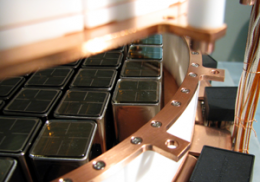
Some of the light sensors that make up the lower detector on the XENON experiment. Image credit: Guillaume Plante

(PhysOrg.com) -- Inside a mountain range in central Italy, Columbia researchers are trying to solve one of the most pressing questions in modern physics: What is dark matter? The riddle has obsessed astronomers and physicists since the 1930s, when Caltech professor Fritz Zwicky first predicted its existence. Because dark matter neither emits nor reflects light and cannot be directly observed, no one has ever proven that it exists; yet theories show it makes up as much as a quarter of the universe. Columbia physics professor Elena Aprile, with collaborators from universities around the world, including Rice University and UCLA, is leading the race to find and identify dark matter for the first time.

“Sometimes I think of as a mysterious woman with her face covered by one of those beautiful Venetian masks,” said Aprile, who is also co-director of Columbia’s Astrophysics Lab. “All of us experimentalists are driven by one desire: to uncover that face.”

Scientists first developed the theory of dark matter to explain how galaxies keep from breaking apart as they spin. Like merry-go-rounds, galaxies generate centripetal force as they rotate. Gravity is the glue that counteracts that force and holds and together, but there isn’t enough in the universe to generate the amount of gravity needed to keep galaxies from being torn to shreds. That’s why scientists believe there must be additional, unseen matter out there. Finding it will give them a deeper understanding of the laws of nature.

Aprile and many other physicists believe that dark matter is made up of WIMPS, or weakly interacting massive particles. As their name suggests, WIMPS very rarely bump into each other or into anything else; otherwise, scientists would have discovered them a long time ago.

Aprile and her colleagues are looking for WIMPS beneath 5,000 feet of rock in Italy’s Gran Sasso mountains in an experiment known as XENON. The project, which recently won $2.5 million of additional funding from the National Science Foundation, consists of a hatbox-sized container of liquid xenon—an element that occurs naturally in the atmosphere as a gas—sandwiched between two detectors. Should a dark matter particle come into contact with a xenon atom, it will trigger a flash of bluish light that the detectors will pick up. The particle is also expected to generate a small electrical charge—weaker than that of any other known radioactive particle. If one of the cameras registers such a charge, it will be a strong indication that Aprile’s team has found dark matter.

The Columbia researchers use xenon because it is one of the heaviest elements in the periodic table; at three times the density of water, it has many atoms per square kilogram, maximizing the chances that a WIMP will collide with it. “It’s like a densely woven fishing net,” said Rafael Lang, a postdoctoral research scientist in Aprile’s lab.

The experiment was set up underground to shield it from as many known atoms and particles as possible, including cosmic rays in the atmosphere. “The number of these cosmic rays keeps going down as you get deeper and deeper in the ground,” said Aprile, who travels frequently between New York and Gran Sasso. A coating of lead around the xenon vat keeps out X-rays and gamma rays; rock inside the mountain acts as a shield against muons, a type of heavy electron. “Gran Sasso is the best place in the world for doing this science,” she says.

The region is home to Italy’s Laboratori Nazionali del Gran Sasso, one of the world’s largest underground physics labs, which hosts a handful of dark matter experiments. Aprile’s experiment is recognized as a leader in the field because it is one of the largest and most sensitive, and it's expanding at the fastest rate. The new funding will allow her team to begin gathering data later this year and, soon, to expand the amount of xenon they use tenfold, to one ton. The experiment will run in phases through 2012.

Provided by The Earth Institute at Columbia University (news : web)


Rate this story - 3.7 /5 (6 votes)

Rank Filter

Move the slider to adjust rank threshold, so that you can hide some of the comments.


Display comments: newest first

  • NeilFarbstein - Jul 27, 2009
    • Rank: 2 / 5 (4)
    It possible that the WIMPS are stopped by all of the rock in their way the same as cosmic rays and muons.
  • Gyuri - Jul 27, 2009
    • Rank: 1 / 5 (2)
    Primordial particles form relative rest of their clusters in space. The enrgies of their prior motion turns into binding energy, A head-on collision of two P-particles is the simplest candidate for Wimp. In spacial symmetries triples, quadtuplets, and higher configurations exist with ever decreasing probabilities. P-particles are absolute solid massless inelastic spheres,. They are matter particles the universe is composed of.
  • LuckyBrandon - Jul 27, 2009
    • Rank: not rated yet
    "Because dark matter neither emits nor reflects light and cannot be directly observed, no one has ever proven that it exists; yet theories show it makes up as much as a quarter of the universe. "

    I'm reading this, and isnt it over 3/4 its supposed to make up?
  • earls - Jul 27, 2009
    • Rank: not rated yet
    http://edelweiss....rPie.jpg

    You're thinking of Dark Energy.
  • LuckyBrandon - Jul 29, 2009
    • Rank: not rated yet
    ah ok thanks earls :)
  • earls - Jul 30, 2009
    • Rank: not rated yet
    Had to double check myself. ;) Hard to keep up with all the unknown, invisible forces dominating the Universe today.
  • KBK - Jul 30, 2009
    • Rank: 1 / 5 (2)
    Electric universe.

    Spin, oscillation, polarization, Heisenberg. Maxwell's original 20 equations in 20 unknowns.

    Thus, not vector sums (Heaviside and Lorentz) but full rotational vortexes, with a very minute total sum vector (this-after the vortex motion, ie a spiral motion-that's what Maxwell's original math had in it), but NEVER forget the original Maxwellian vortex motion, with the slight final unidirectional offset. NO SYMMETRY. The symmetry and simplification was created for engineering as no-one at the time could easily do Maxwell's 20 equations to 'solve electrical problems with practical use and ease'. So, the explanation of the mechanics of the universe were thrown out to satisfy engineers. Utter bullshit.

    Throw Heaviside and Loeretz in the trash bin, go back to Maxwell's original vortex math---and all will become clear.
  • Alizee - Aug 01, 2009
    • Rank: 2.3 / 5 (3)
    ..go back to Maxwell's original vortex math...
    Not quite, until Maxwell's vortex math isn't completelly implicit and recursive and while it reamains strictly orthogonal. We should graph the Heaviside's and Maxwell's form of equations to compare it in illustrative way.
  • superhuman - Aug 02, 2009
    • Rank: not rated yet
    Columbia Researchers Lead Race to Find Dark Matter


    So columbia university proclaims that their own researchers are leading this "race" even though no one knows what it is we are looking for and how to find it? Pathetic that scientific institutions would use such cheap lies whose only purpose is to give mistaken perception to the uninformed public.

July 27, 2009 all stories

Comments: 9

3.7 /5 (6 votes)

  • hide
  • Related Stories

  • Crystal bells stay silent as physicists look for dark matter
    created Feb 25, 2008 | popularity not rated yet | comments 0
  • What Will GLAST Tell Us?
    created Jan 23, 2007 | popularity not rated yet | comments 0
  • What if dark matter particles aren't WIMPs?
    created Dec 12, 2008 | popularity not rated yet | comments 0
  • Mining for dark matter
    created Apr 23, 2008 | popularity not rated yet | comments 0
  • New Limits on the Origin of Dark Matter
    created Jan 27, 2009 | popularity not rated yet | comments 0


  • hide
  • Relevant PhysicsForums posts

  • Light powered spaceship
    created 1hour ago
  • What would a voltmeter read if it were connected between the surface of the cylinder
    created 1hour ago
  • Interception angle
    created 3 hours ago
  • Pressure created by clamping base and cover
    created 3 hours ago
  • More from Physics Forums - General Physics

Other News

Extra large carbon

Extra large carbon

Physics / General Physics

created 17 hours ago | popularity 4.7 / 5 (13) | comments 7 | with audio podcast

An exotic form of carbon has been found to have an extra large nucleus, dwarfing even the nuclei of much heavier elements like copper and zinc, in experiments performed in a particle accelerator in Japan. ...


Scientist explore future of high-energy physics

Scientist explore future of high-energy physics

Physics / General Physics

created 23 hours ago | popularity 4.9 / 5 (12) | comments 8 | with audio podcast

In a 1954 speech to the American Physical Society, the University of Chicago's Enrico Fermi fancifully envisioned a particle accelerator that encircled the globe. Such would be the ultimate theoretical outcome, ...


Leaf veins inspire a new model for distribution networks (w/ Video)

Physics / General Physics

created 20 hours ago | popularity 5 / 5 (3) | comments 0 | with audio podcast

(PhysOrg.com) -- Following the straight and narrow may be good moral advice, but it’s not a great design principle for a distribution network. In new research, a team of biophysicists describe a complex netting of interconnected ...


New magnetic tuning method enhances data storage

New magnetic tuning method enhances data storage

Physics / General Physics

created 23 hours ago | popularity 4.2 / 5 (5) | comments 0 | with audio podcast

Researchers in Chicago and London have developed a method for controlling the properties of magnets that could be used to improve the storage capacity of next-generation computer hard drives.


High-performance microring resonator developed by INRS researchers

Physics / Optics & Photonics

created 15 hours ago | popularity 1.5 / 5 (2) | comments 0

A new, more efficient low-cost microring resonator for high speed telecommunications systems has been developed and tested by Professor Roberto Morandotti's INRS team in collaboration with Canadian, American, and Australian ...