Earliest animals lived in a lake environment, research shows
July 27, 2009
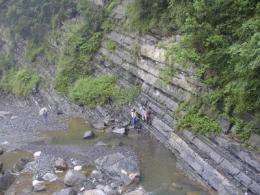
Researchers study exposures of the Doushanto Formation along a creek in the Yangtze Gorges area, South China. Credit: M. Kennedy, UC Riverside
Evidence for life on Earth stretches back billions of years, with simple single-celled organisms like bacteria dominating the record. When multi-celled animal life appeared on the planet after 3 billion years of single cell organisms, animals diversified rapidly.
Conventional wisdom has it that animal evolution began in the ocean, with animal life adapting much later in Earth history to terrestrial environments.
Now a UC Riverside-led team of researchers studying ancient rock samples in South China has found that the first animal fossils in the paleontological record are preserved in ancient lake deposits, not marine sediments as commonly assumed.
"We know that life in the oceans is very different from life in lakes, and, at least in the modern world, the oceans are far more stable and consistent environments compared to lakes which tend to be short-lived features relative to, say, rates of evolution," said Martin Kennedy, a professor of geology in the Department of Earth Sciences who participated in the research. "Thus it is surprising that the first evidence of animals we find is associated with lakes, a far more variable environment than the ocean."
The study, published in the July 27-31 online edition of the Proceedings of the National Academy of Sciences, raises questions such as what aspects of the Earth's environment changed to enable animal evolution.
In their research, the authors focused on South China's Doushantuo Formation, one of the oldest fossil beds that houses highly preserved fossils dated to about 600 million years ago. These beds have no adult fossils. Instead, many of the fossils appear as bundles of cells interpreted to be animal embryos.
"Our first unusual finding in this region was the abundance of a clay mineral called smectite," said lead author Tom Bristow, who worked in Kennedy's lab. "In rocks of this age, smectite is normally transformed into other types of clay. The smectite in these South China rocks, however, underwent no such transformation and have a special chemistry that, for the smectite to form, requires specific conditions in the water - conditions commonly found in salty, alkaline lakes."
The researchers' work involved collecting hundreds of rock samples from several localities in South China, carrying out mineralogical analysis using X-ray diffraction, and collecting and analyzing other types of geochemical data.
"All our analyses show that the rocks' minerals and geochemistry are not compatible with deposition in seawater," Bristow said. "Moreover, we found smectite in only some locations in South China, and not uniformly as one would expect for marine deposits. This was an important indicator that the rocks hosting the fossils were not marine in origin. Taken together, several lines of evidence indicated to us that these early animals lived in a lake environment."
Bristow noted that the new research gives scientists a glimpse into where some of the early animals lived and what the environmental conditions were like for them - important information for addressing the broader questions of how and why animals appeared when they did.
"It is most unexpected that these first fossils do not come from marine sediments," Kennedy said. "It is possible, too, that similarly aged or older organisms also existed in marine environments and we have not found them. But at the very least our work shows that the range of early animal habitats was far more expansive than presently assumed and raises the exciting possibility that animal evolution first occurred in lakes and is tied to some environmental aspect unique to lake environments. Furthermore, because lakes are of limited size and not connected to each other, there may have been significant parallel evolution of organisms. Now we must wait and see if similar fossils are found in marine sediments."
-
Finding an answer to Darwin's Dilemma
Dec 08, 2006 |
not rated yet |
0
-
Oldest animal fossils may have been giant bacteria
Dec 20, 2006 |
not rated yet |
0
-
Unique fossils capture 'Cambrian migration'
Oct 10, 2008 |
not rated yet |
0
-
Two oxygenation events in ancient oceans sparked spread of complex life
Feb 25, 2008 |
not rated yet |
0
-
Embryos Tell Story Of Earths Earliest Animals
Apr 10, 2006 |
not rated yet |
0
-
Engineers build first sub-10-nm carbon nanotube transistor
Feb 01, 2012 |
4.9 / 5 (31) |
30
-
Something old, something new: Evolution and the structural divergence of duplicate genes
Jan 31, 2012 |
4.6 / 5 (7) |
1
-
The hidden nanoworld of ice crystals: Revealing the dynamic behavior of quasi-liquid layers
Jan 30, 2012 |
5 / 5 (3) |
1
-
Stock market network reveals investor clustering
Jan 27, 2012 |
3.9 / 5 (23) |
8
-
Of microchemistry and molecules: Electronic microfluidic device synthesizes biocompatible probes
Jan 26, 2012 |
5 / 5 (1) |
0
-
Mitosis
5 hours ago
-
Stem cell question.
6 hours ago
-
Protease cleavage
13 hours ago
-
Pertubance in a model
19 hours ago
-
Cancer drugs and Alzheimer's, Oh my!
Feb 09, 2012
-
Squishing cells
Feb 09, 2012
- More from Physics Forums - Biology
More news stories
A frank discussion of the power law and linking correlation to causation
(PhysOrg.com) -- Michael Stumpf a mathematics professor at Imperial College in London, and Mason Porter a lecturer at Oxford have teamed together to write and publish a perspective piece in Science regarding the in ...
Employers feel no love for unscrupulous practice of 'service sweethearting'
A new study led by two Florida State University marketing professors finds that some frontline service employees who are rewarded for hikes in customer loyalty and satisfaction also may engage in "service ...
Other Sciences / Economics & Business
13 hours ago |
4 / 5 (1) |
7
The question of life in the ancient world
Theres a general feeling that we dont get the Greeks ancient or modern. Many, including heads of state like Angela Merkel, visibly shake their head in exasperation, rightly or wrongly, at ...
Other Sciences / Archaeology & Fossils
19 hours ago |
1.3 / 5 (3) |
4
Sonic Cradle lands spot in TED exhibition
A Simon Fraser University graduate student project that melds music, meditation and modern technology has landed a rare spot as an exhibit at TEDActive 2012 in Palm Springs, California this month.
15 hours ago |
not rated yet |
0
Do we no longer care about the collective good?
The Transformation of Solidarity, a book co-edited by University of Queensland sociologist Dr Mara Yerkes, tackles the subject of globalisation of national economies and societies where we put a high value ...
Other Sciences / Social Sciences
Feb 06, 2012 |
3.9 / 5 (8) |
39
Anonymous knocks CIA website offline (Update)
The website of the Central Intelligence Agency was inaccessible on Friday after the hacker group Anonymous claimed to have knocked it offline.
New error-correcting codes guarantee the fastest possible rate of data transmission
Error-correcting codes are one of the triumphs of the digital age. Theyre a way of encoding information so that it can be transmitted across a communication channel such as an optical fiber o ...
Humans may have helped the decline of African rainforests 3000 years ago
(PhysOrg.com) -- Large areas of rainforests in Central Africa mysteriously disappeared over three thousand years ago, to be replaced by savannas. The prevailing theory has been that the cause was a change ...
Google users warned of threat to smartphone wallets
Users of Google smartphone wallets were being warned on Friday that there is a way to crack pass codes intended to thwart thieves from going on illicit shopping sprees.
New power source discovered
(PhysOrg.com) -- Researchers at the Massachusetts Institute of Technology (MIT) and RMIT University have made a breakthrough in energy storage and power generation.
Small modular reactor design could be a 'SUPERSTAR'
(PhysOrg.com) -- Though most of today's nuclear reactors are cooled by water, we've long known that there are alternatives; in fact, the world's first nuclear-powered electricity in 1951 came from a reactor ...
Jul 28, 2009
Rank: 1 / 5 (1)
http://www.indepe...638.html
Whenever I read an article like this i am constantly amazed at how CERTAIN people are about theories for which there is NO clear cut empirical evidence...
Interesting article nonetheless...
Jul 28, 2009
Rank: not rated yet
Extraction of new data sets is very useful, to everyone. Isolated local cooking pots for multi-cellular life forms makes somewhat more sense than exclusively ocean-based development, when we consider the diversity of life that followed.
Were the Chinese academia aware of these fossilised lake beds before U.C. Riverside arrived?
Jul 28, 2009
Rank: 4 / 5 (1)
The article makes no such claim. Neither claim is in the article. Why are you making things up? For once Physorg had a decently written article without extravagant claims that admitted to the possibility that there might be other answers.
And that relates to this article in what way?
Since you misread this rather short article I can't be sure that you are reading your professor correctly either. However if you have it correct than he is an idiot. Trade has been around for a very long time and only a complete imbecile would think that trade doesn't spread technology. It still does today.
Whenever you read an article you seem to look for ways to find people making claims of certainty. There is none in this one.
And by the way it is pretty certain that life started in oceans. There is no certainty as to where in the oceans. Some think around undersea vents others the tidal regions. I go for the tidal regions as that gives chemistry a chance to undergo an iterative process. Drying out and then getting a fresh batch of ocean water. It remains speculation but sea vents looks like crap in comparison for me.
This article was about ANIMAL life. We can certain that all fish came from freshwater, for instance, because all fish have kidneys and the rest of salt water life doesn't have an equivalent.
There is one quibble I have with the article.
Do they think animal life started with adults? It had to start with little more than collections of cells. Edicarian life was little more than that and it started earlier than this. Somewhere a basic intestinal system developed. Most likely it had one entrance-exit combination. Basically just a hollow in a surface, much like primitive eyes, only specialized to process food.
The development of adult and larva stages has to come after basic cellular specialization. Maybe they found what came at beginning of that development. The Cambrian Explosion took place less than 80 million years later but there had to be some pretty basic developments first.
Ethelred